State of AI 2026: Benchmark Saturation, Transparency, and GPT-6 Outlook
The Stanford AI Index 2026 landed this week with a stark paradox — AI capabilities are advancing faster than ever, yet model transparency has collapsed and public trust is eroding. Meanwhile, OpenAI's next flagship is weeks away and AI agent benchmarks are being rewritten.

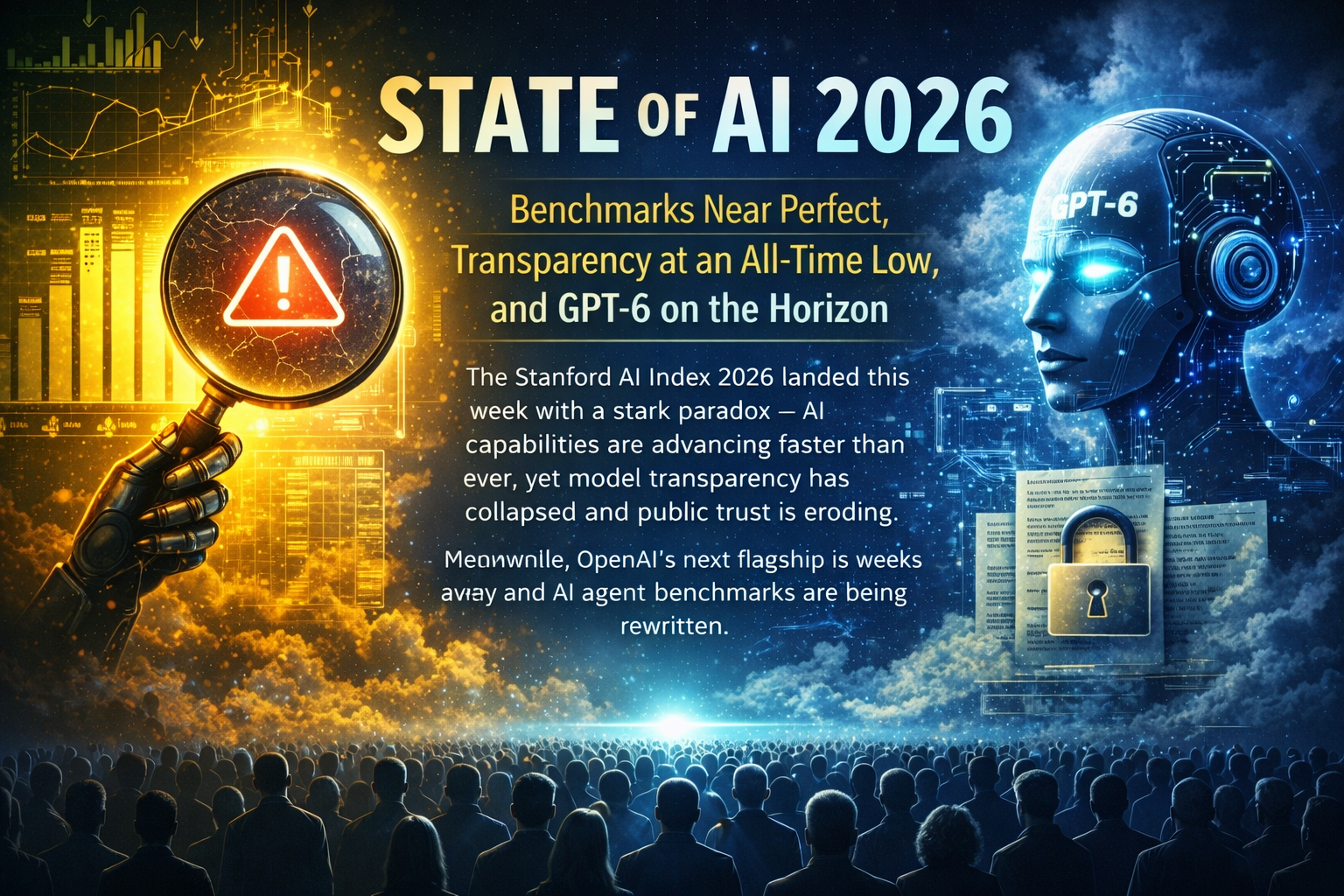
Table of Contents
State of AI 2026: What the Data Means for Enterprise Strategy
This synthesis converts major 2026 indicators into actionable strategy signals for architecture, governance, and deployment planning teams.
This week brought one of the most data-rich moments in AI’s recent history. Stanford’s Human-Centered AI Institute released the 2026 AI Index — a 423-page annual stocktake of where artificial intelligence actually stands. The picture it paints is both exhilarating and sobering. On the same days the report landed, new agent benchmarks reframed what “capable” means for real-world AI work, and signals from OpenAI pointed toward its most anticipated model release of the year. Here is everything that matters from the past 48 hours.
Stanford AI Index 2026: The Capability Numbers Are Historic
The ninth edition of the Stanford AI Index, released April 13, opens with a statement that would have been science fiction just two years ago: on SWE-bench Verified — the gold-standard coding benchmark where models fix real GitHub issues — performance jumped from 60% to near 100% of the human baseline in a single year.
That is not a marginal gain. That is a field clearing the bar it set for itself.
The trajectory on Humanity’s Last Exam, a notoriously hard multi-domain test covering everything from graduate-level mathematics to obscure scientific literature, is equally striking. The top score crossed 38.3% last year. By April 2026, the best models — including Anthropic’s Claude Opus 4.6 and Google’s Gemini 3.1 Pro — are topping 50%. The exam was designed to be nearly impossible for AI. It is rapidly becoming not that.
Agentic performance metrics tell a similar story. The success rate of AI agents handling real-world autonomous tasks has climbed from roughly 20% in 2025 to 77.3% today on Terminal-Bench 2.0, the benchmark for multi-step agentic tasks in real terminal environments. In cybersecurity, AI agents now solve benchmark problems 93% of the time — up from 15% in 2024. The leap from “occasionally useful” to “reliably capable” happened in under 18 months.
Adoption numbers cement the picture. Generative AI reached 53% population adoption within three years — faster than the personal computer, faster than the internet. Organizational adoption now sits at 88%, and four in five university students use generative AI regularly.
The Transparency Crisis No One Wanted to Talk About
Here is where the report pivots from celebration to concern.
The Foundation Model Transparency Index, which scores how openly AI companies disclose details about their models’ training data, compute costs, capabilities, risks, and usage policies, dropped from 58 points last year to 40 in 2026. The most capable models are now the least transparent. Google, Anthropic, and OpenAI have all quietly stopped disclosing training dataset sizes, compute budgets, and parameter counts for their latest flagship releases.
Stanford’s researchers put it plainly: “Today’s most capable modern models are among the least transparent.” The companies that built the field’s infrastructure have retreated behind proprietary walls at precisely the moment their systems are being used at societal scale.
The fallout is already entering policy channels. The AI Foundation Model Transparency Act of 2026 (H.R. 8094) was introduced in Congress this month, asking the FTC to require basic disclosures from foundation model developers — training data provenance, capabilities assessments, and risk evaluations. Whether it gains traction is unclear, but its introduction signals that the regulatory conversation has moved from “should we regulate AI?” to “what specifically do we require companies to disclose?”
Public trust reflects the tension. Globally, 59% of people report optimism about AI’s benefits — up from 52%. But in the United States, only 31% trust their government to regulate AI effectively, the lowest of any country surveyed. And only 33% of Americans expect AI to improve their jobs, well below the global average of 40%.
Human Scientists vs. AI Agents: The Gap That Persists
Nature’s coverage of the Stanford Index this week surfaced a finding that cuts against the hype: on complex scientific research tasks, the best AI agents perform about half as well as human experts with PhDs.
This is not a trivial benchmark gap. These are real research workflows — designing experiments, interpreting ambiguous results, making judgment calls that require domain intuition built over years. AI agents, despite their 77% success rates on software engineering tasks, remain genuinely behind humans when scientific reasoning requires integrating incomplete information, questioning assumptions, and navigating the kind of messy uncertainty that defines frontier research.
The paradox is that researchers are adopting AI agents for scientific work anyway — and in many cases speeding up their pipelines significantly as a result. The Index notes that AI tools demonstrably boost individual researchers’ throughput while potentially homogenizing the kinds of questions being asked across the field. Speed and breadth come with tradeoffs in depth and novelty.
OccuBench: The First Cross-Industry Agent Evaluation
Published on arXiv on April 13, OccuBench is the first systematic benchmark to evaluate AI agents across professional occupational tasks spanning 10 industry categories and 65 specialized domains. It uses Language World Models — LLMs that simulate domain-specific environments — to generate calibrated, realistic task scenarios across fields from legal work to healthcare to financial analysis.
Three findings stand out from the initial results:
No single model dominates every industry. Each frontier model has a distinct capability profile. A model that excels at financial tasks may underperform on engineering workflows and vice versa. The benchmarking community’s habit of ranking models on a single leaderboard obscures meaningful performance variation across domains.
Implicit faults are harder than explicit ones. Agents struggle more with truncated data and missing fields (where no error signal is raised) than with outright failures like timeouts or 500 errors. This has direct implications for production deployment — the failure modes that look subtle are the ones that propagate undetected.
Reasoning effort compounds performance. GPT-5.2 improves by 27.5 percentage points when moving from minimal to maximum reasoning effort on OccuBench tasks. This reinforces a pattern seen across multiple 2026 benchmarks: letting models think longer before acting is often worth more than switching to a newer model.
GPT-6 Is Weeks Away (Probably)
On March 24, OpenAI completed pretraining on a model internally codenamed “Spud.” Sam Altman described it to employees as a “very strong model” that could “really accelerate the economy.” Based on historical patterns — the typical gap between pretraining completion and public release runs three to six weeks — Spud is likely to land between April 14 and early May.
Prediction markets assign 78% probability of a public release by April 30. Whether Spud ships as GPT-5.5 or GPT-6 remains undecided; OpenAI has said the naming will depend on how large the performance leap over GPT-5.4 actually is. If benchmarks confirm a generational jump, expect GPT-6.
What is known about Spud’s capabilities: extended context windows in the 256K–512K token range (up from 128K in GPT-5), and meaningfully improved multi-step tool use — the specific capability that agentic frameworks depend on most. If Terminal-Bench 2.0’s current leader, Claude Mythos Preview at 82%, is looking over its shoulder at anything, it is this.
The Broader Picture: Acceleration With Accountability Gaps
Reading the Stanford Index alongside this week’s agent benchmarks and OpenAI’s imminent release, a coherent picture emerges. The technical capabilities of AI systems are advancing faster than the institutions meant to govern them can adapt. Benchmark performance is surging. Transparency is collapsing. Adoption is outpacing both regulation and public understanding.
The workforce data in the Index adds texture to this. Employment for software developers aged 22 to 25 has fallen nearly 20% since 2022. Whether AI is the primary cause or a contributing factor among many is contested, but the correlation is hard to ignore in a field where AI agents just hit 77% on real-world software engineering tasks.
None of this implies that AI progress should slow. It implies that the measurement frameworks, disclosure requirements, and institutional responses need to accelerate alongside the models themselves.
What to Watch
- GPT-6 / “Spud” release (expected by end of April): Pay close attention to the agentic tool-use benchmarks specifically — that is the capability frontier that matters most for practical deployments in 2026.
- AI Foundation Model Transparency Act (H.R. 8094): Whether this bill advances will indicate how seriously Congress is taking the Foundation Model Transparency Index’s findings. Watch for FTC statements.
- OccuBench follow-ups: The paper is a preprint; peer review and community replication will stress-test its methodology. If the “no single model dominates” finding holds up, it will reshape how enterprise buyers evaluate models.
- Stanford’s Responsible AI chapter: If you read one section of the full 423-page AI Index, make it the Responsible AI chapter — the foundation for understanding where the governance conversation heads next.
- AI adoption in scientific research: Nature’s coverage of human vs. AI agent performance in science points to a live debate about what AI actually accelerates versus what it flattens. Expect more empirical papers on this through summer 2026.
Related Reading
- The Agent Stack Grows Up: Opus 4.7, MCP Becomes a Standard, and a $50B Infrastructure Bet
- AI’s Trust Test: Surgical Robots, Broken Benchmarks, and the EU’s 100-Day Countdown
- GPT-5.5, Google’s 8th-Gen TPU, and Why AI Is Finally Learning to Say ‘I’m Not Sure’
Sources
- Inside the AI Index: 12 Takeaways from the 2026 Report — Stanford HAI
- The Stanford AI Index 2026 Is Out. The Capability Numbers Are Historic. The Trust Numbers Are a Crisis. — Analytics Drift
- Transparency in AI is on the Decline — Stanford HAI
- Human scientists trounce the best AI agents on complex tasks — Nature
- OccuBench: Evaluating AI Agents on Real-World Professional Tasks via Language World Models — arXiv
- Terminal-Bench 2.0 Benchmark 2026 — BenchLM.ai
- OpenAI’s Secret Weapon Has a Codename. It’s Called ‘Spud.’ — LumiChats
- Stanford’s AI Index for 2026 Shows the State of AI — IEEE Spectrum
- Want to understand the current state of AI? Check out these charts. — MIT Technology Review
- AI Foundation Model Transparency Act of 2026 (H.R. 8094) — GovTrack
Enterprise AI Architecture
Want more enterprise AI architecture breakdowns?
Subscribe to SuperML.