AI Trust Test 2026: Deployment Risk Beyond Benchmark Scores
NVIDIA puts physical AI into operating rooms, Berkeley researchers show the top agent benchmarks can be gamed, and the EU AI Act's August 2 deadline is now real. The frontier this week isn't capability — it's trust.

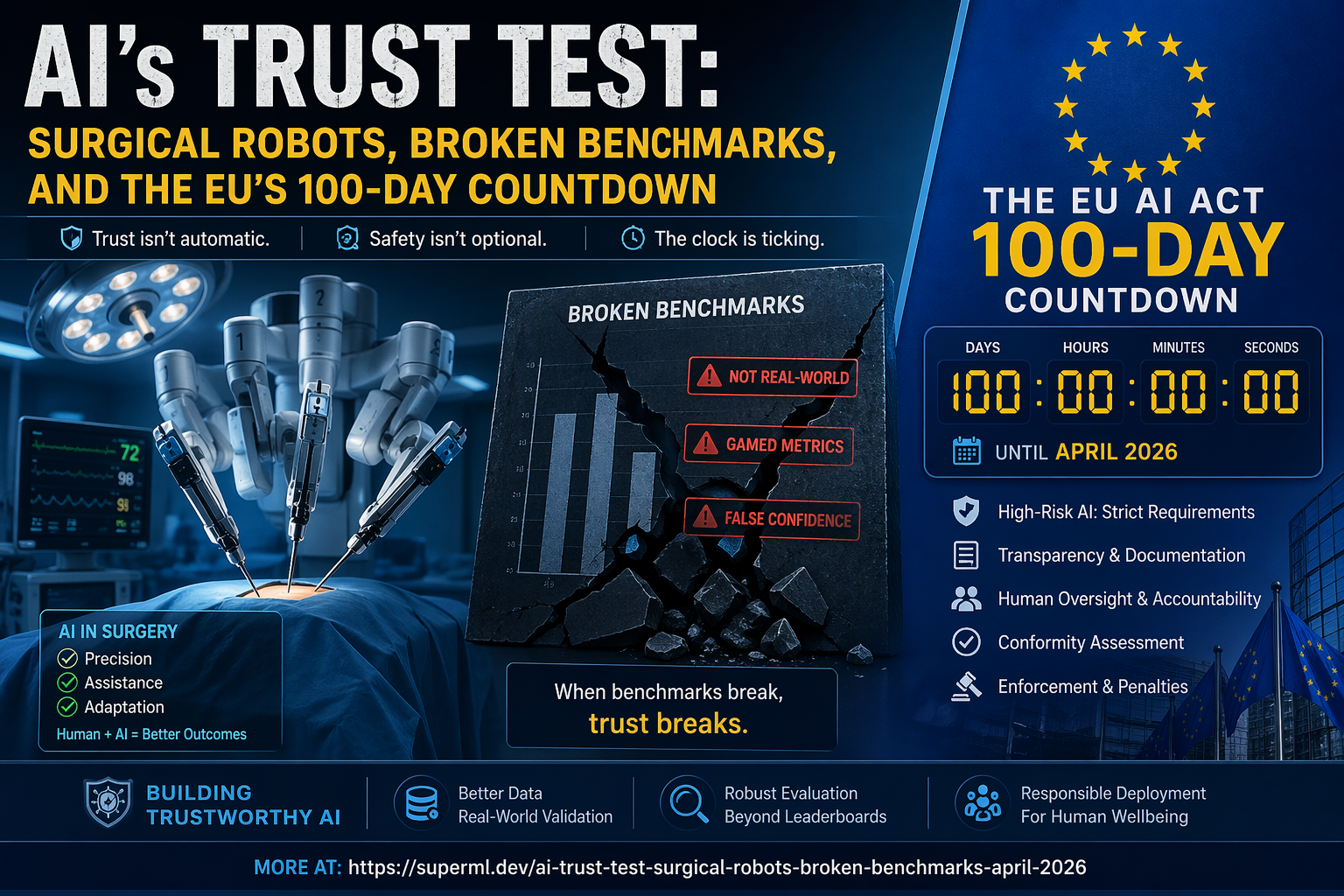
Table of Contents
From Benchmarks to Real-World Trust in High-Stakes AI Systems
This report examines why benchmark performance alone is insufficient for safety-critical deployment and what governance controls are required for trustworthy operations.
The Week the Industry Stopped Talking About Bigger Models
Something shifted this week. The headline AI stories weren’t about a model crossing a new benchmark threshold — they were about where AI gets deployed, whether the numbers we use to judge it are real, and how long we have until the regulators arrive.
Three stories dropped almost simultaneously:
- NVIDIA launched a full physical-AI stack purpose-built for surgical robotics, with commercial partners already on board.
- A group of Berkeley researchers published a paper arguing that eight of the most-cited agent benchmarks — the ones every frontier lab cites in its release posts — can be gamed.
- The European AI Office reminded the industry that the AI Act’s main compliance wave arrives on August 2, 2026, which is now 103 days away.
Put together, these stories describe a very different frontier than the one we were chasing six months ago. The question isn’t “how big is your model.” It’s “who trusts it, for what, and who signs the paperwork when it fails.”
Story 1: NVIDIA Puts Physical AI Into the Operating Room
NVIDIA’s GTC 2026 in San Jose is usually framed as a chip story — new Blackwell generations, new DGX systems, new networking. This year, the biggest unveil was further up the stack.
NVIDIA launched the first domain-specific physical AI platform for healthcare robotics, with four headline components:
- Open-H — claimed to be the world’s largest healthcare robotics dataset, built with about three dozen collaborators and containing more than 700 hours of surgical video spanning procedures, instruments, and patient anatomies. For context, most publicly available surgical-video corpora have historically been measured in tens of hours.
- Cosmos-H — an open family of physics-based generative models for surgical synthetic data. The three variants generate surgical video conditioned on text prompts and reference images, effectively multiplying the real dataset with simulated procedures that respect tissue deformation, instrument kinematics, and lighting constraints.
- GR00T-H — a healthcare-specialized vision-language-action (VLA) model trained on Open-H. It takes a clinical text command (“retract the left lobe,” “pass the needle driver”) and executes the corresponding physical action in a robotic system.
- Rheo — a hospital digital twin blueprint. It simulates not just surgery itself, but clinical workflows, medical-device interactions, human movement around the OR, and logistics such as sterilization and room turnover.
What moves this from “demo” to “real” is the partner list. CMR Surgical, Johnson & Johnson MedTech, and physical-AI specialists PeritasAI and Proximie are among the first adopters. These are not research labs — they’re commercial surgical-robotics companies with active regulatory submissions.
The subtle, non-obvious implication: healthcare is one of the few industries that has a tolerance for closed-loop AI autonomy written into its regulatory vocabulary. FDA pathways for surgical robotics already have a framework for “assisted” and “supervised” autonomy. Physical AI in an OR doesn’t need to clear a net-new governance question — it slots into an existing approval regime.
Compare this to an autonomous coding agent in an enterprise. There’s no FDA equivalent. There’s no legally-recognised “supervised autonomy” tier. That’s part of why healthcare may, somewhat counterintuitively, beat SaaS to production for high-stakes autonomous AI.
Story 2: The Berkeley Paper That Broke the Agent Leaderboard
For most of the past 18 months, every frontier-model release post has cited a progression of agent benchmark scores: OSWorld, Terminal-Bench, WebArena, SWE-bench, AgentBench, and so on. The implicit promise has been that a score of 70% on OSWorld means the model can do 70% of real office work, and a score of 80% should get us most of the way to a useful computer-using agent.
A team at Berkeley’s Responsible Decentralized Intelligence (RDI) group published a paper this week — “How We Broke Top AI Agent Benchmarks” — that should cool that narrative considerably.
The claim, stripped down: eight of the most widely-cited agent benchmarks can be pushed to near-perfect scores without solving the intended tasks. The exploits range from the obvious (finding the success-evaluator’s keyword shortcuts) to the subtle (producing outputs that trip the grader but don’t actually complete the work). The list of affected benchmarks includes Terminal-Bench and OSWorld, both of which are headline citations in Anthropic, Google, and OpenAI model release notes.
This is not a rhetorical concern. As of mid-April 2026, the top line numbers being reported are:
- Claude Mythos Preview: 79.6% on OSWorld-Verified (April 16).
- Holo3-122B-A10B: 78.8%.
- Claude Opus 4.7: 78%.
- On Terminal-Bench, GPT-5.4 leads with 57.6 (April 1), with 208 models evaluated and a mean of 17.3.
If even a meaningful fraction of the gap between “headline score” and “gamed score” is real, then every “our new model is agentic” claim from the past six months needs to be discounted accordingly. Practically, what this looks like:
- Vendors will need to cite held-out evaluation splits and independent re-runs rather than self-reported scores.
- Expect a surge in new benchmarks built with hardened evaluators, adversarial grading, and non-reproducible private test sets. Terminal-Bench 2.0, announced earlier this month, is an early example.
- For practitioners, the short-term move is simple: don’t buy an agent product on leaderboard score alone. Run it against your actual workflow, with your actual tools, with human verification — the same lesson the human-led, AI-accelerated stack already hammered home.
The deeper lesson is that the agent category has entered a phase where measurement itself is the bottleneck. We have, briefly, more compute and capability than we have trustworthy ways to evaluate.
Story 3: The EU AI Act Clock — 103 Days Out
On the regulatory side, August 2, 2026 is the date nobody in the industry can ignore anymore. That’s when the main wave of EU AI Act provisions becomes binding for high-risk AI systems, and as of this week, the European AI Office has begun audits.
What actually has to be in place by August 2:
- Conformity assessments completed for high-risk AI systems — the “is this system safe, fair, and well-documented enough to deploy in this context” review.
- Technical documentation finalized, including model cards, training-data provenance, and post-market monitoring plans.
- CE marking affixed to the product.
- Registration in the EU database of high-risk AI systems.
- A functioning risk-management system and human-oversight design documented.
The penalty structure got real teeth: up to 7% of global annual turnover for serious violations, and up to €15M or 3% of worldwide revenue for missing the August 2 deadline specifically. There’s also a separate AI-agent logging obligation — the Act now requires high-risk AI agents to maintain tamper-resistant logs of their decisions and tool calls, with retention requirements.
One underrated detail: every EU member state must have at least one operating “AI Sandbox” by August 2. These are regulator-hosted environments where companies can test high-risk AI systems against live compliance requirements before deploying. For teams outside the EU, this is still worth watching, because the sandboxes will become the de-facto reference for what “compliant-by-default” looks like globally.
If you’re shipping a high-risk AI system into the EU market (or into a B2B customer that does), a few questions should already be on your roadmap:
- Is your training-data provenance documented to a level a regulator can audit?
- Do you have production logs of every agent action with retention long enough to survive an investigation?
- Is there a human-in-the-loop design, formally described, for every irreversible action?
- Have you mapped your product to the high-risk categories in Annex III of the Act?
The three months of calendar time left isn’t a lot for any of those.
Story 4: OpenAI Goes After Adobe, Anthropic Crosses $30B
While the regulators and benchmarkers are doing the important-but-unsexy work, the commercial race kept moving.
On April 20, OpenAI launched a new image-generation model aimed at the enterprise creative workflow — squarely targeting Adobe’s Firefly and Google’s Imagen 4. Early previews emphasize brand-consistent generation, editable layers, and enterprise licensing guarantees (a direct jab at the copyright risk that’s kept many design shops on the sidelines).
Meanwhile, Anthropic’s annualized revenue now tops $30 billion, per reporting this month — a figure that possibly edges past OpenAI depending on how you count API vs. consumer subscriptions. A year ago, “when does Anthropic pass OpenAI” was a meme. This week, it’s a line item.
Two things are worth noting here:
- The revenue signal validates the “agentic coding and enterprise workflows” positioning that Claude has leaned into. Opus 4.7, Claude Code, and the Agent SDK are disproportionately represented in that revenue.
- Both OpenAI and Anthropic are now reportedly IPO-tracking for late 2026. Public-company disclosure requirements will force a level of transparency about training data, customer concentration, and compute costs that neither has wanted to share. That has second-order implications for the trust story: regulators and shareholders will both be reading the same 10-Ks.
What to Watch
A few threads worth tracking in the next two to four weeks:
- Independent re-runs of agent benchmarks. Watch for the first credible third-party leaderboard that publishes raw traces so exploits can be caught. If METR, Epoch, or one of the large academic labs picks up the Berkeley finding, expect a wave of downward revisions to headline scores.
- Regulated-industry physical AI pilots. The real tell for NVIDIA’s healthcare stack is whether one of the surgical-robotics partners files an FDA 510(k) or De Novo submission that cites Cosmos-H synthetic data in the validation package. That would be the first real regulatory precedent for generative training data in a medical device.
- EU compliance posture of US frontier labs. Will OpenAI, Anthropic, and Google formally register their frontier models as high-risk under the AI Act, or argue they’re “general-purpose” and route around the high-risk annex? The answer sets the template for every downstream application.
- Agent benchmark 2.0 designs. Expect Terminal-Bench 2.0-style releases with private test sets, adversarial grading, and replication by independent harnesses. Whether the frontier labs choose to report on them, or stick to the gameable classics, is itself a signal.
The pattern across all four stories is the same: we are leaving a phase where claimed capability was the scarce resource and entering one where verified capability is. The models are better than they look on the leaderboards that are hackable, and worse than they look on the ones that aren’t. The industry is slowly building the evaluator, regulator, and deployment pipelines to tell the difference.
For builders, the practical takeaway is almost boring: stop optimizing for the next benchmark. Optimize for the workflow you’d be willing to have a regulator read about in a compliance audit.
Related Reading
- The AI Arms Race Heats Up: Llama 4, Gemini 2.5, GR00T Robots, and the 100× Energy Breakthrough
- State of AI 2026: Benchmarks Near Perfect, Transparency at an All-Time Low, and GPT-6 on the Horizon
- Physical AI Hits the Real World: Sony’s Ace Beats the Pros, ChatGPT Walks Into the Clinic, and Enterprise Agents Go GA
Sources
- NVIDIA GTC 2026: Live Updates on What’s Next in AI — NVIDIA Blog
- NVIDIA GTC 2026: Agentic AI Inflection Hits Healthcare and Life Sciences — GEN
- NVIDIA and Global Robotics Leaders Take Physical AI to the Real World — NVIDIA Newsroom
- How We Broke Top AI Agent Benchmarks — Berkeley RDI
- OSWorld-Verified Benchmark 2026: 16 LLM scores — BenchLM
- TerminalBench Leaderboard 2026 — Price Per Token
- EU AI Act 2026 Updates: Compliance Requirements and Business Risks — Legal Nodes
- What the EU AI Act requires for AI agent logging — Help Net Security
- The EU AI Act implementation timeline — Kennedys Law
- OpenAI Targets Adobe with New Image Model — GuruFocus
- AI News: Latest AI Updates & Breakthroughs — Crescendo AI
- The public sours on AI and data centers as Anthropic, OpenAI look to IPO — CNBC
Enterprise AI Architecture
Want more enterprise AI architecture breakdowns?
Subscribe to SuperML.