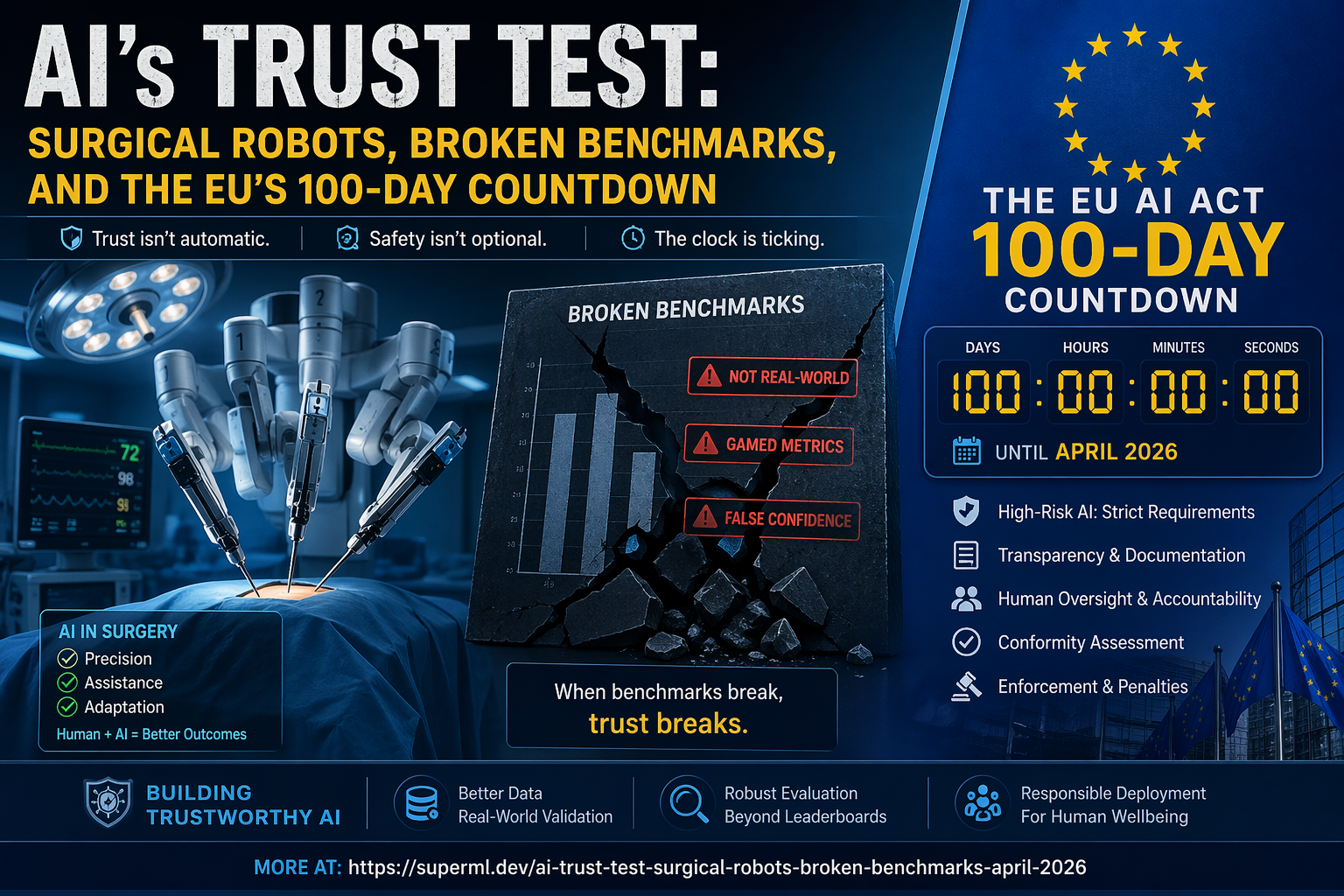
Physical AI Hits the Real World: Sony's Ace Beats the Pros, ChatGPT Walks Into the Clinic, and Enterprise Agents Go GA
Sony's Ace robot beats professional table tennis players on the cover of Nature, OpenAI ships ChatGPT for Clinicians with a new HealthBench Professional benchmark, and Microsoft's Frontier Suite hits GA — three stories, one theme: AI is crossing the sim-to-real gap.

Table of Contents
For the last two years, the dominant question in AI was “how big can a language model get?” This week, a different question moved to the front of the line: “can an AI actually show up in the real world and do the job?”
Three stories from the last 48 hours each answer it in a different domain. Sony AI’s Ace robot landed on the cover of Nature after beating professional table tennis players under International Table Tennis Federation rules. OpenAI launched ChatGPT for Clinicians, a free, HIPAA-capable workspace that — by OpenAI’s own benchmark — now outperforms human physicians on routine clinical writing and research tasks. And Microsoft put a concrete general-availability date on its “Frontier Suite” agent bundle while Infosys and OpenAI locked in a Codex-powered enterprise SDLC partnership.
None of these are a new parameter count. All of them are AI crossing the sim-to-real gap in production. Here’s what actually happened, and why this week matters more than another frontier leaderboard update.
Sony’s Ace Enters the Ring — and Wins
The flagship story is Sony AI’s Project Ace, published on the cover of Nature on April 23, 2026 (“Outplaying elite table tennis players with an autonomous robot”). Ace is, to Sony’s knowledge, the first autonomous system to outperform elite and professional human athletes in an interactive, physical skill-based game.
The technical stack is where this gets interesting. Most robot-manipulation research to date has lived inside curated, lab-style simulators — RLBench-style environments where simulated success rates have climbed to 89.4%, but real-world household robots still succeed on only about 12% of tasks. Ace attacks the exact features that crush sim-to-real policies: millisecond-scale perception, noisy physical dynamics, and an adversary who is actively trying to make the robot fail.
Three design choices are doing most of the work.
First, event-based vision sensors instead of frame-based cameras. Event cameras emit asynchronous per-pixel brightness changes at microsecond latency, which lets Ace perceive a ball traveling at competitive speed without waiting for a 60 Hz frame boundary. Sony’s own semiconductor division shipped the image sensors used in the paper — worth noting for anyone tracking how the vision-sensor hardware layer differentiates from the Tesla/DJI monocular-camera approach.
Second, model-free reinforcement learning for control. The policy is not hand-designed around table-tennis kinematics; it is learned end-to-end against a simulator and then deployed on the physical robot. This matters because it is a real, public proof point that model-free RL plus a good perception front-end can close the sim-to-real gap in a high-frequency, adversarial task — a regime where model-based and imitation-learning approaches have historically been safer bets.
Third, commodity-grade, high-speed robot hardware playing under unaltered professional rules. No ball tracking markers. No oversized table. No rule modifications. Ace achieved three victories in five matches against elite players, competitive play in the remaining two, and its first-ever win over a professional. Elite players in the evaluation cohort consistently rated Ace’s rallying quality as comparable to a skilled human opponent.
The obvious critique — and it is fair — is that this is one task. Table tennis is high-speed but the action space is small and the environment is essentially constant. But the combination of event-based perception plus model-free RL plus real hardware under real rules is what matters; that same stack is transferrable to inspection, welding, high-speed pick-and-place, and surgical assistance. As the implicator.ai analysis put it, the harder match starts now.
ChatGPT Walks Into the Clinic
One day before Ace, OpenAI announced ChatGPT for Clinicians, a purpose-built workspace available free to verified U.S. physicians, nurse practitioners, physician assistants, and pharmacists. Bundled with it: HealthBench Professional, a new evaluation covering three real clinician workflows (care consult, writing and documentation, medical research), and a Health Blueprint playbook for safer healthcare AI deployment.
The numbers are the story. OpenAI ran 6,924 conversations through physician advisors using the tool in daily work across clinical care, documentation, and research. Physicians rated 99.6% of responses as safe and accurate. On HealthBench Professional itself, GPT-5.4 running inside the ChatGPT for Clinicians workspace reportedly outperforms both base GPT-5.4 and — more interestingly — the human physician baseline on the included tasks. About a third of the benchmark examples were constructed by physicians explicitly red-teaming the model.
Two details are worth your attention if you’re building in healthcare.
HIPAA compliance is an opt-in via Business Associate Agreement. It is not the default. The free, consumer-style access tier is for verified clinicians doing professional work but not necessarily for full-PHI patient data. Eligible accounts can enable the BAA, turn on multi-factor auth, and get the training-opt-out guarantees that make it enterprise-safe. This is the same design pattern we saw with Anthropic’s enterprise compliance tiering — the model is the model, but the compliance envelope is sold separately.
HealthBench Professional is open. OpenAI published the benchmark rather than just citing internal numbers, which matters because (a) other vendors can now run their own models against it, (b) the Berkeley RDI critique of hackable agent benchmarks from last week becomes directly relevant — expect adversarial analyses within the month, and (c) “routine clinical writing” is a soft-tissue use case that language models were always expected to do well on. The interesting test will be on diagnostic reasoning and rare-condition triage, where the bar is much higher and hallucination cost is catastrophic.
The broader signal: with CMR Surgical, Johnson & Johnson MedTech, PeritasAI, and Proximie adopting NVIDIA’s Open-H / Cosmos-H / GR00T-H stack for physical AI in operating rooms, and OpenAI now shipping a verified clinician workspace with HIPAA-capable deployment, medical AI has quietly moved from pilot projects to a stack you can actually buy.
Enterprise Agents Go From Pilot to Wave 3
The third story line is less photogenic than a robot beating a pro athlete, but it may matter more to where the next billion dollars of AI revenue comes from.
On April 22, Microsoft detailed the general availability path for Microsoft 365 E7, its “Frontier Suite” bundle. The suite brings together Microsoft 365 Copilot, Work IQ, and Agent 365 — agent governance, identity, and security as first-class citizens — with GA starting in Hong Kong on May 1, 2026, and broader rollout to follow. Microsoft is explicitly framing this as “Wave 3” of Copilot adoption: past experimentation, past pilots, into centrally governed agents embedded in daily operations with measurable KPIs.
Agent 365 is the under-the-hood piece to watch. It promises a per-agent identity model, auditable actions, policy-governed tool access, and central revocation — the boring-but-critical plumbing that turns “we have some Copilot pilots running” into “we can actually deploy this in regulated workflows.” This is the production answer to last week’s Berkeley paper showing that the top eight public agent benchmarks can be hacked: when you can’t fully trust the model, you instrument the runtime.
In parallel, Infosys and OpenAI announced a strategic partnership to bring OpenAI’s frontier models and Codex into Infosys’s Topaz Fabric — a composable, open agentic-services layer aimed at enterprise SDLC. This is the flip side of last week’s smart-sdlc analysis: where smart-sdlc is a skill-first, zero-runtime markdown framework that runs wherever your AI assistant does, Topaz-plus-Codex is the heavyweight, Infosys-delivered enterprise system-integrator play. Both will coexist, because they target different buyers.
And OpenAI itself rolled out workspace agents in ChatGPT — Codex-powered shared agents scoped to a workspace, with team-level permissions, described as an evolution of GPTs. Google, not to be outflanked, shipped Gemini-powered “auto browse” capabilities in Chrome for enterprise users, automating research, data entry, and structured-form workflows.
Step back and the enterprise story is clear: the conversation has shifted from “does AI work at all?” to “how do we govern fleets of agents across employees, vendors, and regulated data?”
Why This Week Matters: The Sim-to-Real Gap Is Closing
Zoom out from the individual announcements and the pattern snaps into focus. Each of these three stories is a different flavor of the same transition:
- Physical domain (Sony Ace): event-based perception + model-free RL crosses the gap from simulator to real, adversarial, human-competitive physical tasks.
- Medical domain (ChatGPT for Clinicians): a frontier LLM plus a purpose-built clinical workspace plus a HIPAA envelope crosses the gap from research demo to deployable clinical tool.
- Enterprise domain (Microsoft 365 E7, Infosys-OpenAI): agent identity, governance, and SDK-style composability cross the gap from proof-of-concept pilot to enterprise production.
The background rail that makes all three possible is a quieter 2026 story: world models and high-fidelity simulation have become industrial-grade. Waymo’s World Model, built on Google DeepMind’s Genie 3, already simulates tornadoes, wildlife-in-the-road, and other events Waymo’s fleet has never encountered, at a scale on top of nearly 200 million real autonomous miles plus billions of virtual ones. Sakana AI’s AI Scientist v2 published autonomous research in Nature in March. AlphaEvolve broke Strassen’s 56-year matrix-multiplication ceiling last week. When simulation gets cheap and high-fidelity enough, robots can learn hard physical tasks offline, clinicians can stress-test AI on red-team cases, and enterprises can unit-test agents before deployment.
The useful mental model for builders: the center of gravity of AI progress is shifting from “train a bigger base model” to “wrap a capable base model in the right perception, identity, evaluation, and governance envelope for a specific real-world domain.” The gap between a model that demos well and a system that survives production in healthcare, robotics, or regulated enterprise work is almost entirely that envelope.
Which is good news, because it means the competitive advantage for builders over the next 18 months isn’t going to be locked up by whoever has the next 10-trillion-parameter frontier model. It will be claimed by teams who can design those envelopes cleanly in a specific vertical.
What to Watch
Ace on a second task. The real test of Sony’s stack is whether the event-vision + model-free-RL recipe generalizes to a task where the action space and environment are more open-ended — warehouse pick-and-place, surgical scissor work, or a different sport. Expect follow-up papers within 90 days.
HealthBench Professional adversarial analysis. Berkeley RDI or a similar group will almost certainly probe the benchmark for the same evaluator-gaming patterns that broke the top eight agent benchmarks last week. If HealthBench holds up, it becomes the de facto buyer’s scorecard for clinical AI. If it breaks, expect a fragmented set of hospital-system-specific evaluations instead.
Agent 365 in regulated deployments. Microsoft’s Frontier Suite GA starts May 1 in Hong Kong. The question is whether Agent 365’s identity and governance primitives are enough to satisfy EU AI Act high-risk deployment requirements when enforcement begins August 2. If yes, Microsoft effectively becomes the default compliance stack for enterprise agents.
Second-order effects on open weights. GLM-5.1 (MIT) and Llama 5 already proved open-weight frontier models exist. If Sony open-sources any of Ace’s control policy or perception front-end, or if HealthBench Professional gets picked up by open-weight healthcare models, the “open beats closed” thesis from two weeks ago gets another major data point.
The Sakana / AI-Scientist trajectory. Sakana’s v2 published peer-reviewed research in Nature in March. If v3 ships in Q3, the question stops being “can AI do research?” and becomes “what does a human scientist’s role look like on an AI-accelerated team?” That is a very different policy conversation than the one happening now.
This week’s pattern — physical, medical, enterprise, all on the same side of the sim-to-real wall — is not a coincidence. It is the first clear view of what 2026 actually looks like when the infrastructure, governance, and simulation layers mature in parallel. Benchmarks are still saturating. Parameter counts are still climbing. But the real story has moved.
Related Reading
- Leveraging Llms For Real World Smart Agents That Will 10x Your Expert!
- Powerful 10 Real-World Applications of LLMs (Large Language Models): That Will Make You Expert!
- The Agent Stack Grows Up: Opus 4.7, MCP Becomes a Standard, and a $50B Infrastructure Bet
Sources
- Outplaying elite table tennis players with an autonomous robot — Nature
- Sony AI Announces Breakthrough Research in Real-World Artificial Intelligence and Robotics
- Inside Project Ace: Discover the Robot Athlete That Competes With Professional Table Tennis Players — Sony AI
- Sony AI’s Research Paper Published in Nature — Sony Semiconductor Solutions
- Sony Ace Shows Physical AI’s Benchmark Problem — implicator.ai
- Making ChatGPT better for clinicians — OpenAI
- Introducing OpenAI for Healthcare — OpenAI
- OpenAI launches ‘ChatGPT for Clinicians’ — Neowin
- OpenAI launches ChatGPT for Clinicians, a free AI tool for physicians — Fierce Healthcare
- From AI experiments to Frontier Success: Microsoft Brings Agentic AI to Hong Kong Organizations
- Infosys announces strategic collaboration with OpenAI — StockTitan
- The Waymo World Model: A New Frontier for Autonomous Driving Simulation
- Waymo taps Google DeepMind’s Genie 3 to simulate driving scenarios — The Decoder
- Stanford’s AI Index for 2026 — IEEE Spectrum
Enterprise AI Architecture
Want more enterprise AI architecture breakdowns?
Subscribe to SuperML.