Wall Street AI Arms Race 2026: Agentic Finance and Risk Platforms
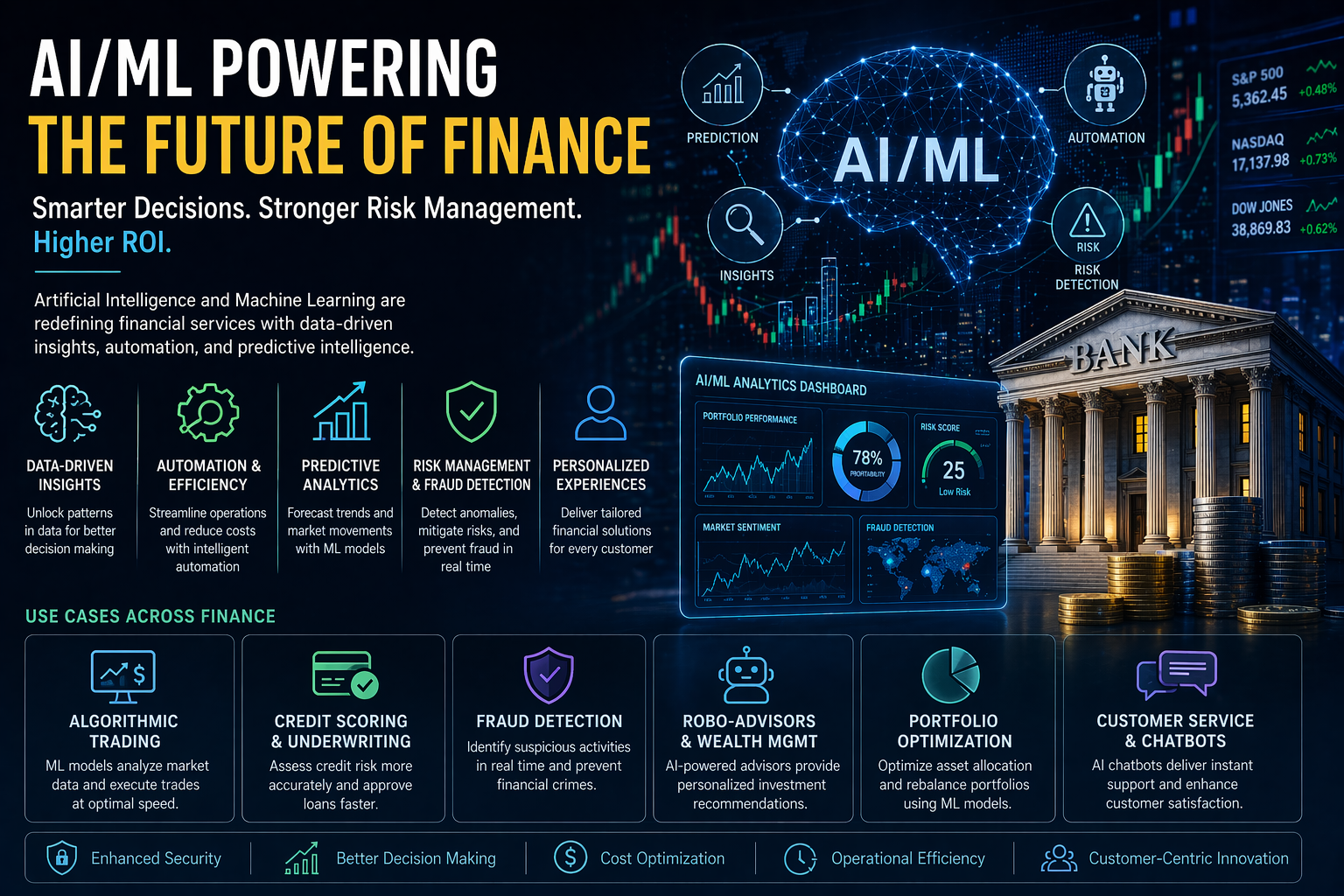
From BlackRock's Asimov to Feedzai's RiskFM and JPMorgan's $19.8B tech budget, the finance sector's AI transformation hit multiple inflection points simultaneously in Q1–Q2 2026.

Table of Contents
How Financial Institutions Are Rebuilding for Agentic AI
Track the architecture and operating-model changes behind finance sector AI adoption, from fraud controls to advisor workflows and model risk governance.
The New Gilded Age of Finance: Where Every Bank Wants to Be an AI Company
The banking industry has always been ruthless about adopting technology that moves money faster, prices risk more precisely, and stays one step ahead of fraudsters. In 2026, that technology is AI — specifically, large language models, agentic systems, and purpose-built foundation models reshaping every corner of finance, from retail banking to quantitative hedge funds.
This isn’t a future story. It’s happening right now, and the numbers are staggering. JPMorgan is spending $19.8 billion on technology this year. BlackRock has a virtual AI analyst scanning the globe’s filings. Feedzai is training foundation models on $9 trillion in annual payments. And OpenAI just quietly bought a personal finance startup. All while Wall Street cut 5,000 jobs in a single quarter — on the way to record profits.
Let’s go through all of it.
BlackRock’s Asimov: The Virtual Analyst That Never Sleeps
Let’s start at the top. BlackRock, the world’s largest asset manager with over $10 trillion in AUM, has deployed what it calls Asimov — a purpose-built agentic AI platform for the firm’s fundamental equity business. Named after Isaac Asimov (presumably with some self-awareness about naming an autonomous AI after the guy who invented the Three Laws to keep robots in check), Asimov functions as a “virtual investment analyst” that ingests research notes, regulatory filings, earnings transcripts, and emails to surface portfolio insights.
COO Rob Goldstein has made no secret of his ambitions: by BlackRock’s next investor day, Asimov is expected to be deployed across the entire firm to “scale our people.” That phrasing — scale our people — is carefully chosen language from someone who understands precisely what “scale” means when headcount enters the conversation.
Asimov isn’t just a search tool. It’s an agentic system that reasons over documents, connects signals across thousands of companies, and synthesizes conclusions that would take an analyst days to produce. For a firm managing capital at BlackRock’s scale, even marginal improvements in research throughput are measured in billions. More importantly, Asimov represents the shift from AI-as-tool to AI-as-colleague: a system that doesn’t just retrieve information but synthesizes it, surfaces implications, and flags things you didn’t know to look for.
The honest question nobody is fully answering yet: when Asimov is deployed firm-wide, how many junior equity research roles still make economic sense to fill?
JPMorgan Chase: 200,000 Employees, One AI Suite, Zero Equivocation
Jamie Dimon has been unambiguous: AI is not a productivity add-on at JPMorgan. It is the competitive battleground. With a technology budget expected to reach approximately $19.8 billion in 2026 — more than the GDP of roughly 40 sovereign nations — JPMorgan is making a statement that money can make.
The crown jewel of this investment is the LLM Suite: an internal platform now accessed by over 200,000 employees, with roughly half using it three or more times per day. That’s not hobbyist experimentation. That’s operational dependency at a scale that rivals any enterprise software deployment in history. For context, Microsoft 365 took decades to reach similar penetration; JPMorgan did it in under two years.
What is the LLM Suite doing? Everything from drafting client communications and summarizing regulatory documents to analyzing earnings calls and generating quantitative model code. The bank has over 450 use cases in production today, with a target of 1,000+ by the end of 2026.
The most telling deployment may be Proxy IQ — the bank’s in-house AI platform for shareholder voting. JPMorgan’s asset management arm has stopped using external proxy advisory firms entirely for US shareholder meetings, replacing them with an AI system that analyzes data from more than 3,000 annual company meetings. When a bank the size of JPMorgan is comfortable putting AI in charge of voting decisions that shape corporate governance across thousands of companies, we’ve crossed a meaningful threshold in institutional AI trust.
Goldman Sachs Deploys Devin: The First Autonomous AI Engineer on Wall Street
Goldman Sachs made history by becoming the first major financial institution to deploy Devin — the autonomous software engineering agent from Cognition — across its entire 12,000-strong developer workforce. Early reports suggest productivity gains in the range of 3x to 4x. If accurate, Goldman effectively added the equivalent of 24,000 to 36,000 software engineers worth of output without adding a single salary line.
Beyond Devin, Goldman is deploying an AI assistant to 10,000 employees for tasks like email drafting and code review, with the system drawing on models from OpenAI, Google, and Meta depending on the specific task. The underlying architecture — the GS AI Assistant, the Louisa networking platform, and autonomous coding agents — represents what Goldman is calling its agentic AI strategy.
The transition from “AI helps employees work 20% faster” to “AI agents execute complex multi-step workflows autonomously” is the inflection point every financial institution is trying to cross. Goldman, by all available evidence, is further along than most. The remaining question is what Goldman’s developer headcount looks like in 2028.
Feedzai’s RiskFM: The Foundation Model That Watches $9 Trillion in Payments
While the big banks are deploying AI across their operations, the fintech infrastructure layer is quietly undergoing its own transformation. The biggest story from March 2026 that deserves far more attention than it received: Feedzai unveiled RiskFM — the industry’s first Tabular Foundation Model purpose-built for financial crime prevention.
This is genuinely significant, and here’s why. Most AI models in financial services are narrowly scoped: a fraud model for card transactions at one bank, an AML model for wire transfers at another. They’re built one customer at a time, trained on that institution’s data, and optimized for that institution’s specific risk profile. The result is slow deployment (months to stand up a new model), high maintenance costs (constant retraining as fraud patterns evolve), and models that go stale faster than fraudsters change their tactics.
RiskFM takes a completely different approach. It is trained on Feedzai’s uniquely broad dataset: $9 trillion in annual payments across 120 billion events worldwide, spanning the entire financial risk lifecycle — onboarding, digital activity, card payments, real-time transfers, and AML workflows. The result is a model that already matches the performance of bespoke supervised models on single-customer data, and surpasses them when trained across multiple institutions and geographies simultaneously.
The analogy is GPT versus a custom chatbot. You could build a fine-tuned model for your specific use case, and it might nail the narrow task perfectly. But a foundation model trained on the entire landscape usually generalizes better, adapts faster to distribution shifts, and improves as more data flows through it. RiskFM is applying exactly that logic to financial crime — and given that fraudsters operate globally and adapt continuously, cross-institutional training is a genuine edge, not just a marketing claim.
The implications for fraud and AML operations at banks are substantial: faster deployment, lower implementation costs, better generalization to novel fraud patterns, and a model that gets better as the network of participating institutions grows. Feedzai is essentially building a financial crime immune system for the global payments infrastructure.
The $50 Billion Market and the 20% Who Are Capturing All the Gains
The macro picture is crystallizing. The global AI in fintech market hit $17.64 billion in 2025 and is projected to reach $97.70 billion by 2034, growing at roughly 20% annually. That’s a 5.5x expansion over nine years — compelling in any sector, extraordinary for one that’s already this large.
But the more important number comes from PwC’s 2026 AI Performance Study: 75% of AI’s economic gains are being captured by just 20% of companies. And those leading companies are not focused primarily on cost reduction. They’re focused on growth — using AI to expand market share, launch new products, and enter segments that were previously uneconomical to serve.
That 20% is not random. These are firms that have moved beyond the “pilot program” phase and embedded AI in daily operations across risk decisioning, pricing models, fraud detection, and client services at genuine scale. Forty-four percent of finance teams are expected to use agentic AI in 2026 — up from near-zero two years ago — and organizations deploying AI agents are reporting an average 2.3x return on investment within 13 months.
The divergence between the AI leaders and the AI laggards in finance is widening, and it’s doing so at a rate that makes catch-up increasingly difficult. A bank that is still running AI as a side project while JPMorgan runs 450+ production use cases and BlackRock deploys agentic research analysts is not just behind on a feature — it’s behind on a compounding capability that generates returns every single day.
Oracle and Agentic Banking Infrastructure
It’s not just the front-office that’s being transformed. Oracle Financial Services is extending its agentic AI platform to corporate banking, embedding AI capabilities and pre-built agents for treasury management, trade finance, credit decisioning, and lending automation. This matters because Oracle’s clients are typically mid-to-large banks that power significant portions of global financial infrastructure — institutions that were previously slower to adopt AI than the Goldmans and JPMorgans of the world.
When Oracle is packaging agentic AI as a standard feature of its corporate banking suite, the technology stops being a competitive differentiator and starts becoming table stakes. Banks that aren’t adopting agentic systems aren’t just falling behind the leaders — they’re falling behind their peers.
OpenAI Buys Hiro Finance: The Tech Giants Want Your Wallet
In a move that signals where the personal finance market is heading, OpenAI acquired Hiro — an AI-powered personal finance startup — in April 2026. The acquisition is modest by OpenAI’s standards, but strategically significant: it positions OpenAI directly in the consumer financial management space, competing with banks’ own apps and established fintechs.
The logic is straightforward. People already ask AI assistants questions like “how much did I spend on dining last month?” and “should I pay off my credit card or invest that $500?” Having direct access to financial data — rather than asking users to copy-paste statements — makes those answers dramatically more useful and actionable. Hiro gave OpenAI the integrations, the regulatory groundwork (connecting to bank accounts via Plaid-style infrastructure is not trivial), and the product thinking to move fast.
Meanwhile, Google Finance has expanded its AI-powered research capabilities to over 100 countries, including live earnings call summaries with AI-generated insights. The consumer entry point for financial information is increasingly AI-first, not search-first. Banks that assumed their apps would remain the primary interface for retail customers are watching that assumption erode in real time.
5,000 Jobs, Record Profits, and the Honesty the Industry Owes Everyone
Let’s not pretend this transformation is consequence-free. Wall Street banks cut 5,000 jobs in Q1 2026, even as they posted record profits. The pattern is precisely what macroeconomists feared when they modeled AI’s impact on knowledge work: productivity gains flow primarily to shareholders while workers bear the adjustment costs on their own.
The jobs being cut aren’t legacy back-office data entry roles — those were automated years ago. The Q1 2026 layoffs are hitting analysts, compliance reviewers, junior bankers, and operations staff whose workflows are being absorbed by AI systems. JPMorgan running 450+ AI use cases and expanding to 1,000 by year-end is not an abstraction. It’s a precise description of functions that used to require human judgment and now increasingly do not.
This is not an argument against AI adoption in finance — the efficiency gains, the risk management improvements, and the fraud prevention capabilities are real and matter enormously. But it is an argument for clear-eyed honesty about who captures those gains, over what timeline displaced workers find alternative employment, and what policy responses would actually help rather than just gesture at helping. The industry owes that honesty to the public debate.
What to Watch
- BlackRock’s next investor day: Goldstein said Asimov would be deployed firm-wide by then. The metrics to watch: how many analysts are using it, what the adoption curve looks like, and whether BlackRock starts reporting AI-driven research throughput as a competitive metric in earnings calls.
- Feedzai RiskFM adoption: Which major banks sign on, and what cross-institutional performance data starts emerging? If RiskFM proves out its cross-institutional performance claims, it could become the fraud detection backbone for a significant portion of global payments infrastructure.
- OpenAI’s fintech roadmap: The Hiro acquisition is step one. Watch for OpenAI pushing into active budgeting advice, investment recommendations, and eventually credit products — each step requiring regulatory navigation that will set precedents for AI in consumer finance globally.
- The 80% who are falling behind: PwC’s study says 80% of companies are capturing only 25% of AI’s financial returns. Expect a wave of urgency-driven AI investment programs — and the consulting spend that follows — as boards start seeing the divergence in quarterly earnings reports.
- Regulatory response to AI in credit and compliance: How regulators handle agentic AI systems making credit decisions and compliance judgments will set the global precedent. The EU AI Act’s financial services provisions are in full effect. Watch for the first major enforcement action involving an AI system in a credit or AML role.
Related Reading
- Google Takes Aim at Wall Street Data, Oracle Wires Up Agentic Banking, and AI Swallows the Advisor Stack
- The $650B AI Supercycle: Big Tech Goes All-In on Capex, Institutional Money Follows, and Agentic Payments Go Live
- AI Hits the Plumbing: Trade Finance Gets Agentic, Hedge Funds Automate Alpha, and Regulators Finally Update the Rulebook
Sources
- AI in Finance and Banking, April 15, 2026 – LLRX
- Feedzai Unveils RiskFM AI Foundation Model for Financial Crime Prevention – PR Newswire
- Feedzai unveils RiskFM AI model for financial crime – Fintech Global
- BlackRock’s Virtual Investment Analyst ‘Asimov’ Ushers in AI Era on Wall Street – The Daily Upside
- JPMorgan expands AI investment as tech spending nears $20B – AI News
- JPMorgan’s Dimon Positions AI as Competitive Banking Battleground – PYMNTS
- Goldman’s AI Rollout Follows Rivals – AI Street
- Goldman Sachs: The Algorithmic Banker – Chronicle Journal
- OpenAI has bought AI personal finance startup Hiro – TechCrunch
- PwC 2026 AI Performance Study
- Agentic AI in Financial Services: A Research Roundup for 2026 – Neurons Lab
- 8 AI and data trends shaping financial services in 2026 – Databricks
- $50.70+ BN Artificial Intelligence In Fintech Market Forecasts to 2034 – GlobeNewswire
- Use of AI by asset managers – Global Regulation Tomorrow
- Agentic AI Is Redefining Private Equity in 2026 – Accenture
Enterprise AI Architecture
Want more enterprise AI architecture breakdowns?
Subscribe to SuperML.