Open Beats Closed, Edge Beats Cloud: AI's Great Efficiency Revolution
From Gemma 4 running offline on a Raspberry Pi to Anthropic overhauling enterprise pricing, the economics of AI are being rewritten — and open-source models are emerging as the biggest winners.

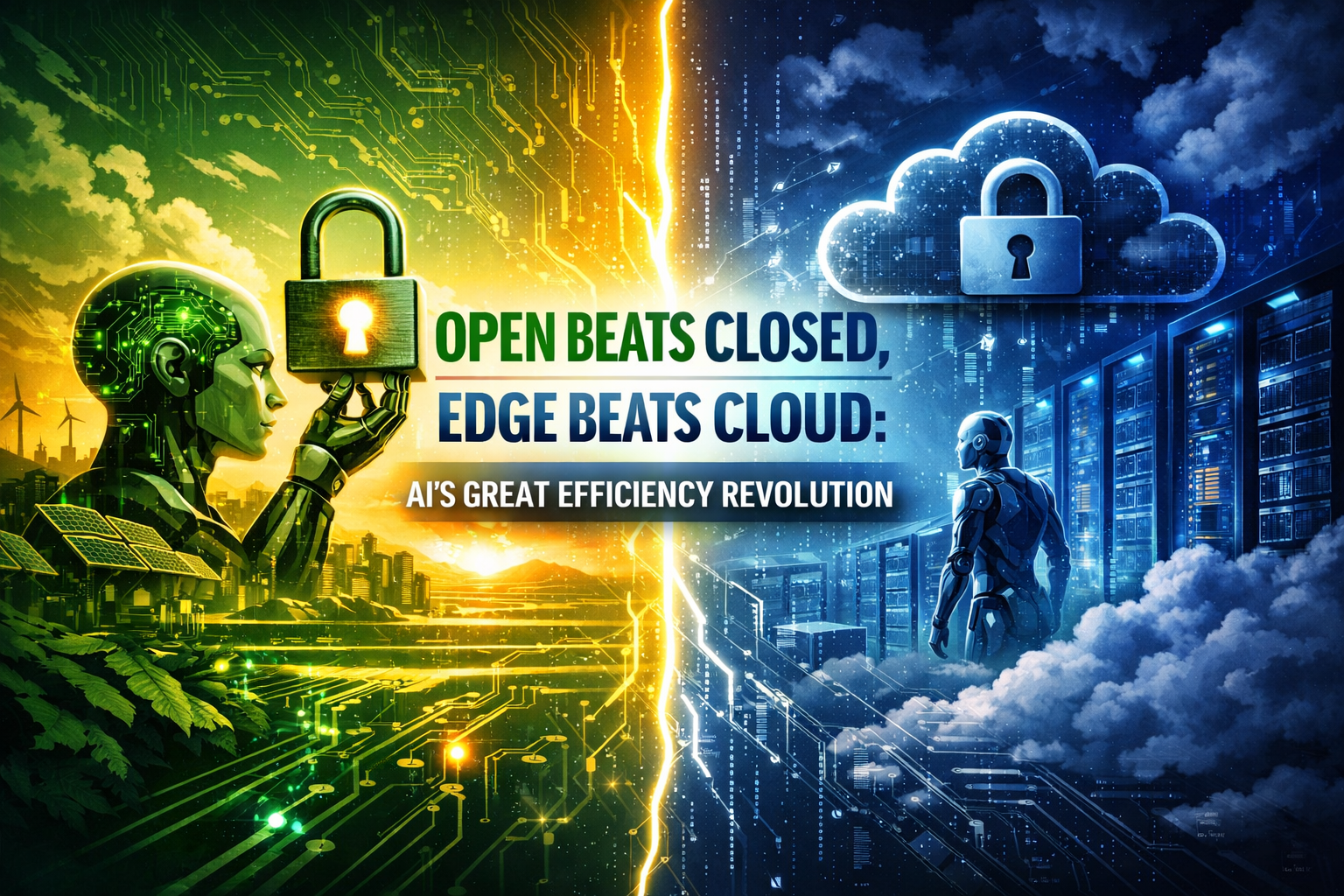
Table of Contents
Something quietly significant happened in AI this week that deserves more attention than it’s getting. A 31-billion-parameter open-source model is now outperforming rivals twenty times its size. Inference costs on the edge have dropped 90% versus cloud. A major AI lab just dismantled its flat-rate enterprise pricing because the old economics broke. And a new inference framework is making it possible to run large language models on a Raspberry Pi — offline, with near-zero latency.
The AI arms race we’ve been watching — bigger model, bigger cluster, bigger bill — is giving way to something more interesting: a race to the bottom on cost, size, and energy consumption, where the winners look nothing like the giants that started this era.
Gemma 4: The Apache 2.0 Turning Point
When Google released Gemma 4 on April 2, the headline was benchmark performance: the 31B Dense variant outperforms models with over 400 billion parameters on several standard reasoning and coding tasks. That’s remarkable engineering. But the detail that matters most long-term is buried in the release notes: Gemma 4 ships entirely under Apache 2.0 licensing.
This is not a trivial distinction. Earlier Gemma versions carried custom licenses that restricted commercial use in ways that made enterprise adoption legally complicated. Apache 2.0 means unrestricted commercial use, modification, and redistribution — the same terms companies trust when they build on Linux or Kubernetes. Google has effectively opened the floodgates for Gemma in production.
The four-variant family — a 2B for mobile, a 4B for single-board computers, a 26B MoE for consumer GPUs, and the flagship 31B Dense — covers almost every deployment scenario from a smartphone to a cloud cluster. All variants support natively multimodal input: text, images, and audio processed inside a single model, not bolted together post-hoc. Context windows reach up to 256K tokens, and the models are fluent in over 140 languages.
What makes the 31B Dense variant’s benchmark dominance meaningful is that it suggests we’ve crossed a qualitative threshold in parameter efficiency. A model that fits on a single A100 is now matching clusters of models that require data-center-scale infrastructure. If this efficiency curve continues — and there’s no reason to think it won’t — the cost curve for capable AI drops faster than most forecasts assumed.
LiteRT-LM: The Missing Piece for Edge Deployment
A great model without a great deployment story is a research artifact. Google seems to have internalized this lesson. Alongside Gemma 4’s momentum, Google announced LiteRT-LM in April — a production-ready, open-source inference framework built specifically for running large language models on edge devices.
LiteRT-LM is positioned as the answer to a real engineering headache: getting capable models to run well on constrained hardware without requiring a PhD in quantization and kernel optimization. The framework handles the low-level details — memory layout, attention kernel selection, quantization-aware execution — and exposes a clean API that works consistently across phones, Raspberry Pi boards, and NVIDIA Jetson Orin Nano modules.
The combination of Gemma 4 and LiteRT-LM is significant for a class of applications that have been theoretically possible but practically painful: fully offline AI assistants, on-device document processing, edge inference for robotics and IoT where network latency or cost makes cloud calls unacceptable, and privacy-sensitive deployments where data must never leave the device.
For practitioners, the 90% cost reduction (edge inference at roughly $0.05 versus $0.50 in the cloud for equivalent workloads) isn’t just interesting — it changes the business case for entire categories of product.
Mistral Medium 3: Frontier Performance at Budget Pricing
Mistral has been making a habit of releasing capable models at prices that make the major labs uncomfortable, and Medium 3 — launched April 9 — continues that pattern. The model claims benchmark scores at or above 90% of Claude Sonnet 3.7 performance while costing roughly 75% less than Claude Opus 4. Priced at $0.40 per million input tokens and $2.00 per million output tokens, it targets the gap that has long existed between small, cheap models and large, expensive frontier models.
Medium 3 is API-only with no open weights, and it’s text-only with a 128K token context. There’s no vision or multimodal capability, which matters for some workloads but is irrelevant for the large class of tasks that remain purely textual — summarization, classification, code review, structured extraction, Q&A over documents.
Two details stand out. First, Mistral has built EU AI Act compliance metadata directly into Medium 3’s release, a first for a frontier-tier model. As regulators ramp up enforcement timelines, having model provenance and capability documentation bundled at launch rather than retrofitted later is genuinely useful for enterprise compliance teams. Second, the model demonstrates particularly strong multilingual performance across European languages, positioning it as the obvious choice for European enterprise deployments that need both regulatory compliance and strong French, German, Italian, and Spanish capabilities.
Anthropic Rewrites Enterprise AI Pricing
The economic strain of running large AI models at scale showed up plainly this week when Anthropic restructured its enterprise pricing model. The company announced it is moving away from flat-rate subscription contracts toward compute-based billing that reflects actual usage more directly. Some enterprise customers are now billed based on how much TPU capacity their workloads consume.
This shift is more significant than it might appear. Flat-rate SaaS pricing works when marginal cost is near-zero — software as a product, licensing as the revenue model. Generative AI doesn’t fit that model. Each inference call consumes real compute, and at the scale that Anthropic’s largest customers operate, the gap between flat-rate revenue and actual compute cost can become enormous. The new model aligns incentives better: customers who use more, pay more; customers who use less aren’t subsidizing heavy users.
The announcement came alongside news that Anthropic has doubled its business customer count from 500 in February to over 1,000 — impressive growth that simultaneously explains the pricing pressure. More enterprise customers, running larger workloads, on a flat-rate model is a recipe for margin collapse. The compute-based structure is the honest architecture for how AI services actually work.
This pricing reckoning was predictable, and Anthropic is almost certainly not the last to make this move. Expect similar restructuring from other major providers as enterprise AI workloads mature from pilots to production-scale deployments.
Agentic AI: The 75% Failure Problem
There’s a striking tension in AI deployment data right now. Agentic AI — models that autonomously plan and execute multi-step tasks — is everywhere as a research demo and almost everywhere as an aspiration. It’s surprisingly rare as a successful production system.
Analysis from April 2026 data points to a consistent finding: fewer than 25% of organizations that have attempted to deploy agentic AI at scale have succeeded in doing so reliably. The challenge isn’t building agents. It’s shipping them. The gap between “impressive demo” and “reliable production system” is filled with reliability failures, cascading errors, unpredictable latency, and the difficulty of defining “done” for open-ended tasks.
This matters because the majority of the efficiency gains described above — Gemma 4’s edge deployment, LiteRT-LM, cheaper inference — are most valuable when an AI system can operate autonomously over extended sequences of decisions. A cheap model that requires constant human supervision is less transformative than a slightly more expensive model that operates reliably without it.
The labs building capable models are not the same organizations solving reliable agentic deployment. That gap is increasingly where the real work is happening: workflow management, error recovery, deterministic sub-task execution, and better evaluation frameworks for multi-step systems. Expect this to be one of the dominant engineering challenges of the next 18 months.
The Convergence: Smaller, Cheaper, More Local
Stepping back, the common thread across this week’s developments is a convergence toward AI that is smaller in footprint, cheaper to run, and more local in execution — all without sacrificing capability.
The 31B model that beats 400B rivals is not an accident; it reflects accumulated progress in training efficiency, data curation, and architecture that consistently extracts more from fewer parameters. The inference framework that makes deployment tractable is an engineering answer to a deployment gap that was real and well-understood. The pricing shift at Anthropic is the market correcting toward honest economics. Mistral’s cost-competitive API is competitive pressure doing its job.
None of this means the large-scale frontier model race is over. GPT-6, Claude Mythos, and Gemini 3.1 Ultra continue to push capability ceilings in ways that matter for the hardest problems. But the middle of the market — capable, deployable, economically sustainable AI — is being built right now, and it looks very different from the centralized, cloud-only, proprietary-only story that dominated the last two years.
What to Watch
The Apache 2.0 release of Gemma 4 sets a precedent that other labs will face pressure to match, especially as enterprises factor license risk into procurement decisions. Watch whether Meta’s next Llama iteration maintains permissive licensing or tightens terms in response to commercial pressure.
Mistral’s EU AI Act metadata integration could become a template. If the EU begins enforcing documentation requirements, models that ship compliance tooling at launch will have a structural advantage over those retrofitting it later. Watch for similar compliance-by-default moves from other European and US labs.
The Anthropic pricing restructuring is the first visible crack in flat-rate enterprise AI economics. If customers accept compute-based billing at scale, others follow. If they push back and migrate to cheaper alternatives, that accelerates the cost race. The next two quarters will clarify which dynamic wins.
The agentic deployment gap — 75% failure rate — represents the largest unresolved engineering problem in applied AI. The organizations that crack reliable multi-step autonomous execution at scale will define the next wave of AI-driven productivity. Watch LangChain, LlamaIndex, and the emerging cohort of workflow-focused AI tooling companies, as well as internal platform teams at major enterprises quietly solving this for themselves.
Related Reading
- Vision Learns to Think, Codex Goes Everywhere, and Open Weights Claim the Coding Crown
- The Silicon Decoupling: Meta’s 1GW MTIA, OpenAI’s $20B Cerebras Deal, and AI’s Quiet Escape From Nvidia
- Cutting-edge Guide to Risks Of Indiscriminate Ai Use Avoiding Model Collapse That Will Boost Your!
Sources
- Gemma 4: Byte for byte, the most capable open models — Google Blog
- Gemma 4 — Google DeepMind
- Welcome Gemma 4: Frontier multimodal intelligence on device — HuggingFace Blog
- Bring state-of-the-art agentic skills to the edge with Gemma 4 — Google Developers Blog
- LiteRT-LM: Google’s New Edge LLM Inference Framework — AIToolly
- Mistral Medium 3: Specs, Pricing & Performance — UC Strategies
- Anthropic Rewrites The Rules On AI Pricing — Web And IT News
- On-Device LLMs in 2026: What Changed, What Matters, What’s Next — Edge AI and Vision Alliance
- AI Agents in April 2026: From Research to Production — DEV Community
- The AI Research Landscape in 2026: From Agentic AI to Embodiment — Adaline Labs
Enterprise AI Architecture
Want more enterprise AI architecture breakdowns?
Subscribe to SuperML.