Fintech AI Architecture Patterns 2026: A Production Pattern Library for Regulated Financial Services
Most AI architecture guides are written for startups deploying on greenfield infrastructure. Financial services has different constraints: regulatory audit requirements, latency SLAs on core banking integrations, data residency rules, fair lending exposure, and model risk governance. This is the pattern library for AI architects building production systems inside those constraints.

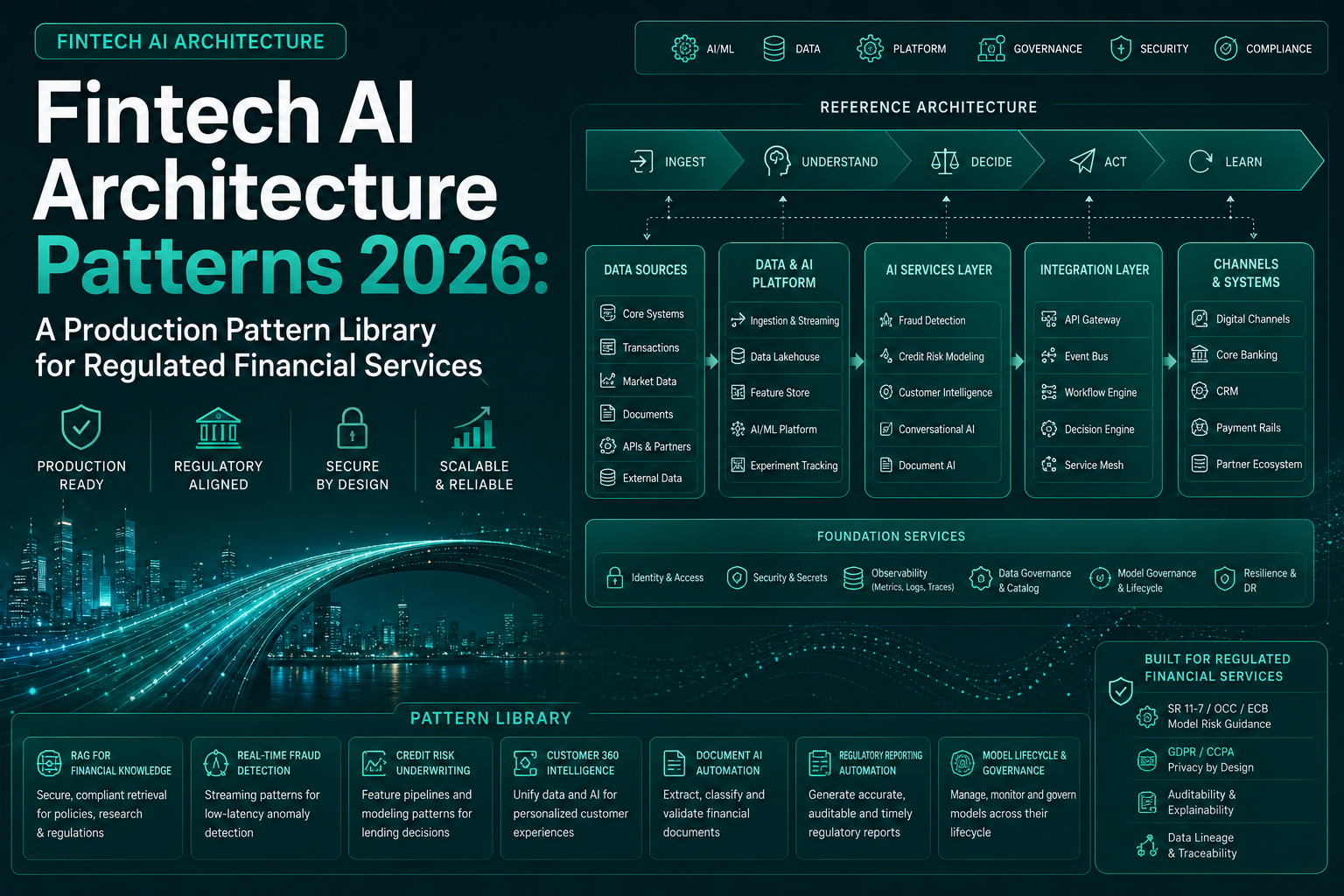
Table of Contents
The enterprise AI architecture guides you find in most places assume a particular operating environment: AWS or GCP, a modern data stack, a team with latitude to iterate fast, and no one from Legal in the architecture review. That environment describes a lot of companies. It does not describe a regulated financial institution.
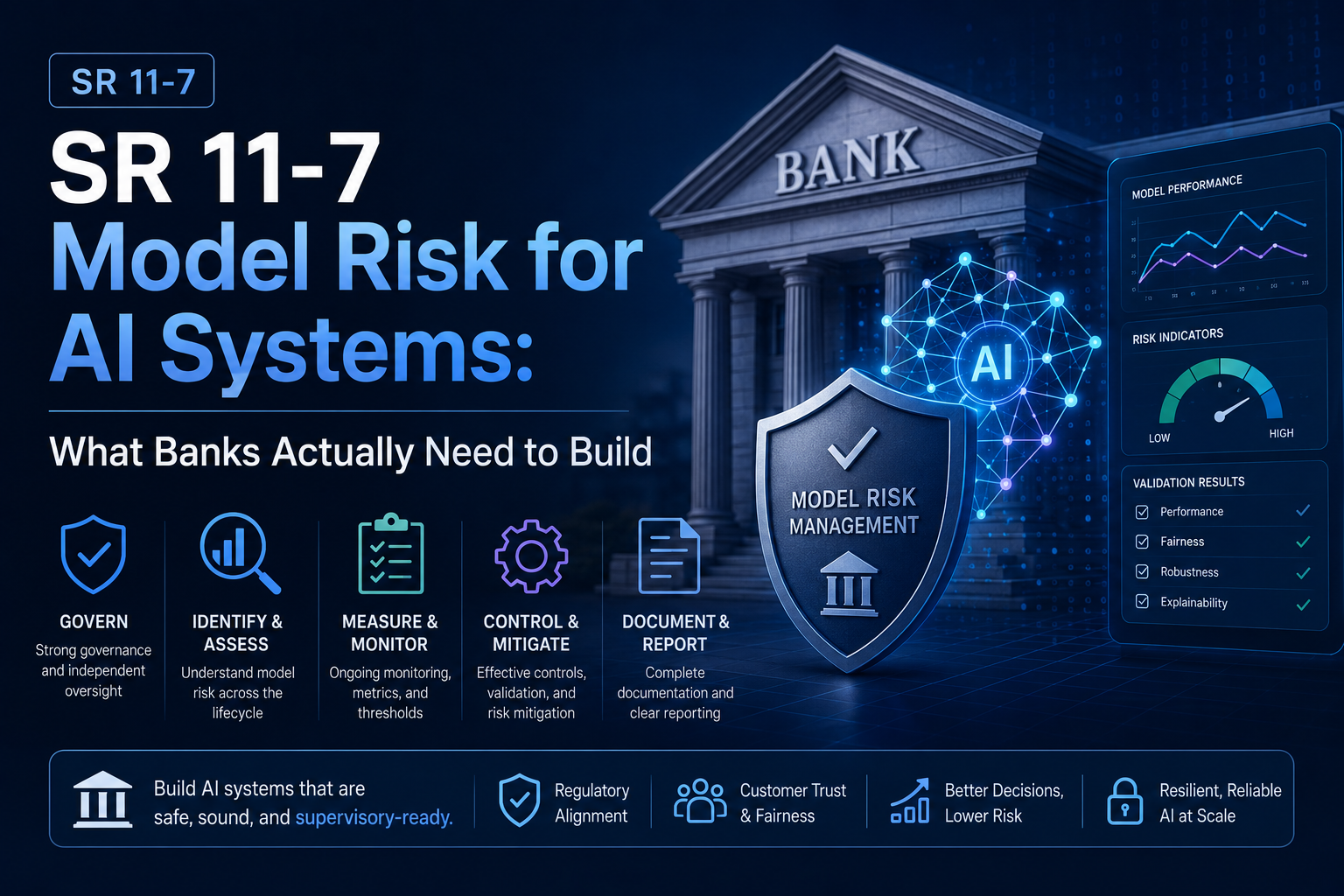
Banks and financial services firms operate under a different set of constraints that fundamentally reshape AI architecture decisions. SR 26-2 model risk governance requirements mean that every production AI system touching a material financial decision needs validation documentation, change management procedures, and audit trails. Fair lending exposure means that LLM outputs in credit-adjacent workflows need systematic bias testing before production. Data residency rules mean that customer PII cannot route through third-party API endpoints without explicit contractual protection and often explicit customer consent. Latency SLAs on core banking integrations mean that AI inference in the critical path needs deterministic performance budgets, not P95 benchmarks.
This is not a catalog of theoretical patterns. Every pattern here reflects design decisions made in production financial services environments, including 26 years of delivery at institutions like Chase and JPMorgan. The constraints are real. The failure modes are documented. The patterns that survive contact with regulators, auditors, and production load are the ones worth writing down.
Pattern 1: Retrieval-Augmented Generation for Regulated Knowledge
Problem: Financial services organizations have massive proprietary knowledge bases — regulatory guidance, policy documents, product terms, internal procedures — that need to be accessible to AI systems without embedding sensitive content in general-purpose model training data.
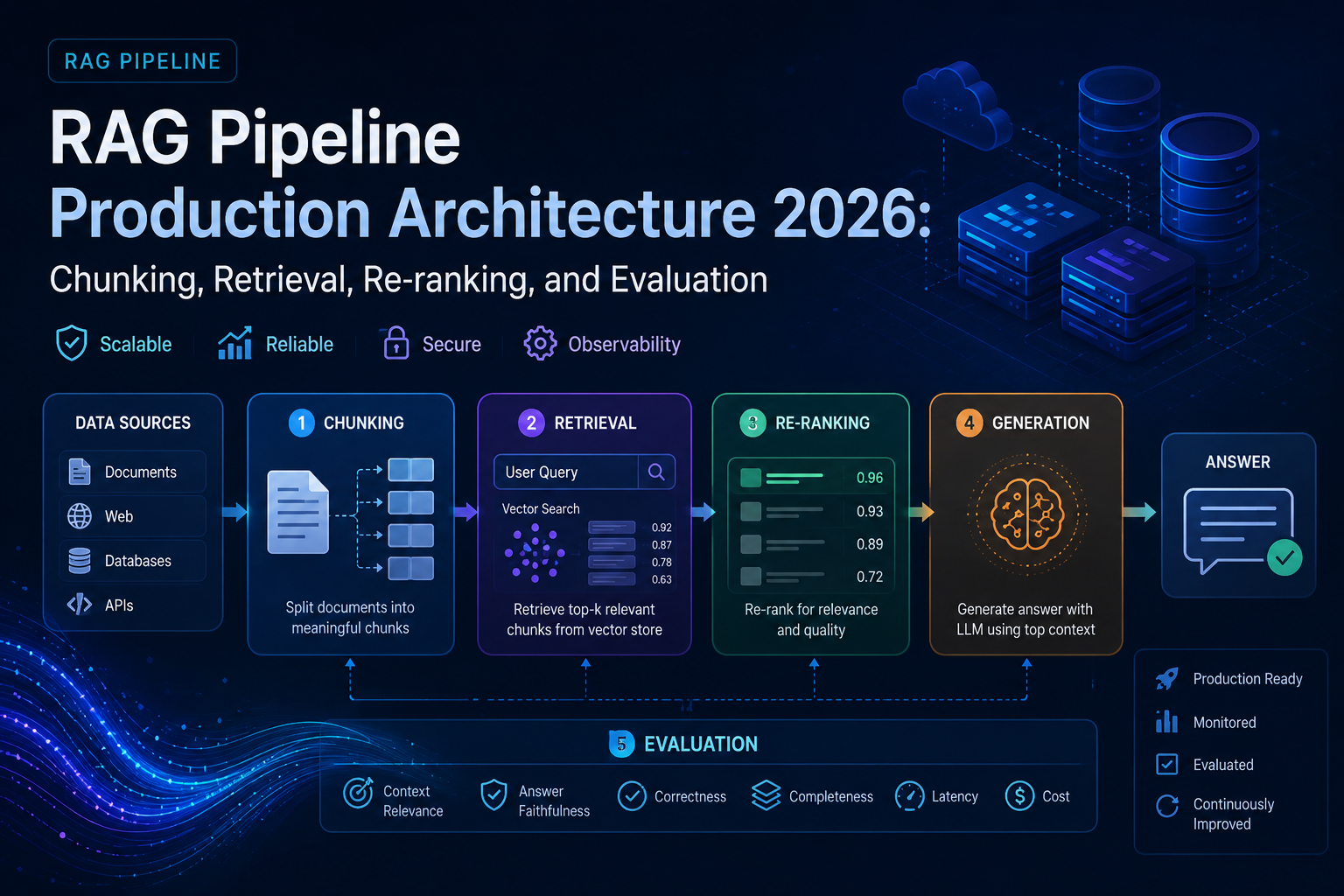
Standard RAG fails here for two reasons: retrieval quality degrades at the scale of enterprise document collections (10k–500k documents), and regulatory content requires high-confidence citation, not hallucinated synthesis. A compliance AI that confidently cites a policy that doesn’t say what it claims is a regulatory liability.
The Pattern
┌─────────────────────────────────────────────────────────┐
│              Regulated RAG Architecture                 │
│                                                          │
│  Query → [Access Control Check] → Retrieval Pipeline   │
│                │                                         │
│         ┌──────▼──────┐                                 │
│         │  Semantic   │ ← Embedding model (on-prem or  │
│         │  Search     │   private endpoint)             │
│         └──────┬──────┘                                 │
│                │                                         │
│         ┌──────▼──────┐                                 │
│         │  BM25       │ ← Keyword overlap for exact     │
│         │  Hybrid     │   regulatory term matching      │
│         └──────┬──────┘                                 │
│                │                                         │
│         ┌──────▼──────┐                                 │
│         │  Re-ranker  │ ← Cross-encoder re-ranking      │
│         └──────┬──────┘                                 │
│                │                                         │
│  Generation ← [Citation-Grounded Prompt]                │
│                │                                         │
│         ┌──────▼──────┐                                 │
│         │  Faithfulness│ ← Verify every claim maps to  │
│         │  Check      │   a retrieved passage           │
│         └──────┬──────┘                                 │
│                │                                         │
│  Output → [Structured Response + Source Citations]      │
└─────────────────────────────────────────────────────────┘
Key design decisions:
Hybrid retrieval is non-negotiable for regulatory text. Regulatory documents are full of defined terms ("qualified mortgage", "covered institution", "model" as defined in SR 11-7) that have precise legal meaning. Pure semantic search will find topically related passages but miss the exact defined-term match. BM25 over a regulatory corpus catches the exact terminology. The hybrid score is a weighted combination of semantic similarity and BM25 overlap.
Access control at the retrieval layer, not just at the application layer. In financial services, different roles have different document access rights. A credit analyst should not be able to retrieve documents from the trading desk’s proprietary strategies corpus via an AI interface, even if the AI interface has no explicit access control on the front end. The retrieval pipeline must enforce RBAC at the chunk level — not just which documents a user can access, but which chunks within shared documents. This is architecturally harder than it sounds and is frequently omitted from general RAG implementations.
Faithfulness verification before response. Every factual claim in the generated response must be traceable to a retrieved passage. If the LLM generates a claim that is not grounded in the retrieved context, the faithfulness check should either strip that claim or refuse the response. The faithfulness checker is typically a smaller, faster model (or a rule-based system for templated responses). The production pattern is to include structured citations in the response format so downstream audit can verify what the model claimed and where it came from.
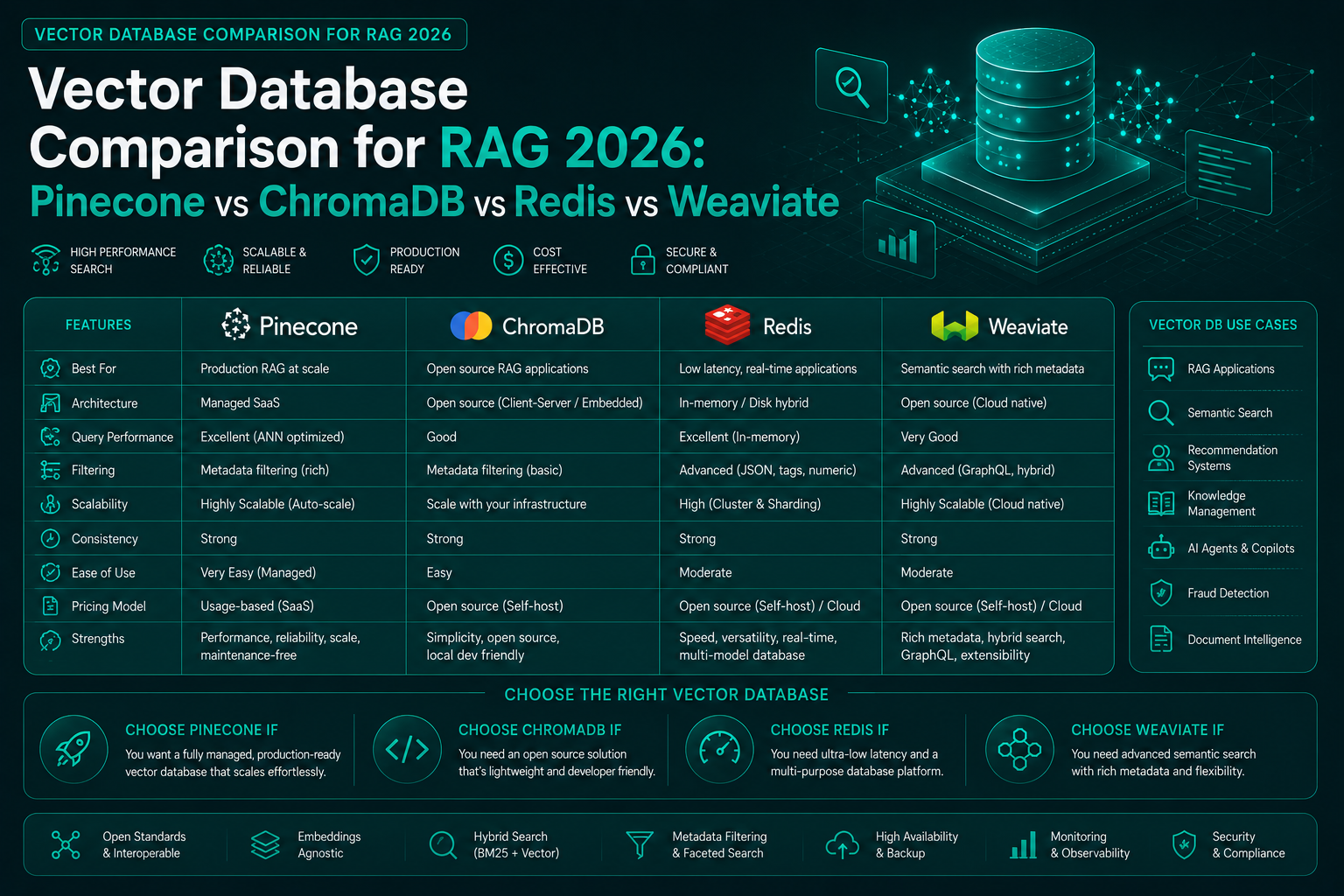
Embedding model placement: For PII-containing documents, the embedding model must run in an environment that meets your data handling requirements. A third-party API endpoint that receives your full compliance document corpus is a data exposure risk. On-prem embedding (via Ollama, vLLM, or a private endpoint) adds latency but eliminates that exposure. The architecture decision is: what classification of data is going into the retrieval corpus, and what does your data handling policy require for that classification?
Pattern 2: NL-to-SQL for Enterprise Financial Data
Problem: Business users need natural language access to financial data (portfolio analytics, risk reporting, transaction analysis) without requiring SQL expertise. But enterprise financial databases have schemas that were never designed for AI: 400+ tables, abbreviated column names, implicit domain knowledge about what joins are valid, and business rules that live in the heads of senior analysts rather than in the schema.
The failure mode is a confident SQL query that is syntactically valid but semantically wrong — joining tables in a way that double-counts revenue, applying a filter that excludes valid records, or using an aggregation that violates a business rule the schema doesn’t encode.
The Pattern
class FinancialNL2SQLPipeline:
    """
    Production NL2SQL for enterprise financial schemas.
    Three-stage: schema routing → SQL generation → safety validation
    """

    def __init__(
        self,
        schema_index: SchemaIndex,      # Semantic index of all tables/columns
        domain_ontology: DomainOntology, # Business concept → schema mapping
        sql_validator: SQLValidator,
        audit_logger: AuditLogger
    ):
        self.schema_index = schema_index
        self.ontology = domain_ontology
        self.validator = sql_validator
        self.auditor = audit_logger

    async def query(self, natural_language: str, user_context: UserContext) -> QueryResult:

        # Stage 1: Resolve business concepts to schema elements
        concepts = self.ontology.extract_concepts(natural_language)
        schema_candidates = await self.schema_index.route(
            concepts=concepts,
            user_permissions=user_context.allowed_schemas,
            max_tables=12  # Practical limit for context window
        )

        # Stage 2: Generate SQL with domain-aware prompt
        sql = await self.llm.generate_sql(
            query=natural_language,
            schema=schema_candidates.to_prompt(),
            domain_rules=self.ontology.get_rules(concepts),
            examples=schema_candidates.relevant_examples()
        )

        # Stage 3: Validate before execution
        validation = self.validator.validate(sql, schema_candidates)
        if not validation.is_safe:
            await self.auditor.log_rejected_query(natural_language, sql, validation.reason)
            return QueryResult.rejected(validation.reason)

        # Execute with row-count guard
        result = await self.db.execute(
            sql,
            timeout_ms=5000,
            max_rows=10000  # Prevent full-table scans
        )

        await self.auditor.log_executed_query(
            natural_language=natural_language,
            sql=sql,
            row_count=result.row_count,
            user=user_context.user_id
        )

        return result
The domain ontology is the critical component that most NL2SQL implementations treat as optional. In financial services, business concepts don’t map cleanly to schema elements: “revenue” might be the sum of three columns minus a fourth, depending on whether you’re measuring gross or net. “Active accounts” might require a join across three tables with a date filter that the schema doesn’t document. The ontology encodes these mappings explicitly — and the SQL generation prompt uses them to steer the model toward the semantically correct query rather than the syntactically valid but wrong one.
SQL safety validation must catch:
- Joins that will produce Cartesian products (unbounded result sets)
- Aggregations that apply to the wrong granularity (summing a per-transaction field at the account level when the question asks for per-customer)
- Filters that use nullable columns without null handling (silently excludes records)
- Queries touching PII columns for users without PII access rights
- Missing
WHEREclauses on large tables (will exhaust memory or timeout)
Audit logging is a compliance requirement, not optional instrumentation. In financial services, every query to financial data by an AI system needs a logged record of who queried, what natural language they used, what SQL was generated, and what data was returned. This is the same audit requirement that applies to direct SQL access. The AI interface doesn’t reduce the audit obligation; it adds a new layer that must be logged.
Pattern 3: Agentic Pipeline for Regulated Decision Workflows
Problem: Multi-step AI workflows (AML case triage, credit underwriting support, loan document processing, customer complaint routing) need to run at scale while maintaining compliance with model risk governance requirements, fair lending rules, and operational risk controls.
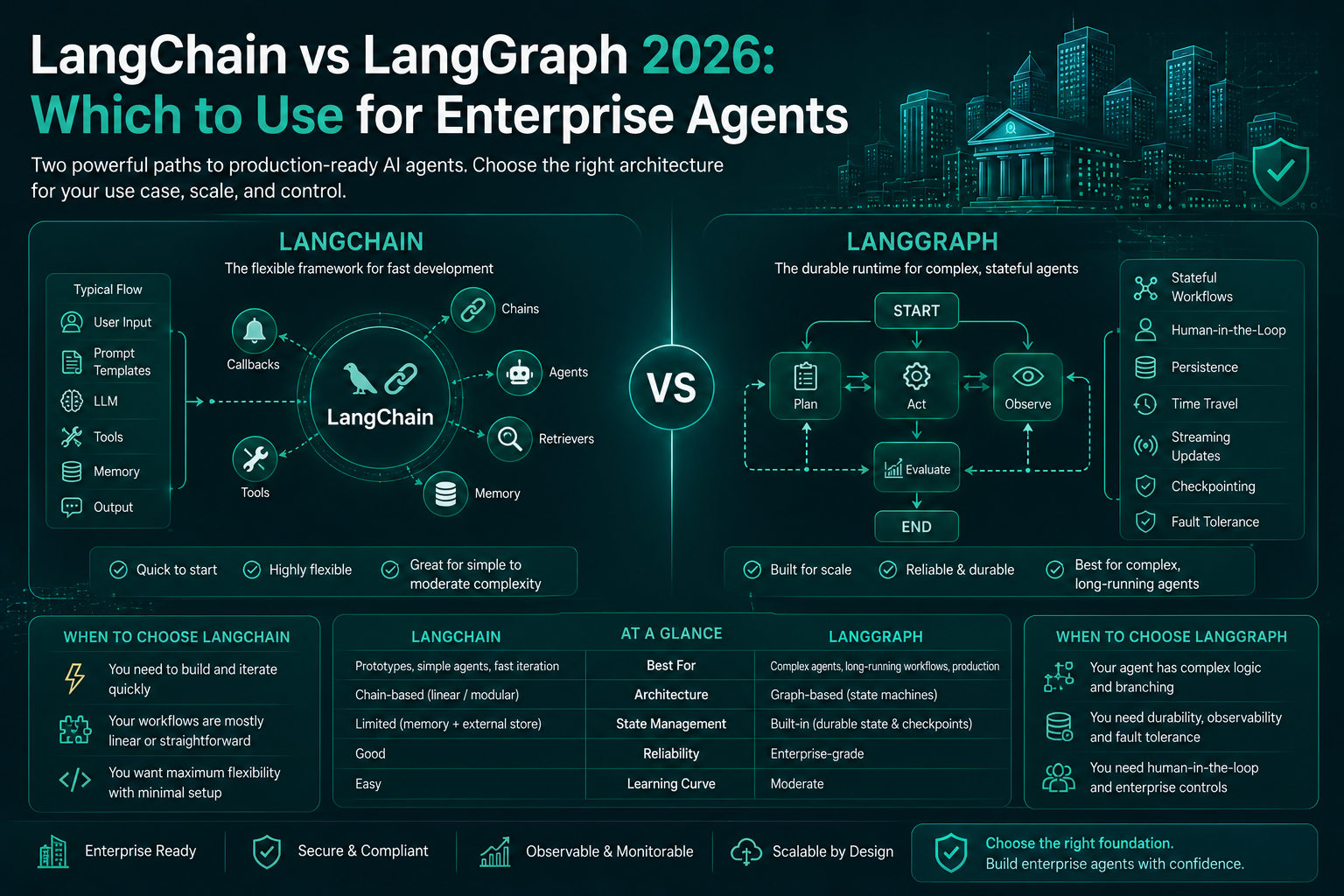
The fundamental tension: Agentic AI is valuable because it can run autonomously and at scale. Regulatory requirements in financial services demand human oversight for material decisions. These are in direct conflict unless the architecture explicitly manages the boundary.
The Pattern
┌──────────────────────────────────────────────────────────────┐
│         Regulated Agentic Pipeline — AML Triage Example      │
│                                                              │
│  Alert Ingestion                                             │
│      │                                                       │
│      ▼                                                       │
│  [Risk Pre-Classifier]  ←── Materiality routing             │
│      │           │                                           │
│  Low Risk      High Risk                                     │
│      │           │                                           │
│      ▼           ▼                                           │
│  [Agent        [Agent +                                      │
│   Autonomous]   Human Gate]  ←── Mandatory before escalation │
│      │           │                                           │
│      ▼           ▼                                           │
│  [Case         [Human        ←── 4-hour SLA for review      │
│   Closure]      Review]                                      │
│      │           │                                           │
│      ▼           ▼                                           │
│  [Audit Log]  [SAR Draft    ←── Agent drafts, human files   │
│                + Sign-off]                                   │
│                   │                                          │
│               [Audit Log]                                    │
└──────────────────────────────────────────────────────────────┘
Materiality routing before the agent runs is the pattern that resolves the autonomy/oversight tension. Not every alert requires human review — a large fraction of AML alerts are clearly low-risk and can be triaged autonomously with high confidence. The pre-classifier separates cases by risk level before routing to the agent, ensuring that human oversight is concentrated on the cases that actually need it. The classification threshold is a governance decision, not a technical one: what false-negative rate on high-risk cases is acceptable for autonomous closure?
Human gate as a structural control, not an advisory step. The agent’s code path for high-risk cases does not have a conditional: “if human hasn’t reviewed, continue anyway when queue is backed up.” The human approval token is a required input to the next step. The architecture enforces this. When reviewers are unavailable and cases queue up, the queue grows — it does not get bypassed. This is operationally uncomfortable and regulatorily necessary.
Agent drafts, humans decide on irreversible actions. SAR filings are legally binding and cannot be unfiled. The agent drafts the narrative, extracts the relevant transaction evidence, and formats the FinCEN report — but a licensed compliance officer reviews and files. The agent’s contribution is quality and speed; the human’s contribution is accountability and final judgment. This division is not a limitation of the AI; it is the correct architecture for the regulatory context.
Every agent action is logged at the event level, not just the outcome level. The audit trail captures: alert received, pre-classifier score, agent tool calls and outputs, evidence retrieved, draft narrative generated, human reviewer assigned, review decision, final disposition. This is the evidence package that satisfies a BSA examination.
Pattern 4: Multi-LLM Routing for Enterprise Resilience and Cost Control
Problem: Enterprise AI systems cannot be single-model dependent. Model provider outages, pricing changes, capability gaps for specific task types, and data residency requirements all create reasons to route different requests to different models.
The naive solution — just pick the best model and use it for everything — fails in production because “best” is task-dependent, cost and latency vary 10x across providers for the same capability, and single-provider dependency creates operational risk that risk management will not accept.
The SmartCIO Routing Pattern
This is the multi-LLM routing architecture from the SmartCIO production deployment. The router is a lightweight classifier that runs before the main inference call and selects the optimal model based on task type, latency requirement, data classification, and cost budget.
@dataclass
class RoutingDecision:
    provider: str           # 'anthropic' | 'openai' | 'ollama' | 'azure-openai'
    model: str              # Specific model ID
    rationale: str          # Logged for audit
    estimated_cost_usd: float
    estimated_latency_ms: int

class FinancialLLMRouter:

    ROUTING_RULES = [
        # Rule 1: PII-containing requests → on-prem only
        RoutingRule(
            condition=lambda req: req.data_classification == 'PII',
            target=('ollama', 'llama3-70b'),
            rationale='PII data cannot leave on-prem boundary'
        ),
        # Rule 2: Reasoning-heavy tasks → Claude Opus
        RoutingRule(
            condition=lambda req: req.task_type in ['complex_reasoning', 'multi_step_analysis']
                                  and req.latency_budget_ms > 5000,
            target=('anthropic', 'claude-opus-4-8'),
            rationale='Opus for high-complexity, latency-tolerant tasks'
        ),
        # Rule 3: High-volume, structured extraction → GPT-4o mini
        RoutingRule(
            condition=lambda req: req.task_type == 'structured_extraction'
                                  and req.daily_volume > 10000,
            target=('openai', 'gpt-4o-mini'),
            rationale='Cost optimization for high-volume structured tasks'
        ),
        # Rule 4: Real-time customer-facing → Sonnet (latency SLA)
        RoutingRule(
            condition=lambda req: req.latency_budget_ms < 2000
                                  and req.task_type == 'customer_facing',
            target=('anthropic', 'claude-sonnet-4-6'),
            rationale='Sonnet for latency-sensitive customer interactions'
        ),
        # Default: balance cost and capability
        RoutingRule(
            condition=lambda req: True,
            target=('anthropic', 'claude-sonnet-4-6'),
            rationale='Default: Sonnet for balanced cost/capability'
        ),
    ]

    async def route(self, request: LLMRequest) -> RoutingDecision:
        for rule in self.ROUTING_RULES:
            if rule.condition(request):
                decision = RoutingDecision(
                    provider=rule.target[0],
                    model=rule.target[1],
                    rationale=rule.rationale,
                    estimated_cost_usd=self._estimate_cost(request, rule.target),
                    estimated_latency_ms=self._estimate_latency(rule.target)
                )
                await self.audit_logger.log_routing(request.id, decision)
                return decision
Data classification drives routing first. The most important rule is the PII rule — data that cannot leave your regulatory boundary routes to on-prem inference before any capability or cost consideration. This is not a preference; it is a hard constraint. The routing logic must enforce it unconditionally.
Cost controls are explicit, not emergent. In production financial services AI, AI inference costs are a P&L line item that someone owns. The router logs estimated cost per request, rolls up to daily/monthly actuals, and has circuit-breaker logic that routes to cheaper models when daily cost budgets are being exceeded. “The models chose to use expensive inference” is not an acceptable answer to a CFO question about AI spending.
Fallback chains for resilience. Each routing rule should have a fallback provider. When Anthropic has degraded service, the router should automatically shift to the Azure OpenAI deployment or the on-prem fallback — without manual intervention, and without the application layer being aware that a fallback occurred. The routing decision log captures which provider actually served each request, enabling post-hoc analysis of fallback frequency and its impact on output quality.
Pattern 5: Semantic Cache for Cost and Latency Reduction
Problem: Enterprise financial AI systems often serve highly repetitive queries — the same regulatory question asked by 500 compliance analysts, the same product terms question from different customer service agents, the same portfolio metric calculated for multiple downstream consumers. Each of these generates a new LLM inference call unless the architecture includes semantic caching.
The Pattern
class SemanticCache:
    """
    Redis-backed semantic cache with similarity threshold.
    Reduces LLM calls by 40-60% for enterprise financial Q&A.
    """

    def __init__(self, redis: Redis, embedder: Embedder, threshold: float = 0.92):
        self.redis = redis
        self.embedder = embedder
        self.threshold = threshold  # Tune per use case — regulatory Q&A needs higher threshold

    async def get(self, query: str) -> Optional[CachedResponse]:
        query_embedding = await self.embedder.embed(query)

        # Vector search across cached query embeddings
        candidates = await self.redis.vector_search(
            index='semantic-cache',
            vector=query_embedding,
            top_k=3
        )

        if candidates and candidates[0].score >= self.threshold:
            cached = candidates[0]
            await self.metrics.record_cache_hit(query, cached.score)
            return CachedResponse(
                content=cached.response,
                similarity_score=cached.score,
                original_query=cached.query,
                cached_at=cached.timestamp
            )

        return None

    async def set(self, query: str, response: str, ttl_hours: int = 24):
        embedding = await self.embedder.embed(query)
        await self.redis.vector_set(
            index='semantic-cache',
            key=f"cache:{hash(query)}",
            vector=embedding,
            metadata={'query': query, 'response': response, 'timestamp': datetime.utcnow()},
            ttl=ttl_hours * 3600
        )
The similarity threshold is a governance parameter. For regulatory Q&A (“What does SR 26-2 require for model validation?”), a threshold of 0.95 is appropriate — the cached answer to a nearly-identical question is the right answer, and the stakes of a slightly wrong answer are high. For conversational AI (“What’s the balance on account X?”), caching is inappropriate entirely because each query is for real-time data. The threshold and TTL must be calibrated per use case.
Cache invalidation on document updates. When the underlying regulatory corpus changes — new OCC guidance published, internal policy updated — any cached responses that drew from the changed documents must be invalidated. This requires the cache to maintain a document-to-response mapping, not just a query-to-response mapping. It is architecturally complex and is frequently implemented as a “TTL-based eventual consistency” approach (24-hour TTL, cache goes stale but recovers) rather than precise invalidation.
Pattern 6: AI Governance Control Plane
Problem: The patterns above generate a proliferation of AI system components — RAG pipelines, NL2SQL agents, agentic workflows, routing layers — each with its own model version, prompt version, audit log, and governance state. Without a unified control plane, governance becomes an archaeology exercise: when regulators ask “what model was used to make this decision on this date,” the answer requires manual investigation across multiple systems.
The Pattern
The governance control plane is not a product — no single vendor provides this for regulated financial services contexts. It is an architectural layer you build with three core capabilities:
1. AI Asset Registry
Every production AI component is registered with:
- Component ID (stable identifier, survives model version changes)
- Component type (RAG pipeline, NL2SQL agent, orchestrated workflow, inference endpoint)
- Current model version(s)
- Current prompt version(s)
- Data classification level
- Materiality rating (material / non-material for SR 26-2 purposes)
- Validation status (validated / pending validation / exempt)
- Human oversight architecture (what checkpoints exist, who owns them)
- Deployed environments (dev / staging / production)
2. Inference Decision Log
A centralized, append-only log that every production AI component writes to:
{
  "event_id": "evt_01HZK8...",
  "component_id": "aml-triage-agent-v3",
  "model": "claude-sonnet-4-6",
  "prompt_version": "aml-system-prompt-v12",
  "input_hash": "sha256:abc...",  // Hash, not raw — for PII protection
  "output_hash": "sha256:def...",
  "latency_ms": 1240,
  "cost_usd": 0.0043,
  "user_id": "u_analyst_042",
  "downstream_action": "case_routed_to_review",
  "human_review_required": true,
  "timestamp": "2026-06-08T14:23:01Z"
}
3. Model Risk Dashboard
Real-time visibility into:
- Which AI components are in production, with their validation status
- Output distribution shifts detected via statistical monitoring
- Human override rates (high override rate signals model performance degradation)
- Cost and latency by component
- Upcoming model version changes and their validation status
This is the document you produce in the first 30 minutes of an examination. The examiner asks: “Show me your AI inventory and tell me which systems are making material financial decisions.” This is the answer.
Architecture Composition: The Full Stack
In production financial services, these six patterns compose into a layered architecture:
Presentation Layer:   Business user interface / API / internal tool
        │
Routing Layer:        Multi-LLM router + semantic cache
        │
Agent Layer:          Agentic pipelines with materiality-gated oversight
        │
Knowledge Layer:      Regulated RAG + NL2SQL pipelines
        │
Data Layer:           On-prem data with access control enforcement
        │
Governance Layer:     AI asset registry + decision log + monitoring
The governance layer cuts across all other layers horizontally — it is not a separate tier, but an instrumentation requirement on every component.
The most important architectural constraint in this stack is not technical. It is organizational: every AI component needs an identified owner who is responsible for its governance state. Without clear ownership, the governance layer accumulates stale entries, validation reviews don’t happen on schedule, and when something goes wrong at scale, no one can answer the question “who is responsible for this component?”
In financial services, the answer to that question has a regulatory consequence. The architecture should make the answer obvious.
What This Looks Like in Practice
The patterns above describe individually clean solutions. Production financial services AI is rarely individually clean. The RAG pipeline has a document classification edge case that breaks the access control check for a subset of legacy documents. The NL2SQL agent hits a schema where the domain ontology has a gap that produces a semantically wrong join once a week. The agentic pipeline has a materiality classifier that is miscalibrated for a specific alert type. The multi-LLM router has a PII detection step that misclassifies a small percentage of non-PII data as PII and routes it to the slower on-prem model.
These are not theoretical problems. They are the actual failure modes that appear in production deployments of these patterns in regulated environments. The governance layer exists precisely to surface them systematically rather than discovering them individually during an examination.
The architecture decisions that matter most are not the ones that make your demos impressive. They are the ones that give you visibility into your own system’s failure modes — and the ability to explain them, correct them, and document that you corrected them.
That is what model risk governance for AI actually requires. Not perfection. Accountability.
Related Reading
- OODA Loop Architecture for Production AI Agents — the agent decision loop pattern used in Patterns 3 and 6
- SR 11-7 Model Risk for AI Systems: What Banks Actually Need — the governance framework these patterns must satisfy
- NL-to-SQL Deep Dive: Schema Linking and ReAct Reasoning — Pattern 2 in full depth
- Agentic AI Architecture Hub — the full pattern library for production agent systems
- AI Governance for Financial Services — regulatory and compliance context for all patterns above
Enterprise AI Architecture
Want more enterprise AI architecture breakdowns?
Subscribe to SuperML.