The EU AI Act Just Blinked — and Banks That Celebrate Are Making a Costly Mistake
On May 7, 2026, EU lawmakers agreed to delay high-risk AI Act obligations for banking and financial services from August 2026 to December 2027. Here's why treating that extension as a gift is exactly the wrong call.


Table of Contents
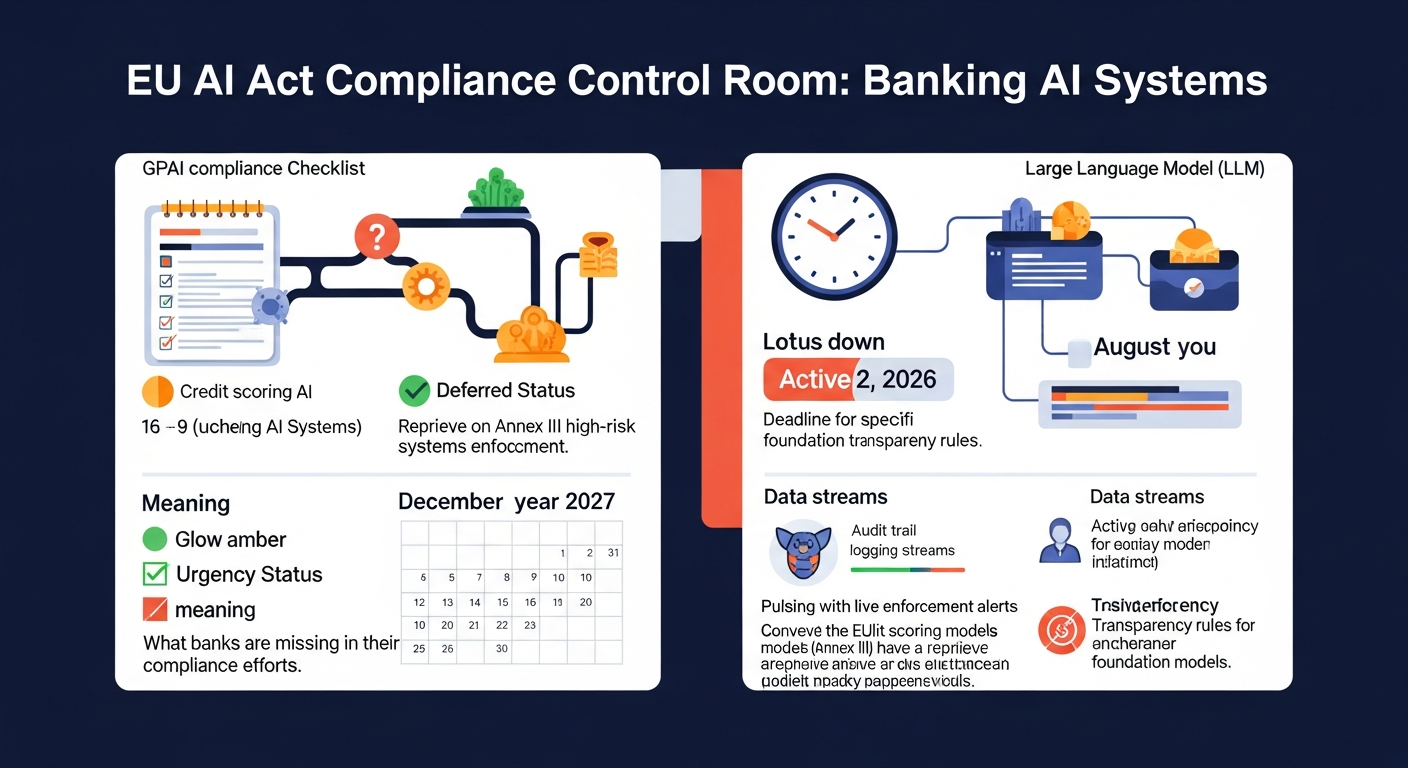
On May 7, 2026, EU lawmakers quietly handed enterprise AI teams something they’ve been lobbying for since last November: more time. The political agreement on the Digital Omnibus package pushed the EU AI Act’s high-risk AI compliance deadline from August 2, 2026, to December 2, 2027 — a 16-month extension covering Annex III systems, which includes credit scoring, insurance risk pricing, AML, employment AI, and a half-dozen other categories that are deeply embedded in how banks actually operate.
Compliance teams at mid-tier European banks are reportedly celebrating. Their US counterparts with EU market exposure are scheduling calls. And consultants are already rewriting their pitch decks to include “compliance readiness sprint” as a 2027 service offering.
Here’s the part nobody wants to say out loud: the delay changes the penalty clock. It does not change the amount of work that needs to happen.
If your bank is running a credit scoring model, an automated loan decisioning system, or any AML alert triage tool that touches EU consumers, you already have a high-risk AI system in production. You already need a systematic AI inventory, a risk management framework under Article 9, technical documentation per Annex IV, conformity assessment procedures, EU database registration, human oversight mechanisms embedded in the system itself, six months of automated log retention, and a working incident reporting process with 15-day windows.
None of that was easy to build in time for August 2026. And none of it becomes easier just because the deadline moved to December 2027.
What Actually Changed on May 7
The political agreement from the Digital Omnibus negotiations — reached after negotiations that nearly collapsed in late April — delivered a cleaner timeline than most compliance attorneys were expecting. The new structure separates high-risk obligations into two tracks.
Annex III systems — the ones financial services firms care about most — now have until December 2, 2027. This covers credit checking and life and health insurance risk and pricing assessments, employment-related AI (recruitment, performance monitoring, promotion, termination), various public sector functions, and biometrics. For a typical bank, this is exactly the AI surface area that has been in production for years.
Annex I systems — AI embedded as safety components in products governed by EU product safety rules — get until August 2, 2028. The definition of “safety component” is also being narrowed: if an AI component merely assists users or optimizes performance without creating health or safety risks, it won’t be subject to high-risk obligations. This matters for vendors selling AI-embedded hardware into regulated sectors, but it’s less directly relevant to pure software systems in financial services.
There’s a third track that didn’t get pushed out: transparency obligations for AI-generated content, including watermarking requirements, are now due December 2, 2026 — actually tighter than some earlier proposals. If you’re using generative AI to produce customer-facing documents, summaries, or communications in the EU, that deadline did not blink.
The deal still requires formal approval from both the European Parliament and Council. It’s not law yet. But the political agreement is broadly expected to hold, and law firms including Travers Smith, Orrick, and DLA Piper are treating it as the operative planning framework for clients.
The Compliance Math That Doesn’t Change
Let’s talk about what the extension actually bought. If you were starting from zero on August 1, 2026, you would have had approximately zero months to achieve compliance. You now have approximately 16 months. That sounds like a lot, until you understand what needs to happen in those 16 months.
The Cloud Security Alliance’s analysis found that large enterprises face initial compliance investments of $8–15 million to bring high-risk AI systems into conformity, with annual ongoing costs of $1–5 million. Mid-size organizations face $2–5 million in initial investment. These figures cover quality management system implementation, technical documentation per Annex IV, conformity assessment procedures, EU database registration, post-market monitoring infrastructure, and incident reporting processes.
The 16-month timeline for all of that, for a bank with dozens of AI systems deployed across credit, fraud, operations, and customer service, is tight. It is not “we have plenty of time” territory. It is “if we start now and don’t lose momentum, we can make it” territory.
And here’s the math that actually matters: the organizations that pause their compliance programs in response to this extension will arrive at December 2027 in precisely the same position they’re in today — with the same inventory gaps, the same undocumented systems, the same missing human oversight mechanisms — only now with a live enforcement regime, active national competent authorities, and penalties up to €15 million or 3% of global annual turnover, whichever is higher.
Over half of organizations currently lack systematic inventories of the AI systems they operate. That’s not a trivial gap. An inventory is the minimum prerequisite — you cannot classify risk, scope conformity assessment, or draft technical documentation for systems you haven’t inventoried. Building that inventory alone, for a complex institution, takes months of cross-functional work across model risk, technology, compliance, and business lines.
What Banks Actually Have In Production
The specific Annex III categories that hit financial services directly are worth naming precisely, because the compliance architecture varies meaningfully by system type.
Credit scoring and creditworthiness assessment covers any AI or ML system that evaluates whether to lend, at what rate, and under what terms. This includes traditional scorecards with ML components, gradient boosting models for underwriting, and increasingly, LLM-based systems that synthesize financial statements for commercial credit assessment. These systems need risk management documentation, conformity assessment, and — critically — human oversight mechanisms embedded in the system itself, not just described in a policy document.
Life and health insurance risk assessment and pricing covers the actuarial and underwriting AI that determines premiums. Many insurers have been running these systems in production for years. The Act requires that the systems themselves support human override capability, not merely that underwriters can theoretically override a recommendation.
Employment-related AI is the one most organizations underestimate. If you have an AI system that screens resumes, ranks candidates, monitors worker performance, assists in promotion decisions, or flags termination candidates — and you’re operating it in the EU — you have a high-risk system. Banks with AI-assisted HR operations are often surprised to discover that their people operations tools fall squarely in scope.
AML and financial crimes AI sits somewhat ambiguously in the regulation. The specific listing under Annex III relates to law enforcement use cases, not private sector compliance directly. But where banks are operating AI that feeds into suspicious activity reporting or risk-tier determinations for regulatory reporting purposes, there’s a plausible argument for high-risk classification, and prudent legal advice is to treat ambiguous systems as high-risk until formally determined otherwise.
The Architecture Work That Was Always Required
The EU AI Act’s requirements for high-risk AI systems are not a compliance checkbox exercise. They describe a specific kind of production AI system — one that has been engineered from the start to support human oversight, generate auditable logs, produce interpretable outputs, and sustain a documented risk management lifecycle. That’s a specific architecture, and retrofitting it onto systems that were built without those properties is genuinely hard.
The seven pre-market obligations under Article 9 through Article 17 describe what a compliant system looks like: a live risk management system that covers the full operational lifecycle, not a one-time assessment; data governance documentation that covers training, validation, and test datasets; technical documentation that must be prepared before market placement and retained for ten years; human oversight mechanisms embedded at the technical level (not just policy); conformity assessment; and EU database registration before the system operates.
The “deployed six years ago before any of this existed” problem is the one that’s going to drive the most compliance spend in the next 18 months. Systems built without compliance intent don’t become compliant through documentation alone. The oversight mechanisms, logging infrastructure, and interpretability requirements have to be engineered in. And for a production credit scoring model processing millions of decisions per quarter, retrofitting those properties without breaking the system is a non-trivial engineering project.
The SuperML Take
Let’s be direct about what this extension is and isn’t. It’s a regulatory acknowledgment that the harmonized technical standards arrived eight months late — prEN 18286, the quality management standard central to the conformity assessment pathway, only entered public enquiry in October 2025, leaving organizations without the standards-based compliance route they needed. The Commission’s proposal to delay, and the political agreement on May 7, are a reasonable response to that standards delay. The regulation’s architects made a promise about the tooling that would be available; the tooling wasn’t ready on schedule; extending the deadline is the right call.
What it isn’t is a signal that the regulation is weakening, that enforcement is uncertain, or that organizations can safely deprioritize compliance work. The penalties structure is unchanged. The national competent authorities that are being stood up to enforce the Act are unchanged. The fundamental obligation to operate high-risk AI systems with appropriate governance, oversight, and documentation is unchanged.
The more significant risk for financial institutions isn’t that they’ll miss the December 2027 deadline — it’s that they’ll use the extension to avoid confronting an inventory and classification problem that gets more expensive with each quarter of delay. Every new model deployed, every production system that goes live without Annex IV documentation, is future compliance debt. And compliance debt compounds exactly the way technical debt does: the longer you carry it, the more it costs to resolve, and the more it constrains your ability to move.
The organizations that will be in the strongest position in December 2027 are not the ones that celebrated when the extension was announced. They’re the ones that used the announcement as a reason to accelerate the inventory work they should have started last year — because building a durable AI governance capability inside a large financial institution is genuinely hard, takes longer than any deadline, and confers competitive advantage over peers who treat compliance as a cost center rather than an operating capability.
The EU AI Act’s transparency deadline for AI-generated content — December 2026 — was not pushed out. If you’re using generative AI for customer communications in the EU and you haven’t started thinking about your watermarking and disclosure approach, you don’t have until 2027. You have until December.
Architecture Impact
What changes in system design? The EU AI Act’s high-risk requirements mandate that human oversight mechanisms be embedded at the technical level inside the system itself — not documented as an organizational policy. This means production AI systems used for credit decisioning, insurance pricing, or employment management need interruption and override capabilities engineered into their inference pipelines, with audit logging that covers not just inputs and outputs but the override events themselves. Systems built without these properties require architectural retrofit, not just documentation updates.
What new failure mode appears? The compliance documentation gap is now also a regulatory liability gap. Technical documentation under Annex IV — which must be prepared before market placement and retained for ten years — does not exist for the vast majority of AI systems currently in production at financial institutions. When enforcement begins in December 2027, the first wave of regulatory inquiries will likely target documentation, not model performance, exposing institutions to penalties for systems that are technically sound but governance-deficient. The failure mode is “model that works fine, institution that can’t prove it.”
What enterprise teams should evaluate:
- Model risk and validation teams: Begin the Annex III scoping exercise now — systematically classifying deployed models against the eight Annex III sectors, with documentation of the classification rationale. Ambiguous systems should be treated as high-risk until formally determined otherwise.
- AI/ML engineering teams: Audit production systems for override capability, log retention, and interpretability requirements. Prioritize retrofitting human oversight and six-month log retention onto high-volume, high-stakes decision systems first.
- Compliance and legal: Map existing model risk management documentation (SR 11-7, internal MRM policies) against Annex IV requirements — there is significant overlap, but the EU Act requires specific additional documentation elements that SR 11-7 does not cover.
- Data governance: Validate that training, validation, and test dataset documentation satisfies Article 10 requirements — particularly bias assessment and completeness attestation.
Cost / latency / governance / reliability implications: Large financial institutions should budget $8–15M in initial compliance investment and $1–5M annually for ongoing compliance operations, per CSA analysis. The latency implications are significant for systems that must now support embedded human oversight: real-time credit decisioning systems that add human review steps for edge cases will see processing time increases of 2–5 business days for referred decisions, which needs to be reflected in customer-facing SLAs. Governance teams that treat December 2027 as a “start then” date rather than a “done by then” date will find the timeline impossible.
What to Watch
The formal adoption of the Digital Omnibus agreement by the European Parliament and Council will publish the final statutory text, which may clarify several open questions the May 7 political agreement left unresolved — including whether the Article 4 general AI literacy obligation for providers and deployers will survive in final form.
The harmonized standards timeline is the critical path for the conformity assessment route: prEN 18286 is in public enquiry, but the enquiry process and finalization typically adds another 12–18 months. Organizations that need the standards-based conformity pathway — rather than the alternative internal assessment route — should track CEN/CENELEC JTC 21 progress closely.
National competent authority establishment is proceeding across EU member states. The enforcement posture of individual authorities — particularly those in Germany, France, and the Netherlands for financial services — will shape how aggressive early enforcement looks. Member states vary significantly in AI regulatory capacity, and the first enforcement actions will set precedents that matter for years.
The December 2026 transparency deadline for AI-generated content is the nearest hard enforcement date. Institutions using generative AI in customer-facing contexts in the EU should treat this as their immediate compliance sprint — not something that can wait for the broader AI Act implementation program to reach it.
Sources
- Travers Smith, EU agrees to delay key AI Act compliance deadlines — Legal briefing on the May 7, 2026 political agreement, published May 8, 2026
- Cloud Security Alliance AI Safety Initiative, EU AI Act High-Risk Deadline: Enterprise Readiness Gap — Comprehensive compliance analysis including cost estimates and readiness gaps, March 2026
- Holland & Knight, U.S. Companies Face EU AI Act’s Possible August 2026 Compliance Deadline — April 2026 analysis of US firms’ exposure
- Finextra, The EU AI Act’s August 2026 Deadline: What Financial Services Firms Must Do Now — Financial services-specific compliance review
- artificialintelligenceact.eu, Annex III — High-Risk AI Systems — Official text of Annex III high-risk categories
- Secure Privacy, EU AI Act 2026: Key Compliance Requirements for Enterprises — Penalty structure and compliance requirement summary
Enterprise AI Architecture
Want more enterprise AI architecture breakdowns?
Subscribe to SuperML.