Fiserv's agentOS Looks Like a Gift for Banks. It's Actually an Architecture Decision You Can't Easily Undo.
Fiserv just launched an agentic AI operating system natively wired into its core banking stack — and the governance, policy enforcement, and audit trail all live in the vendor layer. That's not just a product announcement; it's the moment your core vendor became your AI risk manager.


Table of Contents
There is a version of the Fiserv agentOS announcement you could tell that sounds entirely sensible. Six thousand financial institutions, most of them unable to afford their own AI engineering teams, finally have a path to deploying governed AI agents natively against their core banking system. Commercial loan onboarding that used to take three to four days of manual entry now runs in near-real-time. Daily operational reports that consumed ten minutes of analyst time collapse to seconds. And the whole thing comes pre-wired with kill switches, human-in-the-loop checkpoints, and an audit trail ready for the next regulatory exam. What’s not to like?
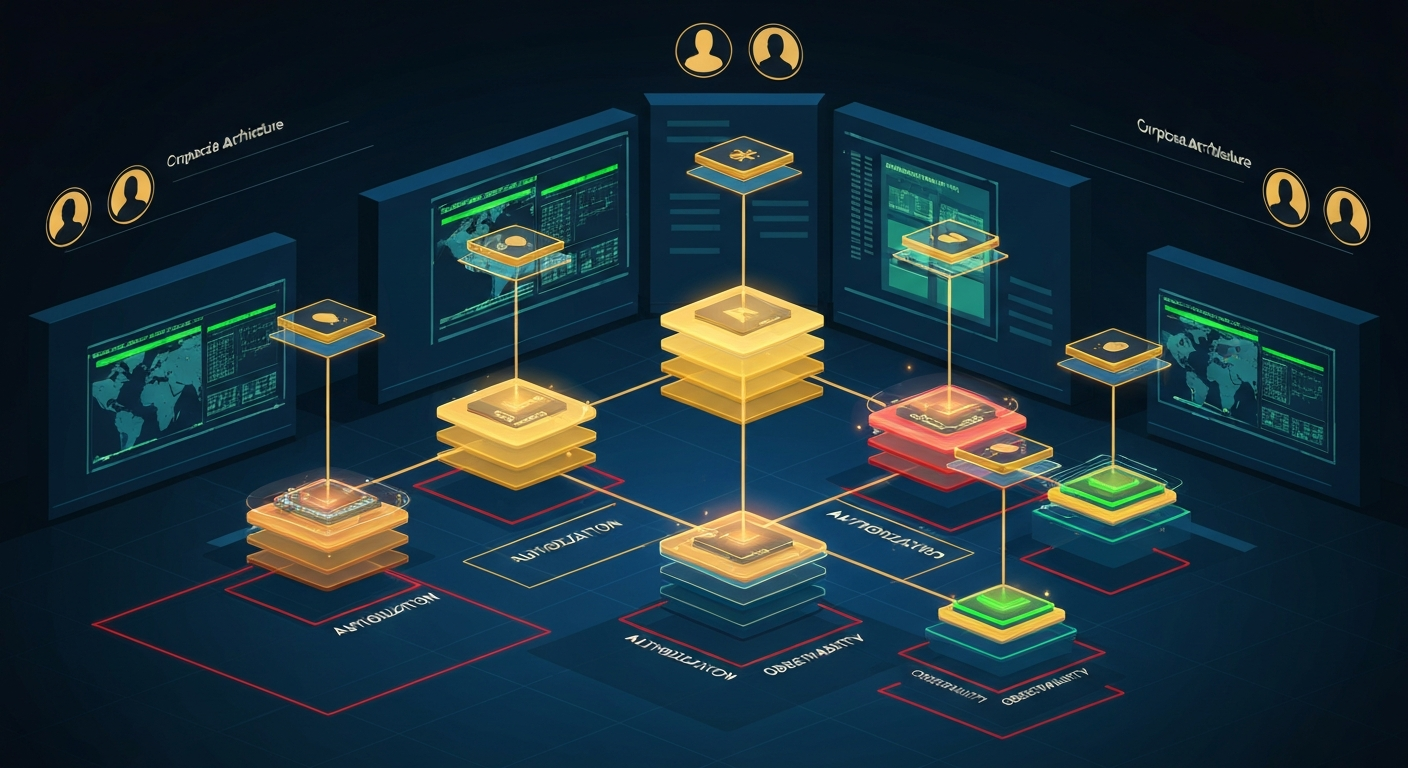
The part nobody is leading with is this: the governance layer — the policy enforcement, the identity-bound execution, the kill switches, the observability stack — is Fiserv-managed, not bank-managed. When you deploy on agentOS, you’re not adding an AI governance layer to your architecture. You’re outsourcing your AI governance layer to the same vendor who runs your core.
That’s a meaningfully different proposition than the press release implies. Banks have spent ten years trying to untangle themselves from core-vendor dependency. agentOS is a very elegant way to re-tangle them — at exactly the layer where the risk is highest.
What Fiserv Actually Built
AgentOS launched on May 14, 2026. The architecture runs on Amazon Bedrock AgentCore, giving financial institutions access to models from Anthropic, Meta, Mistral, and Amazon via a single API. OpenAI is a strategic co-developer, building first-party agents alongside Fiserv and collaborating on software modernization, cybersecurity, and embedding frontier reasoning into existing bank products. Fiserv joins OpenAI’s Trusted Access for Cyber program as part of the deal.
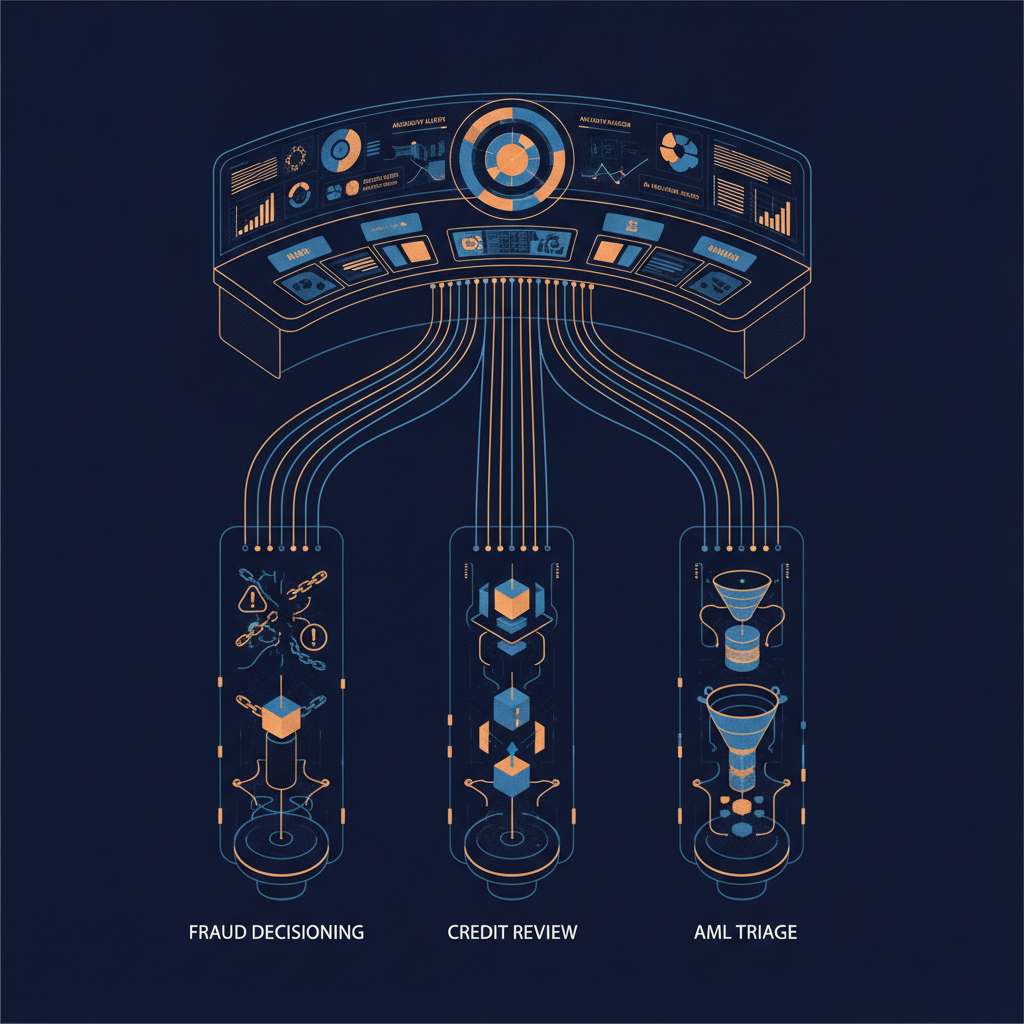
The initial marketplace launches with four Fiserv-built agents — Commercial Loan Onboarding, Daily Operational Analysis and Reporting, Agentic Deposit Intelligence, and Agentic AML Triage Analysis — plus nine third-party agent partners covering customer engagement, financial crimes compliance, deposit intelligence, regulatory compliance, dispute management, and reconciliation. Those nine are Arva, Cognext, iTuring.ai, Lumio, Osfin.ai, Sardine, Sierra, Tracfox, and Trulioo.
Six financial institutions co-developed the platform: First Interstate Bank and Boulder Dam Credit Union are running live pilots today. Salem Five, City National Bank, Bank OZK, and SouthState have deployments beginning this summer. Fiserv serves approximately 6,000 financial institutions total, with 3,000 running its core systems.
The pilot results are real. Boulder Dam Credit Union cut report generation from ten minutes to seconds using the daily operational analysis agent. First Interstate Bank is reducing manual data entry and cycle times in commercial loan onboarding. These aren’t demo numbers — they’re early production results from co-development partners who had direct input into what got built.
The Governance Layer Is the Product
Here’s the framing Dhivya Suryadevara, co-president of Fiserv, used in an interview: “We have kill switches. We have human in the loop on what agents are allowed to do and where you need to involve humans. Every single thing you can think about, from a regulatory and a banking perspective, on controls, we have embedded those into the platform.”
That sounds reassuring. Read it again from an architecture standpoint: “we have embedded those into the platform.” Not “we have given you the tools to configure those controls.” Not “we have published the policy interface so your governance team can define what agents are allowed to do.” The controls are embedded. By Fiserv.
This is different from, say, deploying an agent on AWS Bedrock AgentCore directly, where your team defines the trust boundaries, the tool scopes, the escalation policies, and the logging configuration. AgentOS abstracts all of that into a Fiserv-managed governance layer. That’s the product. The convenience is real. So is the coupling.
For a community bank or credit union with no AI engineering team, this is almost certainly the right tradeoff. They don’t have the capability to configure a governance layer correctly, and getting it wrong is far more dangerous than delegating it to a vendor with 6,000 institution clients and a regulatory track record. The math works.
For a mid-size regional bank or a bank with any meaningful AI maturity, the math gets complicated quickly. Policy enforcement that lives in a vendor release cycle is policy enforcement that changes on the vendor’s schedule, not yours. When Fiserv ships an agentOS update, your agents’ behavioral boundaries shift. Whether your change control process catches that shift depends entirely on how much visibility Fiserv gives you into what changed — and that’s a contractual question, not a technical one.
The Parallel to FIS and Anthropic
It’s worth noting that this is not an isolated move. FIS — Fiserv’s primary competitor in the core banking market — launched its Financial Crimes AI Agent with Anthropic earlier this month. BMO and Amalgamated Bank are deploying it. The two largest core banking software providers in the U.S. are both embedding AI agent infrastructure into their platforms in the same quarter.
What this signals is a broader dynamic: core banking vendors have figured out that the governance layer is the strategic leverage point in AI deployment for regulated institutions. A bank that deploys agents on Fiserv’s agentOS is not just buying AI capability — it’s tying its AI risk posture to Fiserv’s platform roadmap. The same is true for FIS. The core vendor who owns the governance layer owns the relationship.
This is the Palantir playbook applied to fintech infrastructure rather than professional services. Instead of forward-deployed engineers, it’s forward-deployed governance frameworks. The lock-in is structural rather than relationship-based, which makes it harder to quantify and easier to underestimate until you’re already embedded.
The Model Drift Problem Nobody Is Talking About
Carissa Robb, managing partner at SolomonEdwards, put the core operational risk well in a comment to American Banker: “The biggest risk is that agentic AI changes the scale and speed at which decisions can be made within a bank’s core system, creating new challenges around accountability, explainability and model drift. An AI agent may influence a decision, and a vendor may provide the model, but the bank owns the outcome from a regulatory perspective.”
The last sentence is the one that matters most. SR 26-2, the updated model risk management guidance from the Fed, OCC, and FDIC, explicitly holds the bank responsible for outcomes regardless of whether a vendor provided the model. If an agentOS-powered AML triage agent misclassifies a pattern of transactions, Fiserv is not the entity facing the examination. The bank is.
The governance controls embedded in agentOS help with the first-order risk — agents doing things they’re not supposed to do. The second-order risk is trickier: agents doing things they’re technically allowed to do but that produce outcomes that drift from policy expectations over time. “AI agents adapt over time, but without ongoing monitoring and validation, outputs can gradually become inaccurate or misaligned with policy expectations,” Robb said. “Because these agents interact directly with core systems, issues in one area can create downstream impacts across deposit operations, lending, compliance, and customer-facing functions.”
This is the quiet failure mode. Not a dramatic agent error that triggers a kill switch. A gradual drift in the commercial loan onboarding agent’s data classification logic that starts flagging slightly different document types, which produces slightly different risk scores, which produces slightly different underwriting outcomes over three quarters before an examiner notices the pattern diverges from policy. AgentOS has kill switches for the former. It’s not yet clear how it handles the latter.
The SuperML Take
The temptation in reading agentOS is to evaluate it as a product launch. Is the governance good enough? Are the agents useful? Is the pricing reasonable? Those are all fair questions, but they’re not the interesting question for enterprise architecture teams.
The interesting question is: what is the right model for who should own AI governance in a regulated financial institution?
There are three plausible answers. The first is that the bank owns it entirely — builds or configures its own governance layer on top of whatever AI infrastructure it uses, maintains its own audit trails, and keeps the vendor at arm’s length from any policy decision. This is the most defensible position from a model risk standpoint and the most operationally expensive. Most institutions don’t have the people or the tooling to do it well.
The second is what agentOS represents: the core vendor owns the governance layer, and the bank configures within the parameters the vendor exposes. This is pragmatic for a large slice of the market and will produce serviceable governance for most common agent use cases. The risk is that the bank’s ability to customize, audit, and validate independently is bounded by whatever interface Fiserv chooses to expose.
The third — which nobody has built yet — is a genuinely federated model where the bank defines its own governance policies in a portable, vendor-neutral format, and the vendor’s platform executes against those policies. The bank owns the policy plane; the vendor owns the execution plane. This would give you Fiserv’s operational convenience without the governance coupling. It’s also significantly harder to build and would require industry-level standardization on policy formats that doesn’t exist yet.
In the near term, agentOS wins on pragmatism. For the 5,000+ Fiserv clients who aren’t large enough to build their own governance infrastructure, this is almost certainly better than what they have today, which is typically pilots running without any formal governance at all. The pilot numbers are credible. The infrastructure is enterprise-grade. AWS Bedrock gives them multi-model flexibility that won’t trap them with a single AI provider even if they’re trapped with Fiserv at the governance layer.
But the six-to-twelve-month gap between the headline and reality is this: the governance layer that feels convenient today becomes a constraint the moment a bank’s risk appetite or regulatory requirements diverge from Fiserv’s product roadmap. That’s not a reason to avoid agentOS — it’s a reason to negotiate the contract very carefully before you deploy, and to make sure your model risk team understands exactly what they’re signing up for.
Architecture Impact
What changes in system design? Banking agent deployment now has a new architectural tier: the core-vendor-managed governance layer. Agent identity, policy enforcement, audit logging, and kill switches run inside Fiserv’s infrastructure rather than the bank’s own risk and compliance stack. This shifts agent governance from an independently configurable bank function to a vendor-mediated service, with all the tradeoffs that implies for flexibility, portability, and independent validation.
What new failure mode appears? Vendor-managed policy drift is the critical new failure mode. When Fiserv ships an agentOS update, agent behavioral boundaries change on the vendor’s release schedule, not the bank’s change control process. Banks may not have advance visibility into what policy changes a given release introduces, creating a window where agent behavior has shifted but the bank’s monitoring hasn’t caught up. This is distinct from the dramatic, catch-it-immediately failure that kill switches address — it’s the gradual, quiet drift that produces compliant-looking outputs with subtly wrong outcomes.
What enterprise teams should evaluate:
- Model risk teams: How agentOS audit trails map to SR 26-2 model documentation requirements, and whether vendor-managed logs constitute sufficient independent evidence for examiner review.
- Architecture and CTO: The lock-in surface area at the governance layer — what it would take to migrate agent governance to a different runtime or vendor in 18–24 months, and whether that exit path is contractually guaranteed.
- Compliance and legal: Who owns the explainability documentation when the policy layer is vendor-managed, and whether the bank’s independent validation capability is preserved or delegated.
- Procurement: SLAs for advance notice of agentOS policy updates, agent behavioral change logs, and what remedies exist when a vendor update produces outcomes that diverge from the bank’s risk policy.
Cost / latency / governance / reliability implications: The pilot results suggest genuine efficiency gains — report generation from 10 minutes to seconds, meaningful reduction in commercial loan onboarding cycle times — but Fiserv has not published latency SLAs or throughput benchmarks for agentOS in production. The governance implication is the more pressing concern: under SR 26-2, banks own regulatory outcomes regardless of vendor involvement, but if audit trails and policy logs are Fiserv-managed, independently documenting model behavior for examiners becomes a vendor dependency rather than an internal capability. On reliability, the shared AWS Bedrock infrastructure means a Fiserv platform issue takes down agent capacity across all clients simultaneously — a correlated failure risk that doesn’t exist when banks run their own agent infrastructure.
What to Watch
The key question over the next six months is how agentOS fares with its first full regulatory examination cycle. The pilot banks are community institutions; the first regional or large bank exam that touches agentOS-governed agents will tell us how examiners treat vendor-managed policy enforcement under SR 26-2. If examiners accept the Fiserv audit trail as sufficient, adoption will accelerate. If they require supplemental independent documentation, the governance burden shifts back to the bank and agentOS starts to look less like a solution and more like an additional dependency.
Watch also whether Fiserv publishes a policy interface specification — a documented, stable API for how banks can configure agent behavioral boundaries rather than relying on Fiserv’s embedded defaults. The absence of such a specification would confirm that the governance layer is primarily a product-controlled feature, not a bank-controlled capability. Its presence would suggest Fiserv understands the longer-term market pressure toward portable governance frameworks.
FIS and Anthropic’s financial crimes agent is already in deployment at BMO and Amalgamated Bank. If both major core vendors have comparable agent OS offerings live by Q3 2026, the question for community and regional banks stops being “should we deploy agent AI?” and becomes “which core vendor’s agent governance architecture do we trust more?” That’s a meaningful reframe — and one that most institutions’ model risk committees are not yet equipped to answer.
Finally, keep an eye on whether AWS Bedrock AgentCore’s multi-model flexibility is actually exposed to banks through agentOS, or whether Fiserv effectively gates model selection at the platform layer. The press release emphasizes model flexibility. The degree to which banks can actually swap underlying models, or bring their own fine-tuned models, without leaving the agentOS governance framework will reveal how much of the vendor lock-in is at the model layer versus the governance layer.
Sources
- Fiserv Launches agentOS: The Operating System for Agentic AI in Banking — GlobeNewswire, May 14 2026
- Fiserv has co-created AI agents with six banks and OpenAI — American Banker, May 14 2026
- Fiserv Forms Strategic Collaboration with OpenAI — GlobeNewswire, May 14 2026
- Anthropic Races OpenAI to Capture Banking’s Services Core — PYMNTS, 2026
- SR 26-2 OCC/Fed/FDIC Model Risk Management Guidance — Federal Reserve, April 17 2026
Enterprise AI Architecture
Want more enterprise AI architecture breakdowns?
Subscribe to SuperML.