Bank AI Agents Have No Kill Switch — and the Data Proves It
Wolters Kluwer's H1 2026 Banking AI Risk Index found 72% of banks lack kill switches or failure reporting for AI models — the minimum viable governance for agentic AI in production financial systems.

Table of Contents
There is a certain category of risk that only becomes visible after something catastrophic happens. Not because the warning signs weren’t there, but because everyone was too busy deploying to instrument the thing properly. Wolters Kluwer’s US Banking AI Risk and Governance Index for the first half of 2026 — released this week, based on 230 U.S. banking professionals across community, mid-size, and large institutions — puts a precise number on that category: 72%.
That’s the share of bankers who chose either the absence of model kill-switch protocols (34%) or the absence of regulatory reporting for AI failures (38%) as the area where their bank was least prepared on AI-related risk. Not behind on the roadmap. Least prepared. In production. Right now.
To put that in context: banks in 2026 are actively deploying autonomous AI agents into loan processing, collections and recovery, underwriting, operations, and customer service. The Wolters Kluwer survey is not asking about theoretical future deployments. It’s asking about the systems already running. And more than seven in ten respondents said they cannot confidently stop or report a runaway model in the environments where those agents are operating today.
If you’ve been around long enough to remember Knight Capital, you know exactly where this sentence is going. In August 2012, Knight accidentally reactivated a dormant trading algorithm during a deployment. Within 45 minutes, the firm had lost $440 million. The rogue program executed millions of mistaken trades — buying high, selling low — before anyone could stop it. The firm nearly collapsed. Sultan Meghji, CEO of technology consulting firm Frontier Foundry and former Chief Innovation Officer at the FDIC, made the analogy explicit: “Now imagine that failure mode in collections or credit decisioning, where the victims are consumers instead of market makers. An agent misclassifying accounts and initiating collections actions at machine speed isn’t a hypothetical — it’s the obvious next headline.”
What makes this harder than it looks is that the worst case isn’t actually the Knight Capital scenario. That’s the dramatic version — the one that generates headlines and consent orders quickly. The subtler version is what Meghji calls “the quiet disaster”: a drifting model making thousands of slightly-wrong, discriminatory or non-compliant decisions per day for months, invisible because nobody instrumented it. That ends in consent orders and restitution too, just on a longer timeline and with a larger population harmed.
Architecture Impact
What changes in system design?
Agentic AI fundamentally breaks the mental model that underpin conventional model governance. A traditional credit scoring model makes a prediction; a human or a rules engine decides what to do with it. An agent makes a prediction and takes an action, potentially triggering downstream actions in the same millisecond. The fan-out from a single bad agent decision can touch collections queues, customer notification systems, and third-party servicers before a kill switch could theoretically be pulled — if one existed.
The practical implication is that kill switch architecture for agentic deployments cannot be a single red button. As Sumeet Chabria, CEO of consultancy Thoughtlinks and former technology executive at Bank of America, put it: “It’s having a rehearsed, governed playbook: who has the authority, what the trigger is, what the fallback is, and who notifies the regulator and the customer.” A kill switch you’ve never tested in production is not a control. Chabria’s framing is correct: “The kill switch is the last line of defense. Good governance works upstream of it: enforcing AI’s actions in the path so the wrong model or data is never touched in the first place.”
What new failure mode appears?
The most dangerous failure mode surfaced by the survey isn’t the catastrophic visible failure — it’s silent saturation. Meghji notes that most institutions deploying AI today have no trip wires defining what “abnormal behavior” even looks like. Without behavioral baselines and anomaly thresholds, the switch would never get pulled until the damage was done. In a payments or fraud-screening pipeline, even briefly taking the agent offline without a fallback creates its own operational incident. Mature architectures need graduated controls: throttle, constrain, human-in-the-loop escalation, then full stop. The Knight Capital analogy breaks down at exactly this point — Knight had no graduated response either.
What enterprise teams should evaluate:
- Model risk and governance teams: Audit every agentic deployment for behavioral baseline documentation. If you can’t define what “abnormal” looks like for this agent in production, you don’t have a kill switch — you have a label.
- Platform engineering: Implement per-agent circuit breakers and action-rate throttles at the orchestration layer, not just at the model API level. A throttle that fires at 10x normal transaction velocity is worth more than a switch nobody’s authorized to pull.
- Third-party/vendor management: The survey’s Elaine Duffus (former CCO at Nationwide Financial, deputy CCO at M&T Bank) points directly at vendor contracts: “How much of a connection do you have with them, or is it set it and forget it?” Vendor AI agents need the same kill-switch and reporting obligations as in-house models.
- Compliance and legal: Collections and recovery deployments carry the highest risk profile per the survey (30%) and the fewest consumer protections relative to areas like credit underwriting. This is where the next consent order will originate if governance lags.
Cost / latency / governance / reliability implications:
Adding a graduated kill-switch architecture to an agentic deployment isn’t free. Throttle and constraint layers add 5–15ms to agent action latency — material for real-time fraud screening, negligible for collections workflows. The governance cost is higher: maintaining behavioral baselines, running kill-switch drills quarterly, and documenting fallback procedures adds roughly 10–20% to model maintenance overhead. The alternative — a consent order and mandatory restitution program — typically runs $50–200M for mid-size institutions.
Regulatory & Compliance Angle
The regulatory picture here is genuinely uncomfortable, and the discomfort is structural. The OCC released revised model risk guidance in April 2026 — SR 26-2, the successor to the 15-year-old SR 11-7 framework. It should have been the moment regulators caught up to the production AI reality in banking. Instead, SR 26-2 explicitly carved generative and agentic AI out of scope, designating them “novel and rapidly evolving.” The OCC issued a Request for Information (RFI) promising future guidance. The RFI is not guidance.
This means that the highest-risk AI deployments in banking — autonomous agents making real-time decisions in underwriting, collections, and fraud — are currently governed by frameworks written for static models with well-defined inputs and deterministic outputs. That is not a mismatch. It is a category error.
What this creates in practice is a two-track compliance environment. For traditional ML models, SR 26-2 provides a framework, however imperfect. For agentic systems, there is no framework, which means every bank is currently writing its own. Some are doing this thoughtfully; most are not. The survey data confirms it: 72% of respondents are unprepared on the most basic measures.
Regulators have said the right things at the level of principle — every bank needs a human accountable if an AI model fails, with the ability to step in and stop it. But “said the right things” and “provided enforceable guidance” are not the same. Elaine Duffus from Wolters Kluwer recommends banks look to the Financial Services AI Risk Management Framework, a collaborative effort of NIST and the Financial Services Sector Coordinating Council, as a practical reference while formal regulatory guidance catches up.
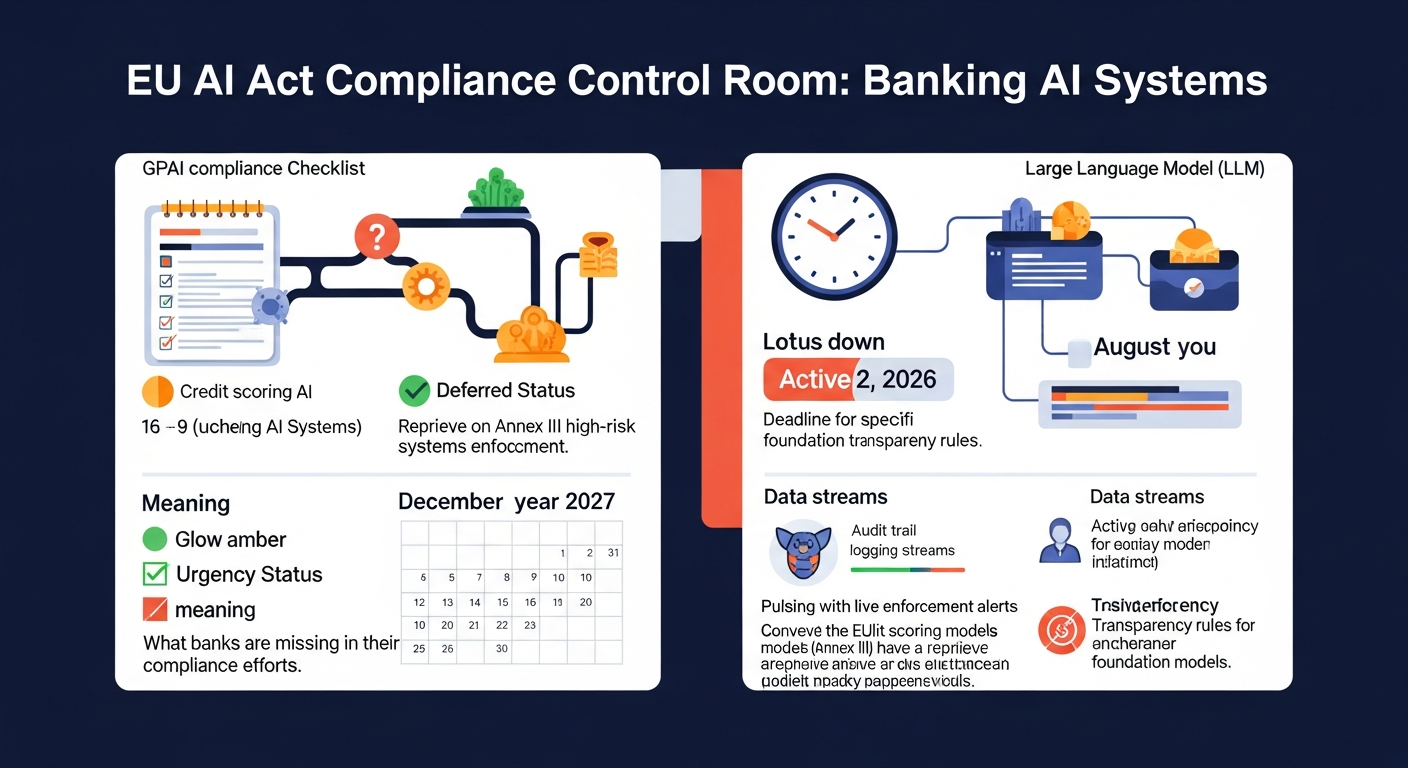
The EU AI Act, with its August 2026 deadline for high-risk AI systems, takes a stricter view. Credit scoring, loan processing, and collections automation all fall under Annex III high-risk categories. For banks with EU operations, the compliance gap the Wolters Kluwer survey identifies isn’t a future concern — it’s a current enforcement exposure. The EU Act requires documented human oversight mechanisms, audit trails, and conformity assessments for exactly the deployment categories where U.S. banks just told a survey they’re least prepared.
The forward view: the OCC/Fed/FDIC RFI on agentic AI will eventually produce formal guidance, likely in late 2026 or 2027. Banks that build their kill-switch and audit-trail architecture now — before the guidance lands — will have a structural compliance advantage. Banks that wait will be retrofitting governance into systems already running in production, which is the most expensive way to do it and the most likely path to findings.
The SuperML Take
The Wolters Kluwer number — 72% — is striking enough to make headlines, but the headline misses the actual problem. Kill switches are the symptom. The underlying disease is that banks have no operational definition of what “this agent is misbehaving” looks like for their specific deployment. You can’t pull a switch if you don’t know the switch needs pulling.
Think about what a collections agent actually does at scale: it generates messages, selects contact channels, determines timing, potentially modifies payment arrangements within policy parameters. Each of those decisions has a distribution of acceptable outputs. When the agent starts drifting — optimizing for a signal the business doesn’t actually want maximized, responding to a covariate shift in customer behavior, running on stale risk thresholds — that drift will look like normal traffic in every dashboard that isn’t specifically watching for it. The Wolters Kluwer survey found 38% of banks lack regulatory reporting of AI failures. That figure almost certainly understates the problem because many failures never get classified as failures in the first place — they accumulate quietly in customer complaints, regulatory referrals, and edge cases that get escalated manually.
The production-ready version of the kill-switch story isn’t “add a red button.” It’s “instrument behavioral baselines, set anomaly thresholds calibrated to the specific agent, test graduated response procedures quarterly, and ensure your vendor contracts create legal obligations — not just SLA language — around failure reporting.” That’s a 12–18 month program for most banks. The banks doing it now are the ones that treated the 2025 agentic AI deployment wave as a governance buildout, not just a feature launch.
There’s also a deeper architectural point worth naming. Chabria is right that governance must live upstream of the kill switch — but “upstream” in an agentic system is different from “upstream” in a traditional model risk context. In a static ML model, upstream governance means training data quality, feature selection, and model validation before deployment. In an agentic system, “upstream” is the orchestration layer: what tools the agent can call, what resources it can modify, what escalation paths exist, and crucially — what it cannot do regardless of what the model infers. Capability constraints baked into the agent’s tool access permissions are worth more than a kill switch in almost every scenario, because they prevent the failure mode rather than responding to it.
The question that should keep every head of AI governance in banking awake is not “do we have a kill switch?” It’s “would we know when to use it?” Based on the data, 72% of their peers would not.
Sources
- 72% of banks lack AI model ‘kill switches,’ failure reporting — American Banker, June 10, 2026
- Wolters Kluwer US Banking AI Risk and Governance Index H1 2026
- Financial Services AI Risk Management Framework — NIST / Financial Services Sector Coordinating Council
- SR 26-2: Interagency Guidance on Model Risk Management — OCC/Fed/FDIC, April 2026
- EU AI Act Annex III — High-Risk AI Systems in Financial Services
Enterprise AI Architecture
Want more enterprise AI architecture breakdowns?
Subscribe to SuperML.