FinCEN AML: 'Effective' Means AI Now. Nobody Built the Governance Yet.
FinCEN's NPRM comment period just closed — and its effectiveness-based AML standard implicitly rewards AI adoption. The problem: banks rushing to deploy AI for compliance credit have no model governance framework, and OCC examiners are already asking about it in every exam.

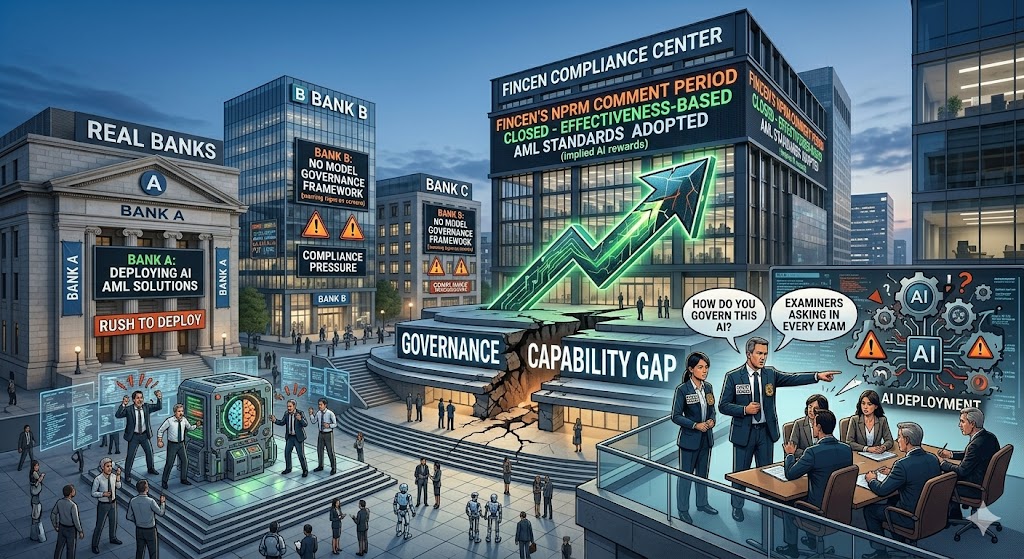
Table of Contents
On June 9, 2026, the public comment period closed on FinCEN’s Notice of Proposed Rulemaking to overhaul the U.S. AML/CFT framework. The industry response was predictable: compliance technology vendors immediately published guides on how to position AI adoption as evidence of program effectiveness. Law firms published memos. Banks formed working groups. Everyone agreed: the new effectiveness standard is an implicit green light for AI.
They’re not wrong. FinCEN’s NPRM, published April 7, explicitly names artificial intelligence in its enforcement considerations — institutions that use AI “in ways that demonstrably enhance program effectiveness” receive favorable treatment. The message is clear enough that you don’t need a lawyer to read it: build more effective programs, adopt AI to do it, document the outcomes.
What almost nobody is talking about is what happens next. OCC and Federal Reserve examiners are now embedding AI scrutiny into every routine bank examination — asking specifically about model validation, behavioral baselines, vendor chain documentation, and emergency shutdown mechanisms for AI systems. They are walking into institutions that just deployed AI-powered transaction monitoring to capture FinCEN’s compliance credit, and finding no documentation for how those models were validated, no baselines for detecting behavioral drift, and no framework for governing them. That’s not a future risk. It’s happening right now, and the banks most aggressively positioning themselves as “AI-forward” for AML are creating the largest examination exposure.
Regulatory & Compliance Angle
FinCEN’s April 7 NPRM is the most significant reform of the BSA framework in two decades. The old standard required banks to maintain four program pillars — internal controls, independent testing, a designated compliance officer, and training. Examiners evaluated whether those pillars existed and were documented. Whether the program actually caught financial crime was secondary. An institution could pass its AML examination with a near-zero productive SAR rate as long as its policy binder was organized.
The proposed rule replaces that entirely. Under the effectiveness standard, what matters is whether the program is actually detecting financial crime activity and reporting useful intelligence to law enforcement. FinCEN proposes measuring this through concrete outcomes: productive SAR rates, alert-to-SAR conversion ratios for high-risk categories, investigation closure time, and the degree to which the bank’s compliance decisions align with national AML priorities. Document your risk assessment, show that your monitoring systems are actually calibrated to catch the crimes you’re supposed to be finding, and demonstrate that your resource allocation follows the risk — not the other way around.
Where AI comes in is specific. The enforcement framework rewards “innovative activities that produce demonstrable outputs, including effective use of artificial intelligence and advanced monitoring tools.” FinCEN goes further, stating that “responsible experimentation” with new technologies adds no supervisory or enforcement risk from the use of the technology alone. This is deliberate: FinCEN is trying to break the decades-long pattern of banks avoiding ML adoption in AML because they feared examiner scrutiny of the models. The implicit message is that adopting AI — and demonstrating that it improved detection quality — is now a compliance asset, not a liability.
The problem is that the rule says nothing about how to govern the AI doing the detection. There is no requirement for ML model validation documentation, no specification for what constitutes adequate behavioral testing of a transaction monitoring model, no standard for how SAR narrative quality from an LLM should be assessed, and no threshold for what “demonstrably enhanced effectiveness” means when the detection system is a neural network rather than a static rule set. The NPRM gives banks a clear incentive to adopt AI. It gives them no framework for governing it.
This is not an accident — FinCEN is focused on outcomes, not technology. But the gap between the incentive structure and the governance expectations creates an operational trap that most compliance teams haven’t fully mapped yet. The final rule is still a rulemaking cycle away. By the time it is finalized — likely in late 2026 or early 2027 — institutions will have spent twelve months building AI-powered AML programs they cannot adequately document for examination purposes.
What the Examiner Will Find
The examiner walks into your bank in Q4 2026. AI is now a standing item on their examination playbook. The OCC and Federal Reserve made this explicit in June 2026: no bank review proceeds without a discussion of AI systems — what they are, how they are overseen, what constraints have been imposed on model behavior, and whether emergency shutdown mechanisms exist.
They are going to ask about your transaction monitoring system. If you upgraded from a rules-based platform to an ML-powered solution in the past twelve months — which many banks did specifically to position for FinCEN’s effectiveness standard — here is what they will look for and likely not find.
Model validation documentation. SR 11-7 and its successor SR 26-2 establish a framework for validating quantitative models: independent validation of conceptual soundness, outcome analysis, monitoring for drift. SR 26-2 explicitly carves out generative AI and agentic AI from its scope. Traditional supervised ML models used in transaction monitoring — gradient boosted trees, neural network anomaly detectors, entity resolution models — do fall within the scope of SR 26-2. If you deployed one of these without a formal model validation, you have an MRA waiting to happen. But the validation standards for these models were written for credit risk scoring, not for AML detection, and most model risk teams have not adapted their validation processes to cover typology coverage, entity resolution accuracy, or SAR narrative quality metrics.
Behavioral baselines and drift monitoring. A rule-based transaction monitoring system is static by design — you know what it does and can document it. A supervised ML model changes its effective behavior as data distributions shift. If your model was trained on 2023–2024 transaction data and the fraud typologies it saw then, it may have already drifted against current patterns without triggering any formal re-validation event. Examiners will ask: how do you know the model is still performing as intended? What is your baseline productive SAR rate? How often do you run outcome analysis? Most teams that rushed ML adoption for FinCEN positioning cannot answer these questions with documentation.
Vendor chain clarity. Many banks adopted third-party AI platforms rather than building their own. Examiners will want to know: what does the vendor’s model actually do? Can you get the model’s training data, feature set, and validation documentation from the vendor? Can you independently assess the model’s performance? Vendor lock-in is now an examination risk — the inability to independently validate a model you depend on for AML compliance is a control gap under any reasonable interpretation of SR 26-2.
SAR narrative quality for LLM-assisted drafts. If your analysts are using LLM assistance to draft suspicious activity report narratives — and many are, whether officially sanctioned or not — examiners will ask how you are ensuring the quality and accuracy of those narratives. FinCEN has specific format requirements for SARs, and a hallucinated or imprecise narrative from an LLM creates FinCEN reporting compliance exposure on top of the examination risk.
Kill switches and incident response. OCC examiners are specifically asking about emergency shutdown mechanisms for AI systems. The Wolters Kluwer survey published June 11 found that 72% of banks lack kill switches or failure reporting for AI. If your ML transaction monitoring system began flagging all transactions from a specific geography or demographic as high-risk due to model drift, how would you detect it and how quickly would you shut it down? The inability to answer this concisely is an examination finding.
The Governance Gap
The core issue is a structural mismatch between three regulatory signals that are operating simultaneously and pointing in different directions.
FinCEN is saying: effective programs are now the standard, AI is a path to demonstrably better effectiveness, adopt it responsibly and get compliance credit. The enforcement direction is clear: don’t hide behind process, show results, use technology.
The OCC and Federal Reserve are saying: AI is now in scope at every examination, we want to see governance, validation, kill switches, vendor documentation, and behavioral baselines. The examination direction is equally clear: deploy AI without governance and you will get findings.
SR 26-2, the actual model risk management framework, is saying: we cover quantitative models in credit scoring, market risk, and capital. We explicitly do not cover generative AI or agentic AI. We are issuing an RFI to figure out what guidance should look like for those systems. In the meantime, you are on your own.
The gap this creates is precise and dangerous. Traditional ML models used in transaction monitoring — the models you would deploy to satisfy FinCEN’s effectiveness standard — are technically within SR 26-2’s scope. But the validation standards in SR 26-2 were designed for credit risk models, not for AML detection systems. Applying champion-challenger testing to a fraud detection neural network is technically compliant but operationally meaningless without typology coverage analysis, entity resolution performance metrics, and outcome tracking against actual law enforcement actions. No bank has a fully adapted ML validation framework for AML, because the regulatory guidance to build it against doesn’t exist yet.
Meanwhile, the AI systems where the governance gap is most acute — LLM-assisted SAR drafting, agentic investigation workflows, generative alert triage — are explicitly outside SR 26-2’s scope. Banks can deploy an LLM to assist with every SAR their compliance team files, and there is currently no regulatory guidance specifying how that system should be validated, monitored, or documented. That absence is not safety. That absence is examination exposure for 2027, when the RFI responses have been reviewed and regulators start forming opinions about what they should have been doing.
The SuperML Take
FinCEN’s effectiveness standard is the right policy direction. Process-based AML compliance was a compliance theater that consumed enormous cost while failing to produce useful intelligence for law enforcement. Shifting the standard to outcomes — productive SARs, actual detection of financial crime patterns, resource allocation calibrated to actual risk — is long overdue.
But good policy direction and good implementation are different things. What FinCEN has created is a compliance incentive without a corresponding governance framework. The banks that respond fastest to the incentive — adopting AI to demonstrate effectiveness before the final rule — are also the banks most likely to be examined on AI governance they haven’t built before the governance guidance exists. This isn’t a hypothetical risk. OCC and Fed examiners are already in the room asking these questions.
The production-ready version of this story, for a model risk officer at a bank right now, looks like this: you have roughly 12 months between now and when a finalized FinCEN effectiveness rule would take effect. In that window, if you deploy ML for transaction monitoring or LLM assistance for SAR drafting without a validation framework adapted to those systems, you are making a bet that examiners won’t find the gap before your governance catches up. Based on what we know about how AI scrutiny is now embedded in every routine exam, that’s a losing bet.
The near-term architecture decision isn’t “should we use AI for AML.” It’s “can we demonstrate that our AI for AML is working and governed.” Those are different problems requiring different teams. The first is a technology procurement decision. The second requires model risk management that has adapted its validation standards to cover ML systems trained on transaction data, established outcome tracking frameworks against productive SAR rates, and documented vendor governance procedures for third-party AI platforms. Most banks have the first problem nearly solved and the second problem barely started.
There is also a specific risk in the timing. FinCEN’s proposed effective date is 12 months after the final rule is published. If the rule is finalized in late 2026, implementation is due in late 2027. But the examination scrutiny on AI governance is happening now, using existing supervisory authority and the OCC’s general safety-and-soundness power. Banks can face examination findings for inadequate AI governance today under existing frameworks, before the final FinCEN rule that incentivized the AI adoption even takes effect. This is the pincer: the incentive to adopt is here now, the governance expectation is here now, the regulatory framework to satisfy both doesn’t arrive until later.
If you’re on a model risk team at a bank, the immediate priorities are not complicated. Map every AI system touching AML compliance — transaction monitoring, alert triage, SAR drafting, entity resolution, risk scoring — and assess whether each has a formal model validation, a behavioral baseline, a drift monitoring procedure, and a documented shutdown procedure. That mapping exercise will surface gaps faster than any regulatory guidance update. Do it before the examiners do it for you.
Sources
- FinCEN Proposes Rule to Fundamentally Reform AML/CFT Programs — FinCEN.gov, April 7, 2026
- Federal Register: Anti-Money Laundering and Countering the Financing of Terrorism Programs — April 10, 2026
- Everything You Need to Know About FinCEN’s 2026 Proposed Rule — ComplyAdvantage, updated June 12, 2026
- FinCEN Proposed Rule on AML/CFT Program Requirements: Key Implications — Pillsbury Law
- U.S. Bank Regulators Scrutinize AI Use in Routine Bank Exams — QZ, June 12, 2026
- Bank AI Oversight Expands to Every Exam — TechTimes, June 13, 2026
- Model Risk Management: Revised Guidance (OCC Bulletin 2026-13) — OCC
- FinCEN Reform Puts AI at the Heart of AML/CFT Compliance — FinTech Global, April 23, 2026
- Sullivan & Cromwell: FinCEN and Certain Bank Regulators Issue Proposed Rules Reforming AML/CFT Program Requirements — Sullivan & Cromwell
Enterprise AI Architecture
Want more enterprise AI architecture breakdowns?
Subscribe to SuperML.