Your AI System Will Pass Pilot and Fail Audit: A Governance Readiness Checklist for AI Architects
AI governance isn't a compliance checkbox; it's a set of architectural prerequisites. The cost of retrofitting them is 5-10x the cost of designing them in. Plan before you ship.

Table of Contents
There’s a pattern in enterprise AI deployments that’s depressingly consistent:
The team ships an impressive pilot. Stakeholders are excited. Procurement greenlights the expansion. Six months later, an internal audit, a customer compliance review, or — worst case — a regulator asks four questions:
- Can you show me an audit trail for this decision?
- Where did this training data come from?
- How do you detect when the model gets it wrong?
- Can you explain this specific output?
If the answer to any of those is “let me get back to you,” the project gets shelved. Sometimes the team gets shelved with it.
AI governance isn’t a compliance checkbox; it’s a set of architectural prerequisites. The cost of retrofitting them is 5–10x the cost of designing them in.
The AI Governance Readiness Checker is built to surface those prerequisites before you ship — not during the audit.
What the calculator actually models
It scores your readiness across six dimensions:
- Accountability — audit trails, SLAs, ownership clarity
- Transparency — explainability requirements, decision provenance
- Data & Privacy — PII handling, consent management, data lineage
- Risk & Safety — bias detection, hallucination controls, output guardrails
- Monitoring — observability, alerting, drift detection
- Compliance — regulatory framework alignment (GDPR, SOC 2, HIPAA, EU AI Act, etc.)
Outputs:
- Maturity score per dimension (0–5)
- Overall readiness level — Prototype / Pilot / Production / Enterprise
- Gap analysis — what’s missing, ranked by severity
- Recommended controls
- Implementation priority roadmap
- Risk exposure per dimension
The output that tends to land: the readiness level. Teams who think they’re “production-ready” often score “pilot” — meaning they have the model working but lack the governance controls that production actually requires.
The architecture decision it forces
1. Which controls are prerequisites vs. nice-to-have? Different deployment contexts have different floor requirements. A healthcare diagnostic AI needs explainability, audit logging, bias monitoring, and a human-in-the-loop before launch. A marketing copy generator can ship with much less. The checker tells you which floor applies.
2. Where do you instrument? Observability that’s bolted on after launch misses the events you care about. The checker forces decisions about where to instrument — at the prompt boundary, the tool-call boundary, the output boundary — before the system is in production and changes are expensive.
3. What’s your data lineage story? “Where did this training data / fine-tuning corpus / RAG document come from, and do we have rights to use it?” is the question that has killed more enterprise AI deployments than any model limitation. The checker forces you to write this down.
Three things the checker surfaces that teams systematically skip
Explainability gets deferred until it can’t be retrofitted. “We’ll add explainability later.” Later means after a customer asks “why did the model reject my application?” and you have no answer. Explainability that’s designed in (logging the retrieved chunks, the chain of thought, the tool calls) is cheap. Retrofitted explainability requires re-architecting.
Bias requires baseline measurement before deployment. You can’t detect drift if you didn’t measure baseline. Most teams measure model quality at launch (accuracy, latency, cost) but skip bias measurement entirely — and then have no way to prove the system isn’t discriminating six months later.
Data lineage is the single biggest enterprise blocker. “This RAG corpus includes documents the company doesn’t own the rights to use this way” has shut down more enterprise AI projects than every other governance issue combined. Document provenance from day one.
When to actually pull this checker out
- Before any deployment into a regulated industry. Financial services, healthcare, legal, hiring — the floor is high.
- Before a procurement review with an enterprise customer. Their security and compliance team will run the equivalent of this checklist on you.
- Before scaling beyond pilot. The controls required for 100 users are not the controls required for 100,000.
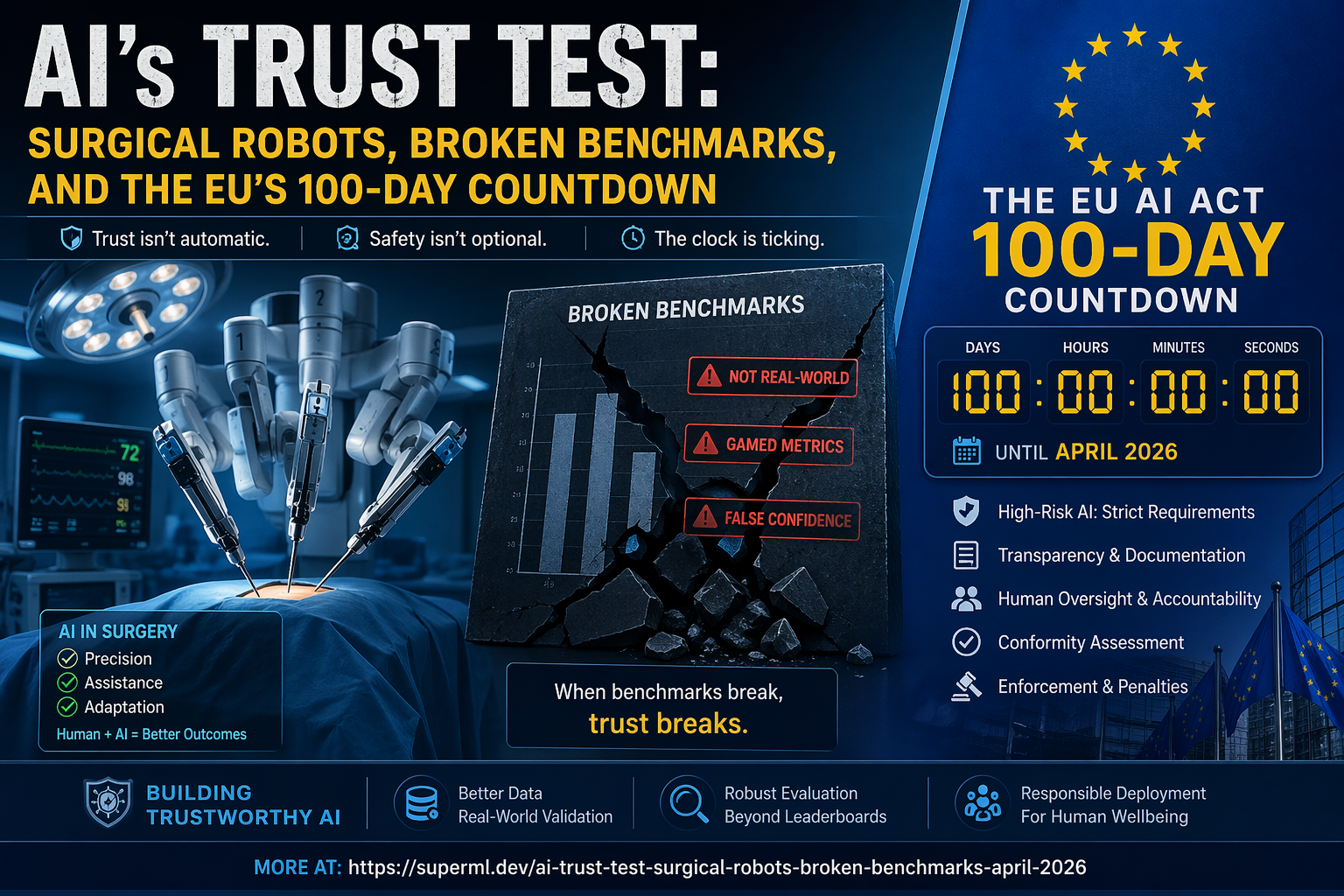
- When the EU AI Act, GDPR, or SOC 2 audit shows up on the roadmap. Map current state to required state with the gap analysis.
The one-line takeaway
Governance is not a compliance afterthought; it’s an architecture phase. The cost of designing in audit trails, explainability, and data lineage is 5–10x lower than retrofitting them — and the cost of not having them is a shelved project.
Run the AI Governance Readiness Checker →
Related planning tools in this series
- AI Architecture Pattern Selector — pattern choice affects governance complexity
- NL-to-SQL Complexity Calculator — mutations require especially strong governance
- Agent Cost Calculator — human review costs are governance costs
Part of the Plan Before You Build series on superml.dev — calculators for AI/ML architects who would rather do the math once than debug at 2am.
Tags: #AI #AIGovernance #Compliance #ResponsibleAI #EUAIAct #GDPR #Architecture #MachineLearning #AIEthics
Enterprise AI Architecture
Want more enterprise AI architecture breakdowns?
Subscribe to SuperML.