
'We Should Self-Host' Is the Most Expensive Decision in AI: When It's Actually Right
GPU self-hosting wins on dollars-per-token at scale, but the break-even is almost always 5-20x higher than teams estimate — because they forget power, utilization, ops headcount, and quantization quality loss.

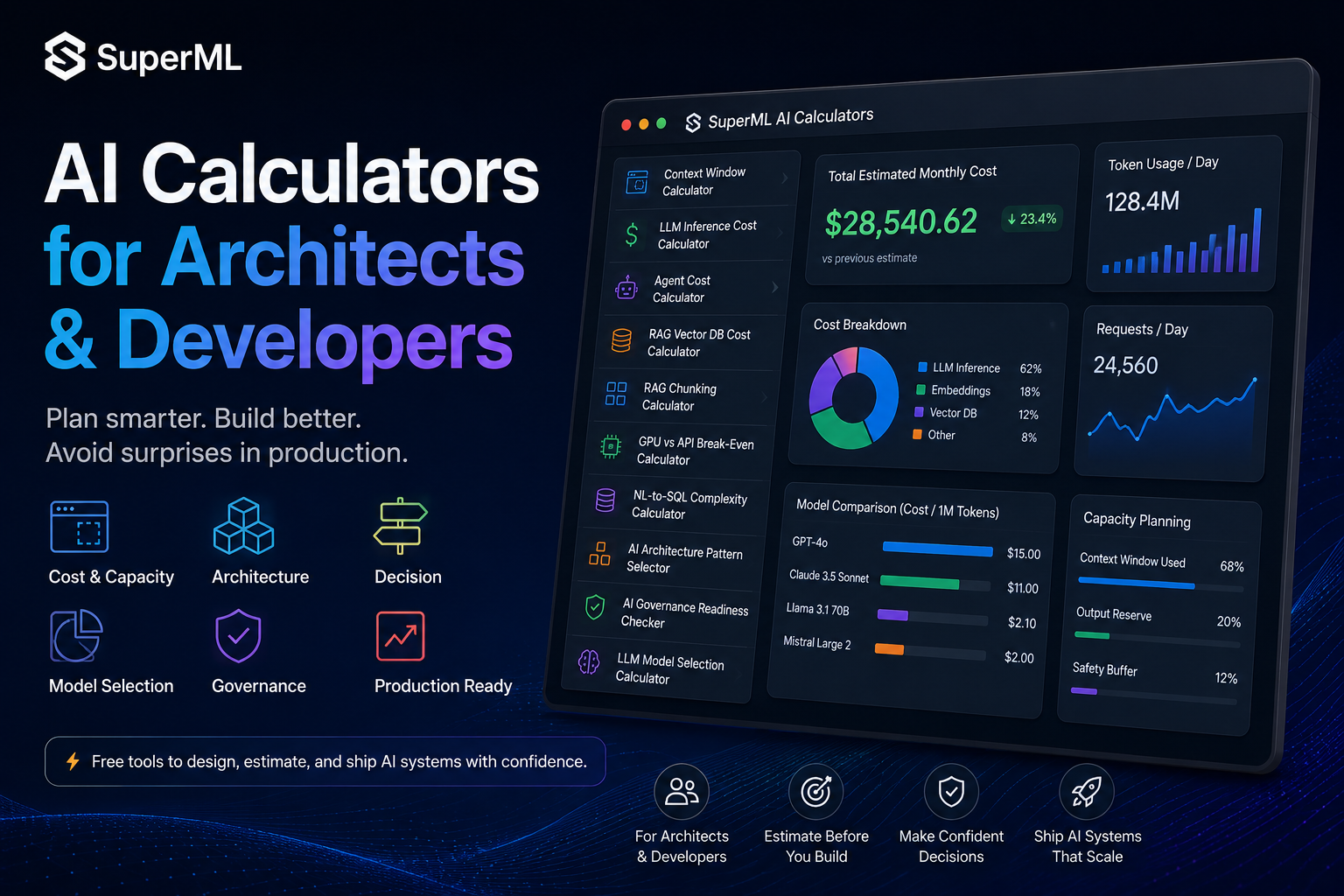
Table of Contents
Every six months, someone in the company looks at the OpenAI invoice and says “we should just buy GPUs.”
Sometimes they’re right. Most of the time they’re three months too early and $400,000 too aggressive.
GPU self-hosting wins on $/token at scale, but the break-even volume is almost always 5–20x higher than the team estimates — because they forget power, utilization, ops headcount, and quantization quality loss.
The GPU vs API Break-Even Calculator is built to answer one question honestly: at what monthly inference volume does owning beat renting?
What the calculator actually models
Inputs:
- Monthly inference volume (tokens or requests)
- Average tokens per request
- GPU hardware cost (purchase or lease, plus amortization period)
- Infrastructure cost — power, cooling, networking, rack space
- API cost per token at your current provider
- Expected GPU utilization — the make-or-break input
- Quantization strategy — int8, fp8, fp16
Outputs:
- Monthly GPU operating cost
- Monthly API cost at the same volume
- Break-even volume — the QPS or token-per-month at which GPU becomes cheaper
- Payback period — months to amortize the upfront capital
- Sensitivity analysis — how the answer shifts if your utilization assumption is wrong
The sensitivity table is the part that changes minds. A break-even calculation at 80% GPU utilization looks great. The same calculation at 35% utilization (the real-world average for unbatched inference) looks awful.
The architecture decision it forces
1. Is your volume actually steady? GPU economics assume continuous, predictable throughput. If your traffic is spiky — 10x peak vs. trough — your effective utilization is the average, not the peak. The break-even moves higher.
2. Can you batch? A single GPU running batched inference at batch size 32 produces 5–10x more tokens/$ than the same GPU running one request at a time. If you can’t batch (latency-sensitive applications), the GPU math gets much worse.
3. Will you actually run quantized? fp16 → int8 quantization reduces memory 4x and lets you serve more requests per GPU, but introduces 1–3% quality regression on most models. If your application is quality-sensitive, you can’t quantize, and your GPU economics suffer accordingly.
4. Do you have the headcount? A self-hosted GPU stack needs an ML ops engineer to keep it healthy. At $200K fully-loaded, that’s $16K/month of headcount you have to attribute to the GPU strategy. Most teams forget this entirely.
Three things the calculator surfaces that teams miss
Power is 2–3x the hardware amortization. At $0.12/kWh, an H100 server pulls $400–600/month in electricity alone. Add cooling overhead (PUE 1.5–1.8) and you’re at $800–1,000/month before you’ve amortized a single dollar of the $30K hardware. Co-location pricing reflects this.
Utilization is the lie everyone tells themselves. “We’ll keep the GPU at 80% utilization.” No, you won’t. Production traffic has off-hours, weekly cycles, and feature-driven spikes. Realistic 24/7 utilization is 30–55% for most workloads. Plug that in and watch the break-even volume jump.
Quantization is a real architectural choice, not a free optimization. The calculator forces you to make the quantization decision explicitly. A model that needs full-precision because of brittle structured output requirements does not have the same economics as one that can run int8.
When to actually pull this calculator out
- When the API bill crosses six figures monthly. Below that, the engineering cost of self-hosting is almost never worth it.
- Before signing a multi-year API commitment. A 3-year API contract may be more or less than a 3-year amortized GPU lease — model it.
- When the workload is batchable and steady. Embeddings, document processing, batch summarization — these are the workloads where GPU wins early.
- When data residency or latency requires self-hosting regardless. In that case, the calculator tells you what the premium over API is — useful for setting expectations.
The one-line takeaway
Self-hosting AI is not a cost decision; it’s an operational commitment. The break-even calculator forces you to price the commitment honestly — power, ops headcount, quantization trade-offs, real utilization — before you sign the capex.
Run the GPU vs API Break-Even Calculator →
Related planning tools in this series
- LLM Inference Cost Calculator — establishes your current API spend
- LLM Model Selection Calculator — which model class needs hosting in the first place
- Agent Cost Calculator — agentic workloads usually argue against self-hosting
Part of the Plan Before You Build series on superml.dev — calculators for AI/ML architects who would rather do the math once than debug at 2am.
Tags: #AI #LLM #GPU #SelfHosting #FinOps #Architecture #MachineLearning #Inference #NVIDIA
Enterprise AI Architecture
Want more enterprise AI architecture breakdowns?
Subscribe to SuperML.