
Tracing Isn't Evals: The Agent Reliability Gap
Most enterprise agent teams have full tracing but no evaluation loop — and that gap, not the model, is why production accuracy runs 20+ points below benchmark.

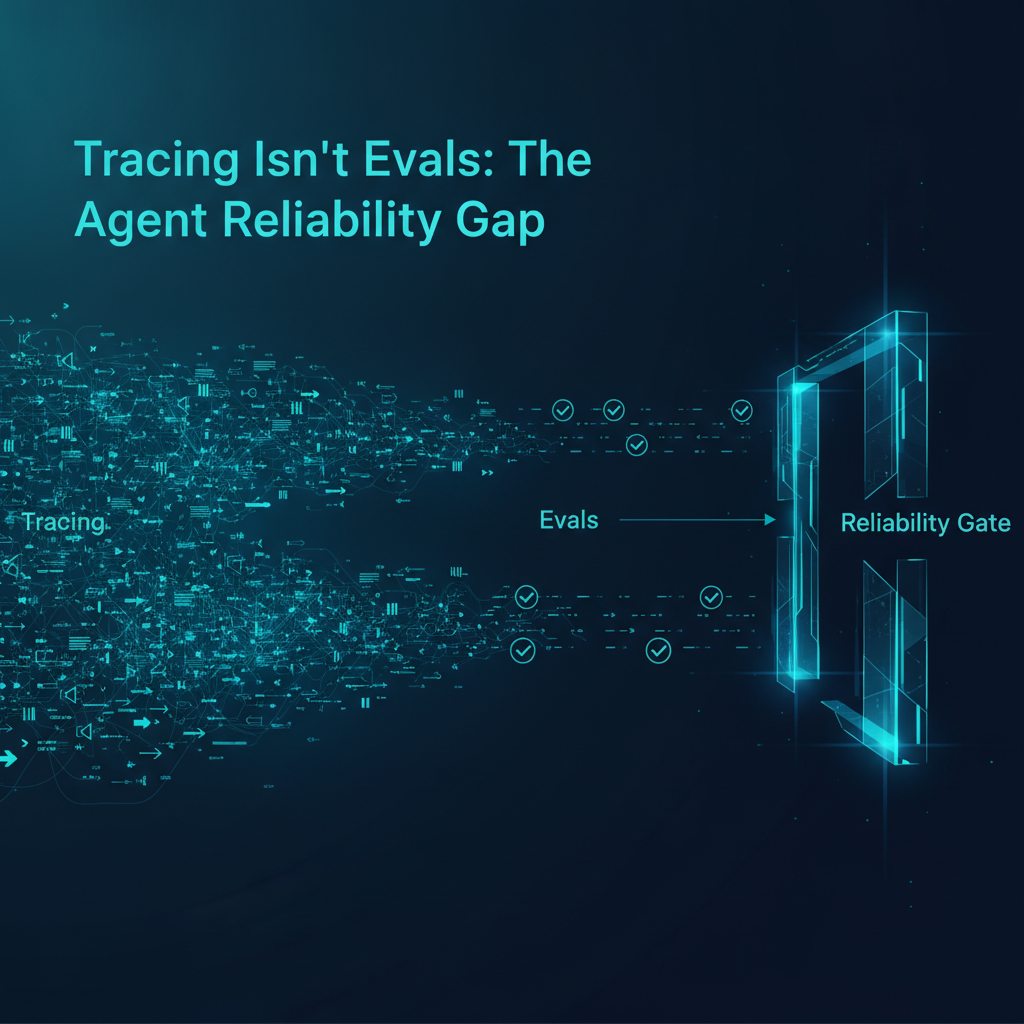
Table of Contents
Your agent passes its benchmark suite at 91%. Three weeks into production, a stakeholder asks why it just called the wrong tool with a plausible-looking but wrong parameter, and nobody on the team can answer with more than “we’ll look at the trace.” You look at the trace. It tells you exactly what happened — which tool, which arguments, which model response — and nothing about whether that pattern is common, whether last week’s prompt change made it more or less frequent, or whether the fix you’re about to ship will make it worse somewhere else. This is the moment most teams running agents in production hit in 2026: full visibility into individual runs, and no system for knowing whether the agent, in aggregate, is getting better or worse.
That gap has a name now, and it has numbers attached to it. LangChain’s 2026 State of Agent Engineering report, one of the more widely cited practitioner surveys of the year, found that 89% of teams building production agents have adopted observability or tracing, while only 52% have adopted evaluations. Separately, an industry analysis covering 1,247 production agents across 89 organizations found that task accuracy drops from 91.3% in benchmark testing to 67.8% in production — a 23.5 percentage point gap — with tool call correctness falling from 94.1% to 71.2% and policy compliance from 96.7% to 78.4%. The pattern held across model providers; the report described reliability as an industry-wide plateau, not a vendor-specific weakness. Tracing tells you an agent is failing. It does not, by itself, tell you why the failure rate is what it is or whether your last change moved it up or down. That’s an evaluation problem, and most teams have not built the infrastructure to solve it.
Why Tracing Alone Plateaus
Tracing and evaluation solve different problems, and it’s worth being precise about the difference because the confusion is exactly what produces the gap. A trace is a record of one execution: this input, these tool calls, this output, this latency. It’s essential for debugging a specific incident and for building intuition about what an agent does. What it cannot do is answer an aggregate question — “across the last 10,000 production interactions, did accuracy go up or down after we swapped the retrieval index” — because a trace store is not organized around repeatable, scored comparison. Teams that stop at tracing end up with excellent forensics and no regression detection. Every incident gets explained after the fact; nothing gets predicted or prevented before the next release.
Evaluation closes that loop by converting traces into a labeled, scored dataset that a candidate change can be run against before it ships. The building blocks aren’t exotic: structural checks (was the correct tool invoked, with parameters inside expected ranges), reference-based checks (does the output cover the facts a rubric requires), and model-graded checks (does an independent judge model rate the response acceptable). None of these alone produces a trustworthy signal — structural checks miss semantic errors, reference checks miss tone and completeness, model-graded checks introduce their own noise — but the combination, run against a growing set of real production cases, is what lets a team say “this change is safe” instead of “this change looked fine when I tried it twice.”
Where the 23-Point Gap Actually Comes From
The benchmark-to-production drop isn’t random variance; the incident data points at specific, recurring mechanisms. Twenty-two percent of tool-related incidents in the 89-organization dataset involved tool output that was structurally valid but semantically wrong — a search API returning stale results, a database query matching the wrong schema after a migration, a weather service returning a timestamp in the wrong timezone. None of these trip a schema validator. All of them silently corrupt the agent’s next reasoning step. Thirty-eight percent of incidents involved a tool failure the agent didn’t handle gracefully at all — it either retried into a loop, propagated a null value downstream, or fabricated a plausible answer rather than surfacing the failure.
Both failure classes share a root cause: benchmark suites are curated, and production traffic is not. A benchmark’s tool responses are well-formed because someone built the benchmark that way. Production tool responses come from live upstream systems that drift, time out, get migrated, and occasionally lie about their own correctness. An agent tuned against curated inputs has never seen the shape of a semantically-wrong-but-structurally-fine response, so it has no learned behavior for catching one. This is precisely the class of error that tracing will show you after the fact and that only a production-trace-derived eval set will let you catch before the next release.
Architecture Impact
What changes in system design? The eval layer becomes a first-class pipeline stage, not a pre-launch checklist item: production traces feed a curation step that promotes notable failures and near-misses into a labeled regression set, and every prompt, model, tool, or retrieval-index change runs against that set before it reaches any real traffic. This requires a data path from your tracing store into your eval harness that most teams currently don’t have wired up — tracing and evals are usually built as separate tools by separate teams on separate timelines.
What new failure mode appears? Without this loop, teams accumulate “silent regression debt” — each individual prompt or model swap looks fine in ad hoc testing, but the aggregate production accuracy erodes release over release with no single change implicated. A second failure mode is eval-set staleness: a team builds an eval set once at launch, never refreshes it from new production traces, and it stops reflecting the current input distribution within a few months, giving false confidence on every subsequent change.
What enterprise teams should evaluate:
- Platform/MLOps: whether the tracing stack (OpenTelemetry GenAI conventions, LangSmith, or equivalent) can export failure cases directly into an eval dataset format, rather than requiring manual re-authoring
- Agent engineering leads: what percentage of the current eval set was derived from real production traces versus hand-written or synthetic cases, and how stale that set has become
- Risk/compliance: whether policy-compliance checks run as part of the pre-release eval gate or only as post-hoc audit, given the reported 18.3-point compliance drop between benchmark and production
Cost / latency / governance / reliability implications: Model-graded evaluation adds real inference cost — running an independent judge model across a growing regression set on every candidate change is a recurring line item, not a one-time expense, and teams should budget for it the way they budget for CI compute. The governance payoff is direct: a policy-compliance eval gate that runs before release is measurably cheaper than the incident response and disclosure costs of a compliance failure discovered in production, particularly under the EU AI Act’s model validation and drift-monitoring expectations that took effect in August 2026.
Implementation Guide
Start by wiring a single, narrow pipeline: take your existing trace store, sample a few hundred real interactions weekly, and route the ones with negative feedback signals — explicit thumbs-down, escalations to a human, retries, or tool errors — into a candidate eval queue. Don’t try to build a comprehensive eval suite on day one; build the mechanism that turns a real failure into a labeled test case, because that mechanism is the actual missing piece, not the initial dataset size. A team of two engineers can have this running against a few hundred cases within a couple of weeks if the tracing infrastructure already exists, which for most teams in 2026 it does.
The mistake to avoid is treating eval-set construction as a one-time project ahead of launch. A static benchmark, however well built, degrades the moment your product, your tool integrations, or your user base shifts — which for an actively used agent is continuously. The other common mistake is over-indexing on a single evaluation method. Structural checks alone will pass an agent that calls the right tool with subtly wrong arguments; model-graded checks alone will pass an agent that sounds right but skipped a required fact. Use at least two of the three check types (structural, reference-based, model-graded) on every case, and treat disagreement between them as a signal worth investigating rather than noise to average away.
You’ll know the loop is working when two things happen: incident postmortems start referencing “this exact failure is now case #214 in the eval set” instead of “we’ve patched this specific instance,” and your team can state, with a number, whether the last three releases moved aggregate accuracy up or down. If neither of those is true six months after standing up tracing, the observability investment is producing dashboards without producing improvement — which is the exact pattern the LangChain data describes at industry scale.
The 6-to-12-month maturity path looks like staged rollouts becoming the default deployment mechanism for agent changes: every change runs against the eval set, then shadows live traffic, then ships to a small percentage of real users with defined quality thresholds that must hold before a full ramp. Teams that reach this point stop treating model and prompt updates as casual edits and start treating them as deployments with gates, the same discipline already applied to any other production system that touches customers. That’s the point at which the benchmark-to-production gap stops being a mystery each release cycle rediscovers and becomes a monitored, bounded number the team actively manages down.
Sources
Enterprise AI Architecture
Want more enterprise AI architecture breakdowns?
Subscribe to SuperML.