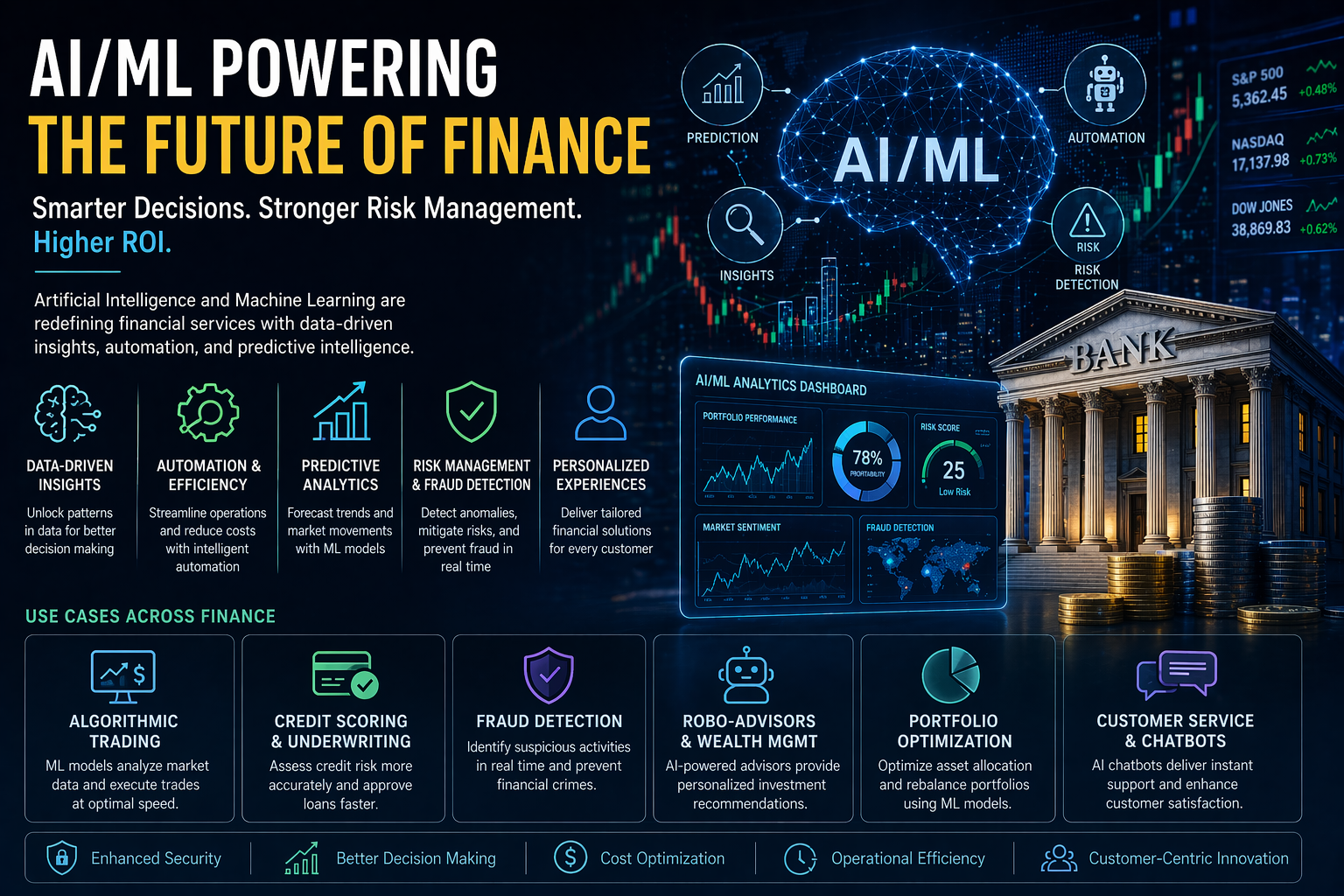
AI Rewires Banking: CAO Leadership, Stablecoin Rails, and RegTech Shift
HSBC appoints its first Chief AI Officer, Comply ships the first agentic compliance platform via MCP, stablecoins quietly become the settlement layer for AI agents, and six banks cut 15,000 jobs while booking record profits. Finance's AI restructuring is no longer a roadmap — it's happening now.

Table of Contents
Banking Transformation Signals from April 2026 AI Moves
Analyze how leadership changes, payment infrastructure, and compliance automation are combining into a structural shift in banking technology stacks.
If you’ve been watching AI land in finance for the past few years, you might have noticed a shift in tone. We went from “we’re exploring AI” (2023) to “we have several pilots” (2024) to “we’re scaling AI across the enterprise” (2025). But what happened in the past few weeks is different again. The language has changed from scale to structure. Banks aren’t just deploying AI — they’re reorganising their institutions around it.
Four stories from this week illustrate exactly what that looks like at the sharp end.
HSBC Names Its First Chief AI Officer — and It Matters More Than the Title Suggests
On April 1, 2026, HSBC quietly made history. The bank named David Rice as its first-ever Chief AI Officer, expanding CTO Mario Shamtani’s role simultaneously to accelerate platform modernisation. The move was widely covered as an HR story. It’s actually a governance story.
When a bank with $3 trillion in assets and operations in 60 countries decides it needs a C-suite executive solely responsible for AI, it’s not signalling ambition — it’s acknowledging that AI decisions now carry enough operational, regulatory, and reputational weight to require board-level ownership. The CAO role sits at the intersection of model risk management, EU AI Act compliance, IT architecture, and business unit enablement. It’s the job you create when “let each division figure it out” stops working.
HSBC’s specific remit for Rice is building a central AI platform that gives all employees access to foundation models, while ensuring the bank doesn’t simultaneously violate DORA, the EU AI Act’s high-risk provisions, and its own internal model risk policies. That’s not a technology project. That’s an institutional rewiring.
HSBC isn’t alone. Citigroup’s CEO Jane Fraser announced an investor day on May 7 dedicated entirely to the bank’s AI strategy — a first. Morgan Stanley’s Ted Pick spent meaningful time on the Q1 earnings call discussing AI’s role in the bank’s cybersecurity resilience. Goldman Sachs’s David Solomon has publicly framed the bank’s deployment of Cognition’s Devin AI engineer as a core productivity strategy, not an experiment. The pattern is consistent: AI has climbed high enough in the institutional stack to require executive accountability, not just departmental ownership.
The HSBC appointment also carries a regulatory subtext. The EU AI Act’s enforcement clock — August 2, 2026, now less than 100 days away — requires designated human oversight for high-risk AI systems. Credit scoring, fraud detection, insurance underwriting, and employment-related AI tools all fall in Annex III high-risk categories. Having a named executive with a dedicated mandate isn’t just good governance; in the post-August regulatory environment, it may become table stakes for operating in the EU financial market.
RegTech’s iPhone Moment: The ComplyAI MCP Server
On April 23, 2026, Comply launched the ComplyAI MCP Server — and unless you’re deep in financial services compliance, you probably missed it. You shouldn’t have.
Here’s the background. Comply is a RegTech platform that handles policy management, pre-clearance, conflict checks, and regulatory change tracking for financial institutions. It’s the kind of software that the compliance team uses intensively and nobody else ever touches. Now, Comply has wrapped its entire compliance intelligence layer into a Model Context Protocol (MCP) server — making it callable by any AI assistant that supports the MCP standard.
What does that mean in practice? A compliance officer can connect the ComplyAI MCP server to Claude, Microsoft Copilot, or ChatGPT and then build a “morning briefing agent” that pulls open pre-clearance requests, certification gaps, and regulatory alerts — automatically, every morning, delivered to Slack. No developer. No IT project. No six-month implementation.
Or they can build a “policy guidance agent” where advisors ask plain-English questions like “can I trade AAPL while my client has that position?” and receive instant, firm-specific answers grounded in the firm’s actual approved policies — not a generic legal disclaimer.
Or an onboarding agent that walks new hires through the code of ethics, collects attestations, and flags exceptions for review.
This is genuinely significant, and here’s why: compliance has historically been the most difficult area of financial services to automate, precisely because it requires deep contextual knowledge of the firm’s specific policies, its regulatory obligations, and the intersection between them. General-purpose AI can’t do that without that context. Comply’s MCP server provides the context programmatically. The AI does the reasoning and drafting. The compliance officer reviews and approves.
The ComplyAI MCP Server hits general availability in May 2026. Comply is calling it the first enterprise-grade MCP server specifically for financial services compliance, and having watched the MCP ecosystem grow from a few thousand servers to over 5,800 in a matter of months (recently adopted into the Linux Foundation’s Agentic AI Foundation), that timing feels intentional. When your protocol becomes an industry standard, the compliance use case — with its deep integration requirements and heavy domain knowledge dependency — is exactly where differentiation lives.
For context on why this is the iPhone moment analogy: pre-iPhone, the mobile internet existed but required a developer for every interaction. The iPhone made it direct. Pre-MCP-enabled RegTech, compliance agents existed but required a developer to connect every data source. The ComplyAI MCP Server makes it direct. Compliance officers build their own agents.
Stablecoins Are Quietly Becoming the Payment Rail for AI Agents
Here’s a question nobody in AI is asking loudly enough: when an AI agent needs to pay for something — an API call, a supplier invoice, a contractor’s hourly rate — how does it actually move money?
Credit card rails require human authorisation or at least a pre-registered card. Wire transfers have cutoff times and manual review thresholds. ACH takes days. None of these are designed for autonomous machine-initiated transactions at millisecond latency.
Stablecoins are.
The GENIUS Act — signed into law in 2026 after clearing the Senate — defines stablecoins issued by permitted issuers as payment instruments, not securities. That legal clarity has unlocked a wave of institutional adoption. Combined stablecoin market capitalisation now sits at $283 billion, roughly three times its 2023 level. USDT and USDC together command $260 billion of that. On April 23, 2026, CME Group announced plans to issue its own stablecoin, marking the first derivatives exchange to enter the space directly.
But the really interesting development isn’t the market cap number — it’s the architectural convergence happening between stablecoins and AI agents.
When you connect an agentic AI system to a stablecoin wallet, you get machine-to-machine settlement: an agent can pay another agent, an API endpoint, a supplier’s treasury, or a downstream contractor instantly and programmatically, without credit card authorisation, without wire cutoff times, without human in the loop for routine transactions under a threshold.
This is what “agentic finance” actually looks like at the plumbing level. Not a bank chatbot that answers questions about your balance. An autonomous finance stack where:
- An AI agent evaluates a supplier invoice
- Cross-references it against the contract terms in its context window
- Confirms delivery via a connected logistics API
- Initiates payment in USDC in under 500 milliseconds
- Logs the transaction to the firm’s compliance ledger automatically
The x402 payment protocol — a nascent standard being built specifically for HTTP-native stablecoin payments — is designed to make this flow as simple as an API call. Early adopters in enterprise procurement, content licensing, and B2B SaaS are already piloting it.
The finance industry’s traditional response to any new payment rail is caution, regulation, and more committees. The GENIUS Act has short-circuited that cycle for stablecoins. The race now is among banks, fintechs, and crypto-native players to build the custody, compliance, and KYC infrastructure that enterprises need before writing their agents a stablecoin wallet.
The 15,000-Person Equation: What Record Profits and Record Layoffs Tell You
Let’s address the most visible dimension of this week’s finance-AI news. Six US banks — JPMorgan, Citi, Bank of America, Goldman Sachs, Morgan Stanley, and Wells Fargo — collectively cut approximately 15,000 jobs in Q1 2026, while simultaneously reporting roughly £35 billion in aggregate profit, one of the strongest first quarters on record.
Bank CEOs spent years insisting that AI would augment workers, not replace them. That message has quietly shifted. On Q1 earnings calls, executives at all six banks credited AI directly with productivity improvements that enabled the headcount reductions. The affected roles skew heavily toward back-office operations: compliance data processing, KYC verification, report generation, regulatory filings, customer service tier-one support, and code review.
Citigroup provided a particularly striking data point: among those cut were employees who had been part of the bank’s internal “AI Champions and Accelerators” program — people whose job was partly to help colleagues adopt AI. They were automated by the same technology they were evangelising.
The profit-layoff paradox is the key structural signal: if banks can cut 1% of headcount while growing profits at record rates, the incentive structure for 2026 and 2027 points in one direction. Goldman’s David Solomon has publicly cited 3-4x developer productivity improvements from Cognition’s AI engineers. If that ratio is directionally accurate even at half the magnitude, the financial services sector is running a controlled experiment in what happens when you replace a large fraction of knowledge work with AI-augmented smaller teams.
This isn’t a story about AI being cruel or corporations being greedy. It’s a story about what happens when automation genuinely reaches the productivity threshold where the cost-of-labour calculation flips. The Federal Reserve’s own April 2026 framework paper on AI and financial stability flagged “labour market displacement at scale” as one of the macro feedback loops that warranted monitoring, alongside model monocultures and algorithmic herd behaviour. The Fed is not usually in the business of dramatic statements. The fact that labour displacement appears in a financial stability paper is a flag worth noting.
The Architecture Underneath It All
Taken together, these four stories describe a single underlying shift: AI is transitioning from a feature layer — bolted onto existing bank infrastructure — to the operating layer that bank infrastructure runs on top of.
The HSBC CAO appointment reflects the governance realignment that transition demands. When AI is a feature, you manage it like software. When AI is infrastructure, you manage it like risk — with executive accountability, board-level reporting, and dedicated regulatory liaison.
The ComplyAI MCP Server reflects the tooling realignment. Compliance, the domain most resistant to automation because of its dependency on institutional context, is now buildable by non-developers using agentic AI and MCP tooling. The walls between “software people” and “domain people” are dissolving.
The stablecoin settlement layer reflects the payment infrastructure realignment. AI agents need to transact autonomously. Legacy payment rails weren’t built for that. Stablecoins, given legal status by the GENIUS Act and institutional scale by the $283B market cap, are being selected as the solution by the ecosystem.
And the 15,000 jobs reflect the economic realignment. The productivity gains from the first three shifts are now large enough to show up in headcount numbers.
None of these are predictions. All of them happened in the past four weeks.
What to Watch
There are several things to keep an eye on in the coming weeks. Citi’s May 7 investor day — described as the bank’s most AI-focused investor communication ever — may set a new benchmark for how financial institutions articulate AI strategy to shareholders. If Citi quantifies AI-driven efficiency in revenue-per-employee terms, expect others to follow. The EU AI Act’s August 2 enforcement deadline continues its countdown, and the HSBC CAO appointment pattern may accelerate at European banks where regulatory exposure is highest. Comply’s ComplyAI MCP Server goes GA in May, and the early enterprise pilots will determine whether the “compliance officer builds their own agent” vision survives contact with actual compliance department workflows. And on the stablecoin front, CME Group’s move into stablecoin issuance is the most significant traditional-finance signal yet that stablecoins are becoming core infrastructure rather than crypto-adjacent experiments.
Related Reading
- My CEO Is an AI Clone, the ECB Runs on ML, and a Cambridge Chip Just Made Data Centers Sweat
- Google Takes Aim at Wall Street Data, Oracle Wires Up Agentic Banking, and AI Swallows the Advisor Stack
- From 3 Days to 3 Minutes: AI’s Underwriting Revolution, the Fed’s Stability Warning, and the $8B Model Risk Boom
Sources
- HSBC names David Rice as first Chief AI Officer — Banking Dive
- Comply ComplyAI MCP Server launch — GlobeNewswire
- How agentic AI is reshaping bank compliance — Fintech.Global
- AI developers and stablecoins as agentic finance rails — CoinDesk
- Stablecoins evolve into financial infrastructure, $283B market cap — Blockchain News
- Six US banks shed 15,000 jobs as AI productivity claims land — ResultSense
- Job cuts driven by AI are rising on Wall Street — The Star
- RegTech confronts implementation gap — FCC Times
- GENIUS Act stablecoins mainstream 2026 — FinTech Weekly
- Why 2026 could be the stablecoin year — FinTech Weekly
- FDIC GENIUS Act proposed rulemaking — FDIC.gov
- Big banks AI push accelerates, security concerns — Banking Dive
- AI adoption in financial services accelerates globally — Fintech.Global
Enterprise AI Architecture
Want more enterprise AI architecture breakdowns?
Subscribe to SuperML.