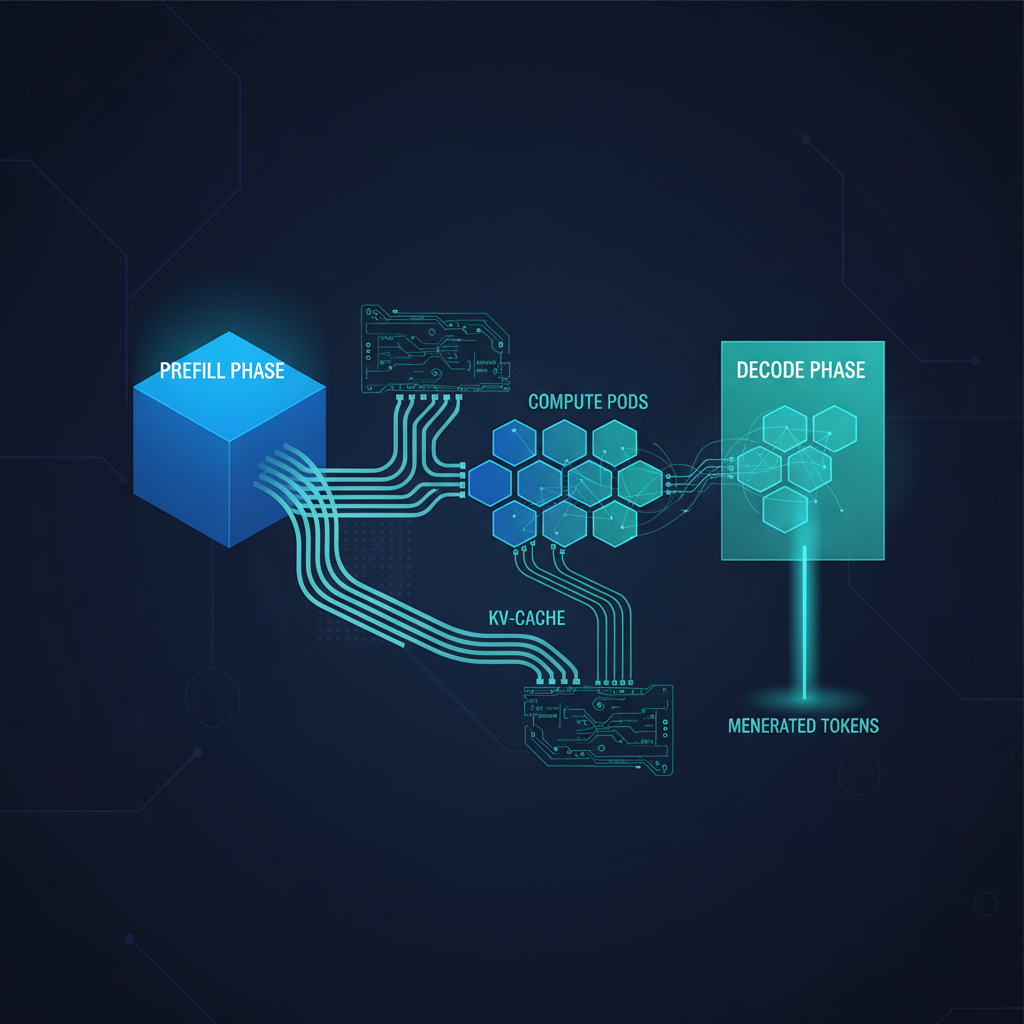
Cerebras Files for $26.6B IPO With OpenAI as 86% of the Backlog: The Wafer-Scale Tier Just Became an Architecture Decision
Cerebras's S-1 lands with a 750 MW OpenAI inference contract, an $1B circular loan, and 86% revenue concentration in two customers — and quietly forces enterprise AI teams to make a routing decision they've been postponing.


Table of Contents
Cerebras filed an amended S-1 with the SEC on May 4, 2026, targeting a $3.5 billion raise at a $26.6 billion valuation. The headline numbers are loud — 76% YoY revenue growth to $510M in 2025, a $20B-plus Master Relationship Agreement with OpenAI for 750 megawatts of inference capacity (expandable to 2 GW), and Morgan Stanley running the book.
But the parts that matter for anyone building production AI systems are the parts buried in the filing. OpenAI loaned Cerebras roughly $1 billion at 6% to build the data centers that will run the chips that OpenAI will then pay Cerebras to use. Two customers — OpenAI and G42 — account for 86% of revenue. And Cerebras’s pitch to the public market is no longer “we sell faster training systems”; it’s “we are the inference tier.”
That last shift is the part nobody talked about on CNBC, and it’s the part your AI architecture has not designed for yet.
What the S-1 actually says about inference economics
The Cerebras pitch in 2024 was wafer-scale training. The pitch in 2026 is wafer-scale inference. Independent benchmarks from Artificial Analysis show CS-3 systems delivering 2,700+ tokens/sec on gpt-oss-120B versus around 900 tokens/sec on a Blackwell B200 — a ~3x throughput gap on a contemporary frontier-class workload. On Llama 3.1-405B, Cerebras has clocked 969 output tokens/sec with a 240 ms time-to-first-token. The architectural reason is unsexy: the WSE-3 carries roughly 7,000x more on-chip memory bandwidth than an H100, which means model weights stay on-die instead of round-tripping over HBM and NVLink for every token.
That number — 7,000x on-chip bandwidth — is what makes wafer-scale a different tier of compute, not a faster GPU. It changes what’s economically reasonable to put in a real-time loop. A 240 ms TTFT and ~2,000 tokens/sec output rate is the difference between “agent reasons, then renders the response” and “agent reasons inline while the user is still typing.” For most enterprise AI teams, the inference budget today is a single line item: cost per million tokens on a hyperscaler endpoint. The Cerebras IPO is the public-market signal that this line item is about to bifurcate into at least two — sometimes three — distinct tiers, each with its own latency, cost, and reliability profile.
The 86% concentration problem is not just Cerebras’s problem
The S-1 discloses that two customers — OpenAI and G42 — generated 86% of 2025 revenue. In the first half of 2024, G42 alone was 87%; that dropped to 24% in 2025 as OpenAI scaled in. The headline framing is “customer concentration risk for shareholders.” The architectural framing is different: if your AI roadmap depends on OpenAI’s inference latency and cost staying competitive, and OpenAI’s inference roadmap now depends materially on Cerebras’s wafer-scale capacity ramping into 750 MW (and beyond), then your architecture has a transitive dependency on Cerebras’s fab yields, data-center buildout schedule, and a $1B loan it owes back to OpenAI.
This is the kind of dependency that doesn’t show up in a vendor risk review because the vendor risk review stops at “we use the OpenAI API.” It shows up the first time OpenAI silently shifts a model variant from a GPU pool to a wafer-scale pool, and your tail latency profile changes overnight without a single line of your code changing. Several of our readers running large RAG and agent pipelines on gpt-5.5 and gpt-5.5-mini already saw this kind of unexplained P99 movement in late April. The S-1 is the explanation.
A new tier in the LLM gateway
Most enterprise AI stacks built in 2024–2025 routed through a single LLM gateway with two things behind it: a frontier hosted model (OpenAI, Anthropic) and a fallback open-weight model on a GPU cluster. By late 2025, the smarter teams added a third lane — small/cheap routers like Gemini 3.1 Flash-Lite for high-volume cleanup work — and called it a day.
The Cerebras IPO, paired with Groq’s continued LPU expansion, NVIDIA’s own Vera Rubin NVL72 announcement at GTC 2026, and Meta’s MTIA and Google’s TPU 8 ramps, makes that three-lane gateway obsolete. The realistic 2026 production gateway has at least four routing tiers:
The frontier tier — gpt-5.5, Opus 4.7, Gemini 3.1 Pro — for hard reasoning and tool use where quality dominates. The fast-inference tier — Cerebras and Groq endpoints, plus whatever wafer-scale capacity hyperscalers expose — for interactive agent loops where TTFT and tokens/sec are user-perceptible. The bulk tier — Flash-Lite-class hosted models and on-prem open-weight clusters — for offline pipelines, evals, batch summarisation, and the long tail of cheap calls. And the edge tier — Gemma 4 on LiteRT-LM, Apple Silicon NPUs, on-device runners — for sovereignty and latency where the round-trip itself is the cost.
Routing across those four tiers is no longer a “nice-to-have observability project.” It is the single largest architectural lever for AI unit economics in 2026, and the Cerebras IPO is what makes it concrete: the fast-inference tier is a publicly traded company with multi-gigawatt capacity contracts, not a research demo.
Why wafer-scale changes the agent-loop math
Agents are the workload most sensitive to this split. A typical enterprise agent loop is 4–8 sequential model calls, each with tool-use round trips, before the user sees a final answer. On a hosted GPU pool, 250–400 ms TTFT per call compounds; eight calls and you’ve burned 2–3 seconds before output starts streaming, and that’s before tool latency. The Salesforce Agentforce data we covered last week made this explicit: cascading cold starts can add 6 seconds of P99 tail latency on a five-call chain.
Cerebras-class inference doesn’t fix the agent-loop architecture, but it dramatically changes what’s affordable inside it. With sub-300 ms TTFT and 2,000+ tokens/sec, a five-call agent loop fits inside a 1.5-second budget — the threshold above which user studies have repeatedly shown drop-off in continued engagement. That budget changes which workflows are realistic to make agentic at all. Customer-facing chat, IDE coding agents, financial-services pitchbook drafting, real-time underwriting copilots — all of these become genuinely interactive on a wafer-scale tier and remain frustratingly slow on commodity GPU inference.
The flipside, and the part that doesn’t show up in any S-1: wafer-scale capacity is rare, contracted years out, and currently dominated by two customers. Anything you architect to depend on that latency profile is depending on a tier that may quietly be rationed in 12–18 months as OpenAI ramps into its 750 MW commitment.
The circular financing pattern is now an architecture risk
This part deserves to be said plainly. OpenAI signed a $20B+ purchase agreement with Cerebras. OpenAI separately loaned Cerebras roughly $1B at 6% to build the data centers. Cerebras’s IPO proceeds will partially repay or refinance that loan. OpenAI is also a Cerebras shareholder.
For shareholders, that’s a governance and disclosure question. For AI architects, it’s a different question: what happens to your roadmap if OpenAI’s revenue softens, OpenAI exercises its loan terms, Cerebras’s fab ramp slips, or G42’s share of capacity gets reallocated? Each of those scenarios changes the inference latency and cost profile your application sees — without anyone shipping new code. The “embed engineers, lock in the model” pattern we wrote about this morning, with OpenAI’s $10B Deployment Company JV and Anthropic’s $1.5B Blackstone-Goldman venture, has the same architectural property: vendor decisions you don’t control now shape the runtime characteristics of systems you do.
The mitigation is not “don’t use Cerebras” or “don’t use OpenAI.” It’s that the LLM gateway has to start carrying real metadata: which underlying inference tier is serving this call, what is the historical TTFT and tokens/sec for that tier in the last 24 hours, and at what threshold do we shed load to a different tier. Most production LLM gateways today do not carry that metadata. They will need to.
The SuperML Take
Cerebras’s IPO is being read as a chip-industry story. It is actually an inference-architecture story, and the thing it forces into the open is something most enterprise AI teams have been quietly avoiding for two years: inference compute is no longer a commodity, and routing across non-commodity tiers is now the dominant lever on cost, latency, and reliability all at once.
The press-release version says “Nvidia rival files for $26.6B IPO.” The production-ready version says: starting roughly 6–12 months from now, your tail latency on hosted frontier models will become a function of how your provider routes your traffic across heterogeneous inference hardware that you don’t see. You will discover this either by instrumenting your gateway to track per-call TTFT and tokens/sec by upstream pool, or by getting paged at 2 a.m. when your agent loop’s P99 doubles and you have no instrumentation to explain why. The first option costs a sprint. The second option costs your roadmap.
For a senior platform engineer or AI architect reading this, the right move this quarter is not to pilot Cerebras directly — most teams don’t have the volume to justify a direct contract, and most workloads won’t see the benefit. The right move is to make your LLM gateway aware that the tier exists. That means three things: per-call latency telemetry tagged with the upstream model and pool, a routing layer that can carry workload-class hints (interactive vs. batch vs. offline) into the model selection decision, and a fallback policy that degrades gracefully when a provider quietly shifts your traffic into a slower pool during capacity pressure. None of these are flashy projects. All three become operationally critical the day Cerebras ships its first earnings report and the inference-tier conversation moves from architecture blog posts into board-deck appendices.
Six to twelve months from now, the gap between the headline and reality will be exactly this: every enterprise AI roadmap will say “we have a multi-model strategy,” and only a small fraction of them will have a multi-tier strategy that knows the difference between a frontier-tier failure (model quality regression), a fast-inference-tier failure (latency tier capacity pressure), and a bulk-tier failure (cost overrun). Cerebras’s IPO is the moment that distinction stops being theoretical.
Architecture Impact
What changes in system design? The LLM gateway stops being a thin router over models and becomes a tier-aware scheduler. Every upstream call now needs a workload class (interactive agent, RAG retrieval, batch eval, edge), a latency budget, and a tier preference. The agent-loop budget — historically a single end-to-end SLO — splits into per-call TTFT budgets that the gateway can use to prefer wafer-scale or LPU-class endpoints for interactive segments and bulk endpoints for offline segments inside the same agent run. Compound AI inference patterns, which already failed on naive autoscaling, now also fail on naive single-tier routing.
What new failure mode appears? Silent tier substitution. Your provider quietly moves a fraction of your traffic from a wafer-scale pool to a GPU pool during capacity pressure. Your model name does not change, your API call does not change, but your P95 TTFT moves from 280 ms to 900 ms and your tokens/sec drops by 3x. Every downstream timeout, retry budget, and queue depth assumption built around the old latency profile silently degrades. Worst case: your agent loop’s eight-call chain crosses your hard timeout and the entire interaction fails for users who were succeeding 24 hours earlier. This failure pattern does not surface in model-quality evals or in single-call latency dashboards; it only surfaces in per-call TTFT distributions tagged by upstream pool, which most teams do not collect.
What enterprise teams should evaluate:
- AI platform team: instrument the LLM gateway to record per-call TTFT, tokens/sec, and an upstream pool/tier tag (where the provider exposes it; where they don’t, infer from latency clustering). Add alerting on tier-distribution shifts, not just absolute latency.
- Agent engineering team: re-budget agent loops by call class, not by total wall-clock time. Identify which calls in the chain are user-perceptible and tier-tag them as “interactive”; let the rest fall back to bulk-tier routing.
- FinOps / vendor strategy: model the cost-latency-reliability frontier across at least three tiers (frontier, fast-inference, bulk), not just per-token cost. The cheapest token is not the cheapest agent run if it forces three retries.
- AI governance / model risk: extend SR 26-2-style model risk inventories to include inference-tier dependency, not just model dependency. “We use GPT-5.5” is no longer a sufficient inventory entry; “we use GPT-5.5 with an expectation of <400 ms TTFT served from a fast-inference pool” is.
Cost / latency / governance / reliability implications: On latency, the realistic 2026 spread between tiers is roughly 3x — 200–300 ms TTFT on wafer-scale or LPU-class inference vs. 600–900 ms on commodity GPU pools — with proportional movement in tokens/sec output rate. On cost, fast-inference tiers carry a 2–4x premium per token but can deliver 30–50% reductions in agent-run cost by collapsing retry budgets and cutting tail-latency timeouts; this is the same architectural lever Salesforce reported in its Agentforce production paper. On governance, the 86% revenue concentration in two Cerebras customers, paired with the OpenAI–Cerebras circular financing, creates a dependency chain that most enterprise vendor risk frameworks do not currently capture; expect this to surface in EU AI Act conformity assessments after the August 2, 2026 deadline as auditors start asking about inference-tier provenance for high-risk systems. On reliability, the new 2026 SLO conversation is not “is the model up” but “is the tier I expected serving my call” — and the team that gets that telemetry in place this quarter will spend Q4 debugging the right problem.
What to Watch
The next inference-tier signals to track over the next 90 days. Cerebras’s IPO pricing day and whether the book closes above the $26.6B target — undersubscription would slow the data-center buildout, which would tighten capacity allocation across OpenAI and G42 first. Whether OpenAI publishes any model-card or system-card update describing inference-tier routing for gpt-5.5 traffic; the first provider to make this explicit will set the disclosure norm. Groq’s response — likely a capacity-expansion announcement or a new LPU generation — that would confirm fast-inference is an industry tier, not a single-vendor product. NVIDIA’s Vera Rubin NVL72 deployment timeline at Google Cloud and whether hyperscalers expose tier hints (e.g., “low-latency pool”) through their Bedrock/Vertex/AI Foundry APIs. And the first EU AI Act audit that asks a regulated bank or insurer to disclose inference-tier dependencies for a high-risk credit-scoring or KYC agent — that’s the moment governance frameworks formally absorb this layer.
Related Reading
- OpenAI and Anthropic Adopted the Palantir Playbook. Now Enterprise Architecture Teams Need a Counter-Move.
- When RAG Breaks at Agent Scale: Pinecone Nexus and the Context Compilation Turn in Enterprise AI
- Five AI Vendors Shipped Agent Registries in One Quarter — That’s Not Competition, It’s a Production Crisis Signal
Sources
- Cerebras files for $3.5 billion IPO at a $26.6 billion valuation to challenge Nvidia’s grip on AI chips — MSN/Reuters, May 4, 2026
- OpenAI’s cozy partner Cerebras is on track for a blockbuster IPO — TechCrunch, May 4, 2026
- Cerebras S-1 Teardown: Is the $23B Wafer-Scale IPO the End of GPU Homogeneity? — Futurum Group
- Nvidia Rival Cerebras Unveils IPO Details — The Motley Fool, May 5, 2026
- Breaking down AI chipmaker Cerebras’ S-1 — PitchBook
- Cerebras CS-3 vs. Nvidia DGX B200 Blackwell — Cerebras blog
- Introducing Cerebras Inference: AI at Instant Speed — Cerebras blog
- Google Cloud AI infrastructure at NVIDIA GTC 2026 — Google Cloud Blog
Enterprise AI Architecture
Want more enterprise AI architecture breakdowns?
Subscribe to SuperML.